
You can join some TF2 taunts without owning them. That lets you participate in another player's animation; it doesn't add the taunt item to your backpack or let you start it independently afterward. Ownership and participation are separate capabilities.
The distinction explains a familiar situation: a player joins a Conga line in one match, then can't find Conga in the next match's taunt menu. The earlier dance was real, but it wasn't an item grant.
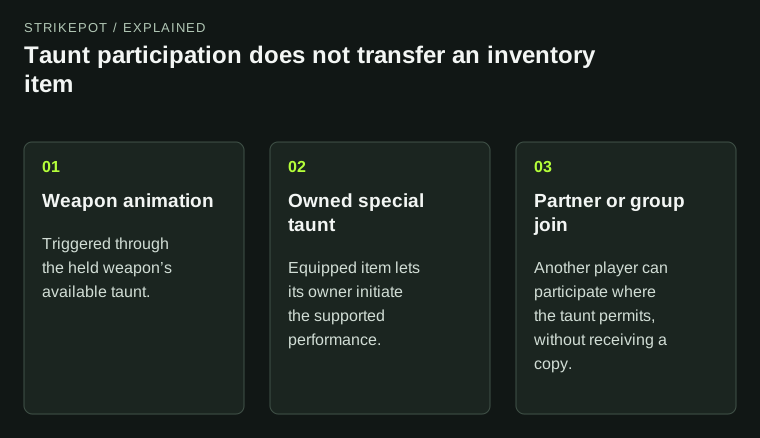
Identify the action first: perform, initiate or join. These do not imply the same ownership state.
Start by separating weapon taunts from taunt items
TF2 has animations associated with held weapons as well as special taunt items equipped through the loadout. The official taunt reference documents both. Seeing your class perform a weapon's standard animation doesn't establish that you own a separate marketable taunt.
When special taunts are equipped, the taunt control opens their selection menu, with slots for up to eight choices. The same reference describes pressing the taunt control again to perform the held weapon's taunt. Use the binding shown in your own client if you've changed the controls.
This gives a useful first diagnostic. Are you trying to perform the ordinary animation for your held weapon, select a special item from your equipped slots or accept a nearby player's invitation? The same general taunt control can be involved in three different contexts.
Check the selected class and equipment before changing several settings. The loadout-preset guide explains why a saved equipment choice belongs to a class. It doesn't turn an animation you joined into an owned object.
Partner taunts provide an invitation
High Five! is a useful example. Its owner starts a waiting pose. Another player stands in the appropriate place and uses the taunt control to join, completing the shared animation. The joining player doesn't need to own High Five.
The invitation can be accepted across teams. That is a participation rule for the animation, rather than a general truce or a transfer of equipment. The surrounding match continues to have its own objectives and threats.
Space matters, too. The Wiki describes obstacles and height differences as reasons a partner taunt cannot be initiated, with a message explaining the problem. A failed invitation in a cramped location doesn't by itself prove that the taunt is missing or that both participants must buy copies.
Consider a hypothetical pair of friends who want a high-five screenshot. One owns the taunt and offers the pose; the other joins it. Their ability to complete that scene doesn't require two inventory copies. If both want to initiate it separately in future matches, that is a different ownership question.
Group taunts can spread beyond their first owner
Conga demonstrates a broader form of participation. Nearby players can join the ongoing group animation without owning it. The dance can continue through participating players even if the original initiator stops.
Imagine three hypothetical players. Alex owns Conga and begins it. Blair joins, then Casey joins the ongoing dance. Alex stops. Blair and Casey may still be participating, but neither has received Alex's inventory item. An animation being sustained by the group is different from an item being duplicated.
That difference is why a video is limited evidence of ownership. It can show someone performing a joinable taunt without establishing who had the item that initiated it. To document ownership, look at the relevant inventory object, not just the character's movement.
It also explains why the option may disappear when nobody nearby is performing the taunt. Participation depended on an ongoing joinable animation. Without that context, a player needs their own compatible equipped item to begin it.
Class eligibility and movement vary by taunt
High Five and Conga are documented all-class examples. Don't infer from that that every special taunt supports every class. Read the particular item's class information and preview the supported animation before choosing equipment.
The performance itself also varies. Conga permits slow movement and rotation, while a waiting partner pose has a different purpose and positioning requirement. General advice that all taunts are stationary would miss this distinction.
Nor should a player assume every animation is harmless decoration with identical behavior. TF2's taunt reference includes weapon-related actions that can heal or attack. The individual animation determines those mechanics; a nickname or a shared taunt category doesn't supply them.
For practical use, choose a suitable moment and enough space, then observe the actual client prompt. Changing ownership assumptions won't solve a positioning notice, and changing a loadout won't make a nonjoinable animation accept participants.
Identify what an inventory offer actually supplies
A special taunt item is reusable equipment. An effect-application tool is a different object, with its own use and compatibility rules. The Unusualifier guide covers that separate tool distinction.
For a proposed trade, record the exact taunt name, supported classes and any named properties on the item. Then compare those details with the actual Steam offer. A picture of an animation doesn't establish that the offer contains the reusable taunt rather than a tool referring to it.
If a taunt you previously joined is absent from your backpack, start by asking whether you ever owned it. If you did own it and it's now missing, follow the inventory-location checks. Those two situations need different evidence.
The decision is about the action you want available: joining a nearby performance, initiating it yourself or owning a particular collectible version. Once that goal is clear, the class list, equipped slots and actual inventory object answer the rest.