
The Dueling Mini-Game is a usable TF2 item that starts a challenge inside a match. The duel has its own opponent-specific score. A Dueling Badge records longer-term participation and wins. Remaining uses, points in this round and badge level are three different numbers.
Reading those numbers separately explains why a tied round can leave the item unchanged, why a player can earn a badge without winning and why a high badge level doesn't tell you how many challenges an unused tool contains.
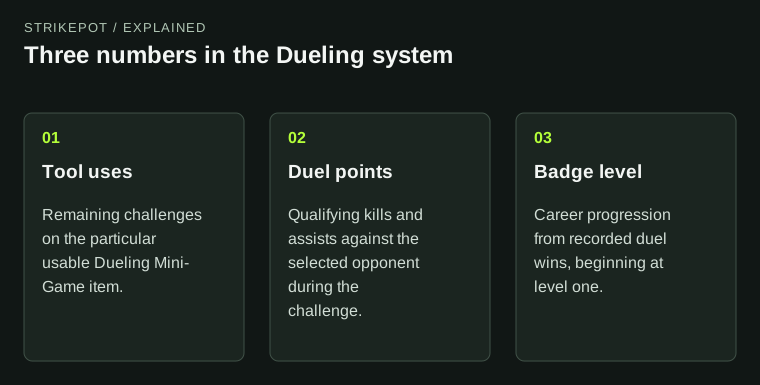
A consumable count, round score and badge level are not interchangeable.
A challenge needs an opponent's acceptance
The official Dueling Mini-Game reference describes an action item used to challenge another player. The recipient can accept or decline. A declined challenge doesn't consume one of the item's uses.
The crossed-pistols icon is the tool's representation, not a pair of weapons added to the combat loadout. Its purpose is to create the duel relationship and track the resulting contest inside the existing game.
Valve's October 2010 update changed new drops of the item to five uses. For an actual copy, inspect its remaining-use information instead of assuming every tool offered today is untouched. A partly used object and an unused object can share the same base name.
The equipped Action slot or the backpack's use action can start the request in the appropriate game context. Before changing equipment, check the class and current selection; the loadout guide covers that separate configuration question.
Duel points are not the team's match result
During an accepted duel, qualifying kills and assists against the chosen opponent count toward the duel score. The higher score at the round's end wins the duel. Kills elsewhere in the match don't become opponent-specific points just because the player is currently dueling.
For a hypothetical example, your team might win its objective while your duel score ends at two points against your opponent's three. Those results can coexist. The team result answers which side won the match objective; the duel result answers which participant accumulated more relevant points.
Assists also matter. A player looking only at direct kills in a personal recollection may miss why the recorded duel score differs. Use the duel's own notifications and result rather than trying to reconstruct it from an overall scoreboard total.
This isn't the same as a weapon's lifetime statistic or a streak within a life. The Strange Part guide concerns counters attached to an item. A duel score belongs to this challenge between these participants.
A class restriction changes what the participants agree to play
The Hatless Update introduced the option for both duelists to use a mutually selected class. A class-locked challenge is therefore different from an unrestricted one, even though both use the duel system.
Read that choice before accepting. If your intention is to play Medic for the team, agreeing to a duel locked to another class can conflict with that plan. The challenge's settings are part of the activity, rather than decoration on its notification.
Class restriction shouldn't be treated as a guarantee of equal circumstances. Position, teammates and the ongoing match still affect encounters. It constrains one aspect of the challenge; it doesn't turn the live server into an isolated competitive arena.
Ties, departures and forced cancellation aren't one outcome
Valve's July 2015 notes explicitly changed non-zero ties so they don't consume a duel use. The current Wiki also documents preservation of the use for tied results and specified server-forced interruptions.
Voluntarily leaving or switching teams has a different documented consequence: the opponent can win. A forced team change, a kick or a server/map transition can instead cancel the challenge under the reference's conditions. An interrupted duel therefore needs its actual ending recorded.
If you're comparing before-and-after uses, save the final result and the reason play stopped. A screenshot of two players with equal points midway through a round doesn't establish a finished tie. Likewise, an absent player alone doesn't distinguish a voluntary exit from an automatic server action.
An active tool also has temporary handling limits. The 2010 update notes prevent deleting, trading or crafting the item while it is being used for a duel. A blocked trade during the challenge needs that context recorded before diagnosing a permanent inventory restriction.
The first badge recognizes participation; later levels track wins
The Bronze Dueling Badge is awarded after a player's first completed duel. The player doesn't have to initiate it or win. Receiving the badge therefore doesn't prove the first result was a victory.
Its level begins at one and increases for each ten duel wins. That starting point matters: the documented Silver upgrade at level twenty-five occurs after 240 wins, rather than 250. The extra initial level isn't an extra bundle of tool uses.
Valve also changed the badge display to wins instead of a full loss record. A displayed win count doesn't reveal every unsuccessful challenge or establish a win percentage. You'd need the missing outcomes before making that calculation.
For example, a hypothetical player with ten completed wins has advanced a career measure, regardless of whether a separate Dueling Mini-Game in their backpack has four uses or five. There is no arithmetic conversion from badge level back into unused inventory charges.
The badge itself isn't tradable or marketable. If a trade lists a Dueling Mini-Game, inspect that usable item and its remaining uses; it isn't transferring someone else's badge history. Use the final-offer checks to match the actual object.
For your own record, keep one row for the tool's remaining uses, one for the latest duel result and one for badge progress. That arrangement preserves the difference between an activity you can initiate, a match you just played and a career statistic you've already earned.