
Completing an action, saving contract progress and claiming a reward are different events in TF2. Contract Points measure work on objectives. Stars unlock more contracts. A reward enters the picture when the relevant completed objective is turned in. A full-looking progress bar doesn't answer all three questions.
The ConTracker makes more sense when you follow that sequence. First identify the contract set and active node, then distinguish saved progress from this round's work, and finally read what is ready to turn in.
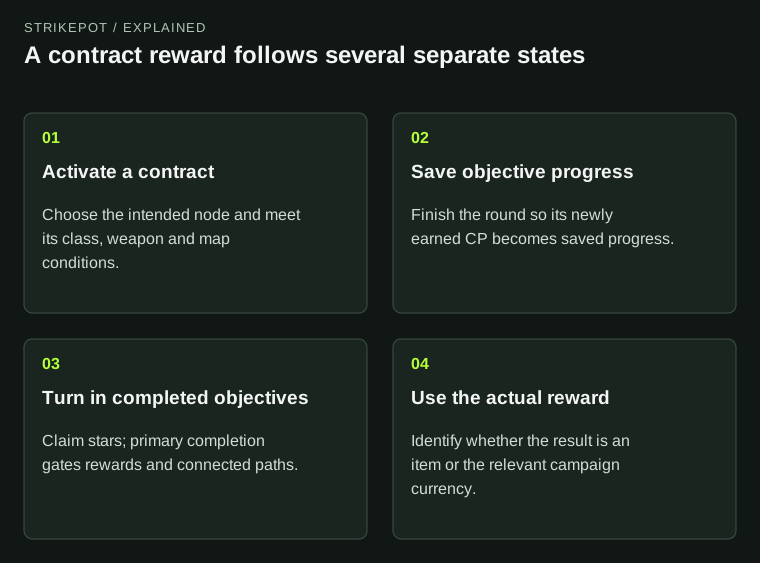
A progress meter, unlock star and inventory reward should not be treated as the same event.
The contract set determines access and the kind of reward
The official contract reference distinguishes free Pyroland contracts, the pass-based Mercenary Park set and seasonal contracts. A restriction on one family doesn't establish that every contract requires a purchase.
For example, Pyroland contracts provide a free route through weapon-related objectives. Mercenary Park uses its own progression and rewards. The first useful piece of a problem report is therefore the set and exact contract name, rather than simply saying that contracts are locked.
Historical campaign pages need care. Valve's February 2018 announcement said existing Jungle Inferno owners would retain contracts and Gift Shop access after the campaign ended. The subsequent update added a contracts-only pass without the original campaign-specific perks. Old launch advertising isn't a promise that all those temporary perks remain included.
Points, stars and Blood Money have different jobs
Contract Points, usually abbreviated CP, measure progress toward an objective's target. Stars are used to activate additional nodes. Blood Money is a reward currency associated with Mercenary Park's Gift Shop. These shouldn't be added together as though they were one balance.
| Progress or reward | Question it answers | What it doesn't establish |
|---|---|---|
| Contract Points | How much of this objective is complete? | Whether another contract is unlocked |
| Contract Stars | Can the required star cost be met? | Whether a primary objective or prerequisite path is complete |
| Blood Money | What can be selected in the relevant Gift Shop? | A Steam Wallet or withdrawable cash balance |
Valve's campaign explanation connects completed contracts with either specific item rewards or Blood Money choices. The dollar-like presentation belongs to that game system. Reading it as cash proceeds would answer the wrong question.
In a hypothetical example, a player has finished enough actions for one objective but still lacks the stars required by a later node. Repeating the already complete action may do nothing useful. The missing requirement could be an unfinished bonus objective elsewhere or a prerequisite primary objective that hasn't been turned in.
Choose one active contract and meet its conditions
The ConTracker instructions distinguish the active contract from nodes merely visible on the chart. Only one contract is active at a time. Seeing an attractive reward on another node doesn't make your current actions count toward it.
Read the selected objective literally: the required class, weapon, map and any offensive or defensive role matter. Work in the eligible matchmaking context for that contract. A similar action on another map or with another weapon may not satisfy its wording.
A useful troubleshooting example is a player changing to a new class while leaving the previous weapon contract active. The match can proceed normally while contract progress remains unchanged. Before treating that as a delivery failure, compare the active objective with the equipment and context actually used.
The class and preset checks can help confirm the equipped weapon. Saving a loadout and activating a contract are separate interface actions, so verify both when an objective names particular equipment.
Finish the round before treating progress as saved
The ConTracker distinguishes previously saved work from progress earned in the current round. Its reference explains that the round must finish to save that new work. Leaving early can discard it.
Switching contracts during the round also discards that round's progress on the abandoned contract. This includes the round-end humiliation period described in the reference. A visible completion message is therefore a reason to finish and review the saved state, rather than immediately switch or disconnect.
Suppose a hypothetical player makes several qualifying actions, sees the meter rise and leaves before the round finishes. A lower saved total afterward doesn't show that a backpack reward vanished. The missing event was saving the new objective progress.
For evidence, record the contract, the saved amount before the round, the new amount shown during play and whether the round ended. That tells a much clearer story than a screenshot of the reward thumbnail alone.
Turn-in and loaner items need their own checks
A completed objective can be turned in for its star. The primary objective is the gate for the contract's reward and the connected path. Unfinished bonus objectives can be pursued later by reactivating a partially completed contract where the set remains available.
A loaner weapon is different from that permanent reward. Some weapon-specific contracts temporarily provide the equipment needed to do the task. Changing away from the relevant contract or completing it can change the loaner's availability. Possession of a loaner doesn't establish that the reward has already been earned and claimed.
Keep progress for separate contract sets separate, too. A star balance in one family does not establish that a similarly drawn node in another family can be activated. The node's own prerequisites remain the useful check, particularly when several folders are visible in the same interface.
After turning in, identify the actual output. An item, a package and a reward currency are different results. If a War Paint is the output, the redemption guide explains its next step. If an expected inventory item is missing, use the inventory-location checks with the completed contract and claimed reward recorded together.