
A completed Steam achievement set can record an achievement milestone that survives later changes to the list. It is not necessarily a statement that the player has unlocked every achievement currently listed. Valve’s documented rule preserves completion when new achievements are added to an already completed set.
That distinction matters when two players compare profiles after the October Achievement Sets introduction and November display fixes. A completed label, a current unlock count and a completion date answer related but different questions. Treating them as interchangeable can turn an ordinary change in content into an apparent contradiction.
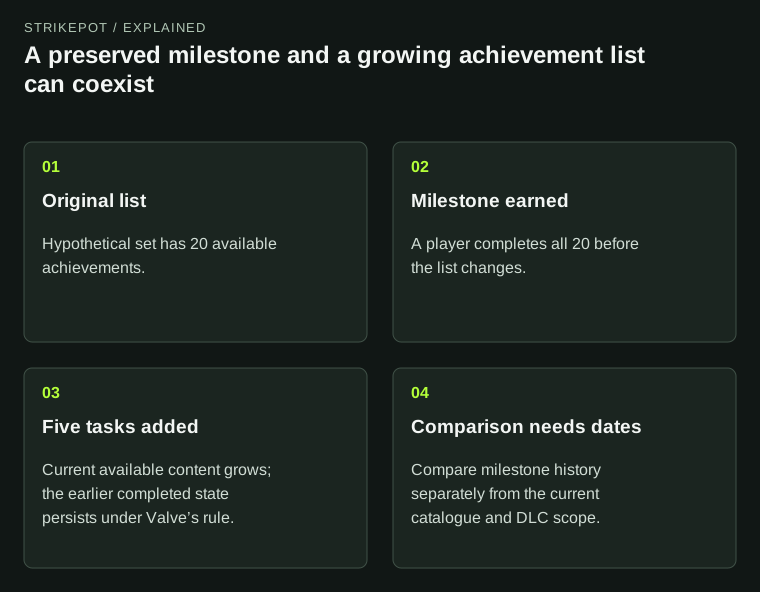
Invented counts illustrate the documented persistence rule; they do not predict the exact layout or percentage shown by every Steam client.
Completion has a memory
Valve’s Achievement Sets documentation says completion is tracked for each set. Once achieved, it persists even if more achievements are later added to that set. This is the key rule behind the historical interpretation.
Imagine an invented set containing 20 available achievements. Alex unlocks all 20 on Monday. A developer adds five on Friday. Alex has already reached the milestone under the earlier list, even though there are now five more achievements to pursue.
The arithmetic 20 divided by 25 equals 80%, but that calculation describes the invented current catalogue, not the preserved completion rule. It is a conceptual ledger rather than a prediction that every Steam screen must display “80% completed” in exactly that form. Valve separately cautions developers that adding achievements to a released set may not display naturally.
Two completed sets need not represent identical histories
Now add a second hypothetical player, Sam, who begins after Friday and unlocks all 25. Both players can have a completed milestone while their unlock histories differ. The label alone cannot establish that they completed the same tasks under the same content version.
That does not make the label useless. It tells us that the relevant completion condition was met. It simply carries less detail than a full dated achievement record. The mistake is asking one summary field to prove everything about the achievement list, the player’s timing and later content additions.
For a fair comparison, name the set and state what is being compared: the milestone, all currently available tasks, the time taken, or participation before a change. Those are legitimate separate comparisons. They need not produce the same ordering of players.
| Question | Relevant evidence |
|---|---|
| Did the player complete this set? | The set’s recorded completed state. |
| Have they unlocked the current available list? | The named set’s present achievements and individual unlock records. |
| Did two people complete equivalent content? | Content version, set membership and relevant dates. |
| Does a profile display prove every expansion was completed? | The actual sets and ownership context, beyond the showcase alone. |
Archived content changes who shares the same denominator
Valve’s archive rule adds another time-dependent difference: an earned archived achievement remains visible to its earner, while an unearned archived achievement is not required for that player’s set completion. A retired task therefore need not act as a permanent obstacle for someone who arrives later.
Take an invented seasonal task that an early player earned and a later player never had an opportunity to attempt. A comparison of their visible achievement histories may differ because their opportunities differed. The early record can preserve participation without requiring the later player to complete an unavailable event.
This is a different question from whether a currently available achievement has failed to unlock. The former concerns a changed content catalogue; the latter concerns an individual expected event. Before describing a missing task as lost progress, establish whether it was archived and whether the player ever earned it.
DLC adds ownership context to completion comparisons
The documentation also makes DLC sets depend on ownership for completion accounting. A base-game set and an expansion’s set are therefore separate scopes. Owning another expansion can change the relevant collection without changing which base-game achievements were previously earned.
Imagine a discussion in which one person means “finished my base set” and another means “finished every set for content I own.” Their statements can both be accurate while describing different scopes. A percentage with its scope omitted cannot settle the disagreement.
The DLC ownership and installation guide addresses a separate practical issue: whether the expected content is available to the account and game. For an achievement comparison, keep the DLC name alongside the set name. Buying or installing content is not evidence of having completed its tasks.
A showcase is a summary with its own qualification rule
Valve says a game can qualify for the Completionist Showcase after the player completes any of its sets. A showcased game consequently does not, on its own, prove that every set and expansion has been exhausted.
That is a reading limit, not an accusation about a player’s profile. A summary designed to celebrate milestones will naturally omit details that a content audit would need. Someone can accurately show a qualified game while still pursuing additional achievements elsewhere in it.
For a community comparison, a clearer description might be “base set completed before the expansion” or “all currently available owned sets completed on this date.” These are examples of precise wording, not additional Steam status categories.
November’s display fixes should not rewrite the story
The official November 3 Preview/Beta notes address totals omitting some unlocked achievements and completed sets appearing in library completion sorting. That makes the difference between a record and its presentation especially relevant.
A hypothetical total increasing after the counting fix does not prove a new achievement was earned at that moment. Equally, a completed set becoming easier to find in a sorted library does not establish that it was completed during that update. Preserve the individual unlock dates where they matter.
The Achievement Sets briefing explains the introduction, while the November release briefing identifies the testing-channel changes. When comparing results, keep three records distinct: the milestone reached, the content available now and the interface version presenting them. Together they explain far more than a completed label on its own.