
The hours shown for TF2 are not a counter of guaranteed item rewards. Random drops depend on eligible play, an available drop allowance and the game's distribution rules. Even when an item is due, that doesn't mean it will be the particular weapon or cosmetic you want.
To understand an apparent discrepancy, separate four questions: did this time qualify, was allowance still available, what kind of award occurred and did the item reach the backpack? Adding more hours doesn't answer those questions by itself.
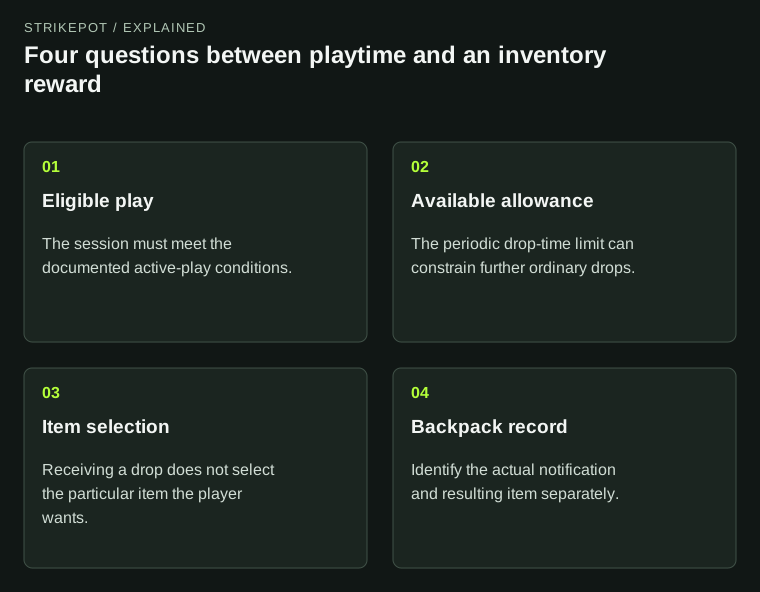
Total application hours do not establish all four states.
Running the game and earning eligible time are different
Valve's active-play explanation specifies the relevant conditions: connection to a VAC-secured server, responding to in-game drop notifications without external programs, running one game instance and staying out of textmode.
Those conditions are narrower than simply having the application open. Time at the menu or away from the game shouldn't be treated as interchangeable with qualifying play. A Steam library total doesn't tell you which portions satisfied each condition.
The notification requirement matters after an item is found, too. A player who overlooks the new-item prompt may be waiting for another drop while the earlier prompt still needs attention. Check the client before assuming that the item system owes an entire evening's expected output.
Valve also explains that idle time pauses drops rather than deleting drops already earned or changing the cap. That is a pause in eligibility, not evidence that something already in the backpack was taken away.
The weekly allowance limits what a longer session can add
In its 2010 redesign announcement, Valve described a weekly limit on the amount of playtime that can produce random drops, with some unused time rolling forward. The system therefore isn't an unlimited reward stream proportional to total hours.
The official Wiki's drop reference discusses an approximate numerical cap, but labels that figure as an estimate. An estimated general value isn't an exact remaining allowance for your account, especially when earlier play and rollover haven't been recorded.
Consider two hypothetical players who each complete a two-hour session. One has already played extensively during the current allocation period; the other has not. Identical session lengths don't establish identical remaining eligibility. The hypothetical comparison explains a variable, rather than predicting either player's actual drops.
If you're keeping records, note earlier eligible sessions in the same period instead of counting only the latest one. Where you don't know the remaining allowance, keep it unknown. Inventing a precise balance from total Steam hours makes the explanation look more certain than the evidence supports.
More regular delivery doesn't mean a chosen item
The redesign changed the scheduling question from whether a drop would occur at a check to when the next one would occur. That was intended to reduce long unlucky gaps. It didn't turn random item selection into a menu where the player chooses the next reward.
A useful distinction is frequency versus identity. A player might receive several items at broadly regular intervals and still get duplicates. Their complaint may concern the item pool or repeated selection, even though the schedule itself is operating as described.
Likewise, receiving an item you already own doesn't prove the game failed to register your inventory. A random selection system doesn't have to be a collection-completion system. Unless a specific reward mechanism promises a missing item, don't assume it targets gaps in your backpack.
This is why multiplying a guessed hourly drop count by a desirable item's price isn't a dependable personal earnings forecast. The calculation would need an established schedule, remaining allowance, item probabilities, eligible pool and an actual sale outcome. A library-hours number provides none of that on its own.
A stronger scoreboard isn't a documented drop multiplier
Valve's redesign explanation explicitly discussed why it avoided tying random drops to performance measures. Incentivizing a particular class, map or artificial scoring routine would change how people played. The cited design instead centers on eligible playtime.
That separates a successful match from a promised inventory result. More kills, a higher score or a win may be satisfying gameplay achievements, but these documents don't establish them as a way to select a more valuable ordinary random drop.
If another progression system names a reward for a specific task, record that system separately. A contract objective, an achievement and an ordinary timed drop aren't automatically the same mechanism merely because all can result in an item notification.
Account type affects the eligible pool
Valve's Free-to-Play FAQ describes a more limited drop pool for free accounts and access to rare and cosmetic random drops for Premium accounts. A cosmetic appearing in another player's drops therefore doesn't establish that your account has the same eligible pool.
That is a pool distinction, rather than a promise that upgrading produces a particular cosmetic. It also doesn't mean the game's combat experience requires buying that cosmetic. The FAQ describes nearly every weapon as available through achievements, drops or crafting.
If the question is instead storage space, use the backpack-capacity guide. Owning an Expander, having free slots and being eligible for a particular random drop are separate facts.
Record the award before diagnosing missing delivery
A useful record identifies the session, the exact notification, its item name and whether the object appears in TF2 and Steam. Note any unaccepted prompt and distinguish normal drops from containers or task rewards. The Wiki documents crate drops as a separate timer, so a container shouldn't automatically be counted as the same kind of weapon drop.
If a notified item is missing from another website, follow the inventory comparison steps. If the item arrived but an action is unavailable, read its actual restriction. Neither problem can be resolved by assuming that additional playtime will replace the object.