
One refined metal represents nine scrap metal through TF2's normal metal recipes. That relationship is fixed by crafting. The amount of refined metal another player will exchange for a key is a price, agreed between people. These two kinds of numbers can appear beside each other in a trade discussion, but they answer different questions.
Understanding the difference makes a mixed offer easier to count. It also stops a common mistake: assuming that because scrap converts into refined at a defined ratio, every other TF2 object must have an equally fixed conversion into metal.
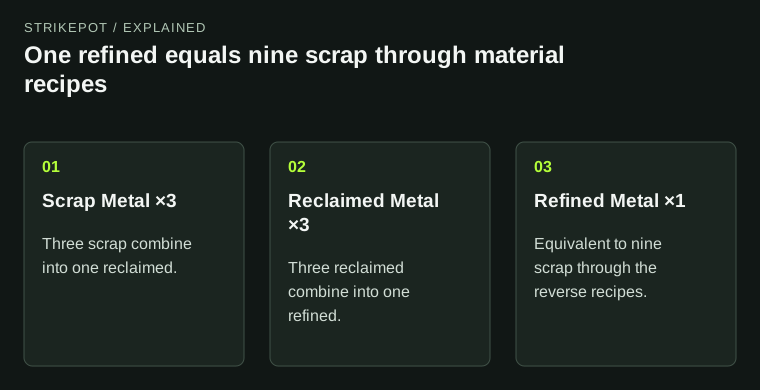
The diagram represents crafting ratios only. A key price is a separate negotiated exchange.
The three denominations share a recipe relationship
The official crafting reference lists the relevant blueprints: three scrap make one reclaimed, and three reclaimed make one refined. Reverse recipes split refined into reclaimed and reclaimed into scrap. For counting ordinary metal, use scrap as the smallest common unit.
| Inventory object | Equivalent in scrap | Equivalent in reclaimed |
|---|---|---|
| One Scrap Metal | 1 | One third |
| One Reclaimed Metal | 3 | 1 |
| One Refined Metal | 9 | 3 |
These are recipe equivalents, rather than quoted cash values. The table says nothing about dollars, a website balance, a trading service's acceptance rules or the desirability of a particular weapon. It gives you a reliable way to add the metal objects actually present.
You don't need to craft anything to do that calculation. Converting an offer to a common unit on paper is enough to check its size. This is particularly useful when you want to preserve your current backpack organization or when the trade hasn't been accepted.
Count a mixed offer before comparing its price
Consider a hypothetical bundle containing two refined, one reclaimed and two scrap. The two refined account for eighteen scrap, the reclaimed accounts for three, and the remaining two bring the total to twenty-three scrap. That is two refined plus five scrap in equivalent terms.
Now compare a second hypothetical bundle: one refined, four reclaimed and two scrap. Its total is nine plus twelve plus two, also twenty-three scrap. The bundles contain different numbers of inventory objects, but their metal denominations add to the same amount.
This distinction matters when a screenshot shows a row of icons without a complete item list. Counting icons alone can make a bundle with many small denominations look larger. The relevant arithmetic is the quantity of each named metal type multiplied by its scrap equivalent.
A useful comparison record has three columns: the actual object name, its quantity and its scrap-equivalent subtotal. Keep the original quantities beside the total. An arithmetic match does not replace checking that the offered objects really are Scrap Metal, Reclaimed Metal and Refined Metal.
Why a key is a different kind of unit
A Mann Co. Supply Crate Key is a consumable tool for a compatible container. It isn't another level of the scrap-to-reclaimed-to-refined blueprint chain. Someone asking for a key in a trade is asking for that inventory object.
Suppose, purely for illustration, two people agree to exchange a key for fifty refined. Fifty is the price in their hypothetical agreement. It doesn't become a permanent recipe ratio, and this example is not a current quote. Another offer can ask a different amount or include different conditions.
There are therefore two separate checks. First, does the metal bundle total the amount being discussed? Second, is that amount the exchange the parties intend to make? Correct arithmetic answers the first question. It cannot establish that the second is a competitive or completed transaction.
If comparing a key quote with a cash listing, add a third check: what form of proceeds would each route produce? Steam Wallet credit, metal items and money received outside Steam are different outputs. The buyer-total and seller-proceeds guide explains why even a Market listing needs its two amounts kept separate.
Duplicate weapons explain metal's use, not every weapon's value
Valve introduced crafting as a way to combine inventory ingredients using blueprints. One of the material recipes takes two eligible weapons usable by the same class and produces a scrap. Repeating the ordinary chain would require eighteen suitable weapon inputs to produce one refined.
That calculation describes an input count. It doesn't mean that every set of eighteen weapons has the same trade value as refined metal. A weapon may have a collectible version, attached customization or personal significance that the recipe's base-name requirement doesn't express.
For example, a player organizing duplicates may have two apparently similar weapons but wish to preserve one with a custom inscription. Calling both of them recipe inputs ignores that preference. Arithmetic can show what a blueprint produces; deciding which actual objects to sacrifice requires inspecting the ingredients.
The separate crafting and restriction guide covers eligibility and inherited limits. A metal total doesn't establish that every object can be traded now, nor that every weapon you counted is a valid ingredient.
A clear offer names both the amount and the objects
When discussing metal, write out the bundle if shorthand is ambiguous: two refined, one reclaimed and two scrap is much harder to misread than an unexplained decimal. If a service formats fractional refined amounts, check how it maps those fractions back to whole inventory objects. One scrap is one ninth of a refined, so a short decimal is an approximation of that fraction.
Before accepting, compare the actual offer with the agreed bundle using the Steam trade review checklist. Recount from the current offer if any item changes. A saved chat total is useful context, but it doesn't put missing metal into the exchange.
The practical boundary is straightforward: recipe ratios let you count; current offers let you compare proposed exchanges; completed records tell you what transferred. Keep those records separate, and the familiar metal icons become much less confusing.