
Steam’s October Remote Play beta expands HDR support, but an HDR setting being enabled is not the same observation as a game producing HDR content and that content reaching the intended display. The update changes several points in the streaming path. Each needs to be interpreted at its own level.
The clearest example is the new On option: Valve explicitly says it can allow increased brightness for SDR content. A brighter picture can therefore be an expected output choice without proving that the source game has started rendering new HDR detail. This makes “HDR works” an incomplete description of what changed.
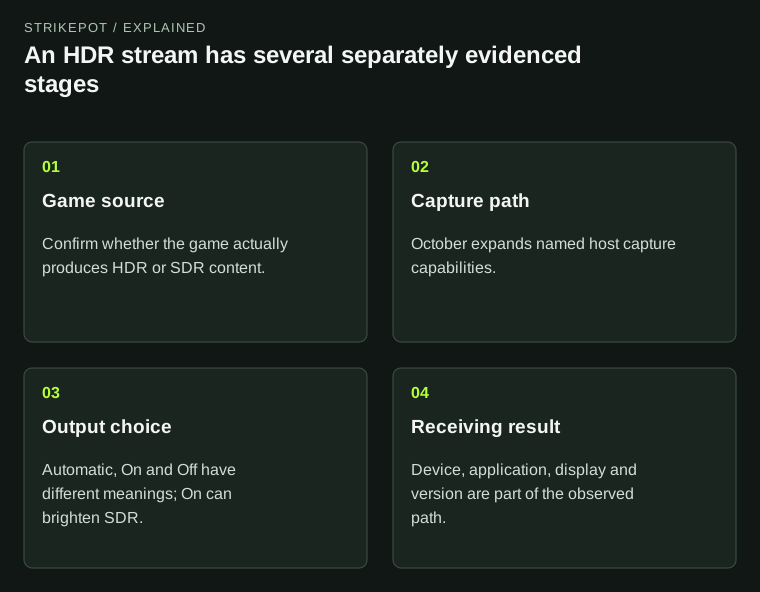
A conceptual evidence map for the October beta changes, without a universal hardware-compatibility or calibration claim.
The October change covers more than one device role
Valve’s October 22 Preview/Beta notice expands HDR capture to PipeWire on desktop Linux and streaming from macOS. It also enables HDR again on Steam Deck OLED and identifies Android 15 or newer with the beta Steam Link app.
Those statements concern different roles. Capture support describes obtaining the host picture. A receiving-device entry describes another endpoint of the experience. One newly supported role does not automatically establish that every combination of host, client application and display is supported.
The existing Remote Play host guide explains which machine runs the game. For HDR analysis, that distinction gains an additional purpose: the operating system named for capture and the device named for viewing may be on opposite ends of the stream.
Source content, capture and display are separate questions
A useful comparison separates three observations. What picture does the game produce? Can the selected capture path handle that picture as documented? What output reaches the receiving device and its display? A single screenshot or switch usually answers only part of that sequence.
Imagine a hypothetical game that offers both SDR and HDR modes. A receiving device’s HDR-related indicator does not, by itself, identify which game mode is active on the host. Likewise, confirming the host’s HDR mode does not establish what a second device actually displays.
This is a logical distinction between stages, not a claim that every stage can be inspected with a particular Steam diagnostic label. Use only indicators that the actual software exposes. If a stage is unobserved, record it as unknown instead of filling it in from the setting beside it.
Always-on output does not mean every source is native HDR
The October setting offers Automatic, On and Off. Valve describes Automatic as enabled when HDR content is enabled, while On can remain enabled and permit increased brightness for SDR. Those descriptions make the source/output distinction part of the feature itself.
Suppose an invented comparison uses the same SDR scene with output On and then Off. A brightness difference could be consistent with the documented choice. It would not prove that the game generated a different set of HDR highlights, textures or lighting information between the two views.
That distinction matters for reviews as well as support. “Brighter with On” describes an observation. “This game now renders HDR” makes a claim about the source. The second requires evidence about the game’s actual output rather than relying on the first statement.
The overlay slider adds another variable to visual comparisons
The full October 22 notes also add a brightness slider to the streaming overlay. As a result, two streamed pictures can differ while using the same game, display and HDR mode if the relevant brightness control differs.
A hypothetical before-and-after image is weak evidence if the reviewer changed the game’s brightness, the streaming control and the display’s picture mode together. The viewer can see a difference, but cannot isolate which change produced it. A fair comparison states those settings alongside the source mode.
This review did not measure luminance, colour accuracy or latency. The update notes do not supply a calibration result for a particular panel, so they should not be turned into a claim that a brighter stream is objectively more accurate.
Historical compatibility reports need their version attached
Valve’s May 2024 HDR-to-HDR rollout described a particular supported path, including a receiving HDR display. It is useful history showing that HDR support was conditional from the outset. It is not an exhaustive specification for the expanded October 2026 feature.
The new note’s wording that HDR is enabled “again” on Deck OLED is another warning against timeless conclusions. A report from an earlier client can accurately describe that version without settling what a later version supports. The hardware model alone does not identify the software behaviour being discussed.
The same caution applies to Android. The current note names both an operating-system threshold and a beta application. Removing either condition changes the claim. A generic statement that every Android phone now receives HDR would exceed the documented scope.
Record the path that produced the picture
| Record | Question it helps answer |
|---|---|
| Game and source display mode | Was the source intended to produce SDR or HDR? |
| Host OS and capture context | Does the reported path match a documented capture change? |
| Receiving device, app and version | Does the endpoint match the supported configuration? |
| HDR output choice and brightness controls | Could output processing explain the visible difference? |
| Client channel and observation date | Which release’s behaviour was actually observed? |
Those records support a more useful statement than “the HDR switch is on.” A report might identify that source HDR is confirmed but the receiving output is unverified, or that the source is SDR and the brightness changed under the always-on choice. Both are precise findings.
The client-channel guide helps identify the installed release, and the support-record guide can preserve the path. The analytical lesson of October’s update is that expanded capability and visible brightness are separate evidence. Describe the source, the supported path and the observed output before treating them as one result.