
A Steam beta patch note establishes that Valve has announced a change for a named testing channel and a described problem. It does not, by itself, establish that every stable client contains that change, that your symptom has the same cause, or that a particular account’s underlying data has been repaired.
The November 2026 updates make these distinctions unusually concrete. They include a false Cloud-conflict warning, an achievement-count correction and an input setting that previously was not taking effect. Those are three different relationships between what Steam shows, what it stores and what it does.
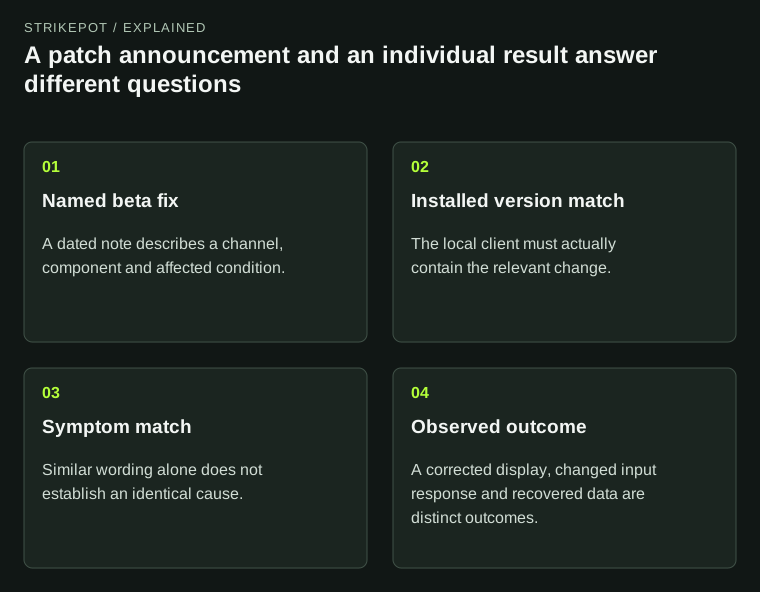
An evidence ladder for November’s documented fixes, rather than a claim that a beta announcement proves a stable rollout.
Start with the claim the update actually makes
Valve’s November 6 beta notes identify an incorrect Cloud-conflict display affecting some games, with Monster Hunter World as an example. The same update addresses a firmware-update indicator remaining briefly available after application, and a Joystick Power Curve setting that had not been applied.
Each sentence has a boundary. “Some games” does not mean every Cloud incident. A briefly stale availability indicator is different from an update failing. A setting beginning to affect input is different from the game suddenly choosing a new sensitivity on its own. Removing those boundaries makes a patch sound more universal than the documented change.
A useful reading preserves the software component, channel, date, affected condition and observed behaviour. Those details turn a promising headline into a claim that can be compared with a specific report.
A false warning and a recovered save are different outcomes
Consider a hypothetical player who sees a Cloud-conflict message and later reads that a false-conflict case was fixed. The note makes an incorrect warning a plausible explanation. It does not tell that player which local or remote file contains the intended progress.
That matters because two problems can share similar wording. One report may concern an interface warning that should not have appeared; another may involve genuinely different save states. A patch addressing the first is not evidence that the second has been resolved. The individual files and timestamps remain separate evidence.
The Cloud-conflict guide handles an actual save decision. This analysis supplies the narrower interpretation: an announced warning fix should reduce confidence in the warning as a diagnosis under the affected conditions, without becoming permission to guess which save is correct.
A corrected total does not describe newly earned achievements
The November 3 client notice explicitly labels its release Preview/Beta. It includes achievement totals missing some unlocks and completed sets not appearing under completion sorting. These are useful examples of a displayed summary and the records it represents diverging.
Suppose a hypothetical summary changes from 19 to 20 after an update while the same 20 achievement records were already present. That observation is compatible with a counting correction. It does not establish that the player earned the twentieth achievement during the update.
Conversely, a missing individual achievement and a wrong aggregate total are not interchangeable reports. Saying “my achievements are broken” erases the distinction. A precise report identifies whether the disagreement concerns the individual record, the total, the set’s completed status or its place in a sorted list.
A fix can make an old setting produce a new response
The input case has another shape. A stored setting can exist while the relevant behaviour fails to use it. Correcting that failure may change the response without the stored value changing. Valve’s November 6 note explicitly warns that users who changed the affected power-curve setting may notice a different response.
The analytical point is that identical configuration text does not always establish identical behaviour across versions. The earlier version and the corrected version can interpret or apply that value differently. An old screenshot of the slider proves its position, not that the old software applied it correctly.
This is not a measured claim about aiming performance or a recommendation for a particular curve. It is a reason to keep the version alongside a configuration comparison. Otherwise, a reader may attribute a version-dependent change to their controller hardware or to the game without enough evidence.
Client channel and game branch are separate coordinates
Valve’s application-branch documentation describes branches as particular builds of an application, including its default build. That game-level selection answers a different question from which version of the Steam client is installed.
A person can therefore describe a game as using its normal release while the Steam client itself uses a testing channel. Another person can use a game’s test branch with a stable client. Merely writing “I am on beta” leaves the relevant software unidentified.
The distinction extends to operating-system notes. Valve’s separate October SteamOS 3.9.5 announcement says it was released for all users. That wording establishes a release scope for that operating-system update; it does not silently promote a later Steam client beta fix to every user. Shared branding does not make separate release announcements interchangeable.
Match the evidence before judging the result
| Evidence | Conclusion it supports | Question still open |
|---|---|---|
| A beta note names the symptom. | Valve documents a targeted change. | Does this installed client contain it? |
| The relevant build is installed. | The local version is a plausible match. | Does this incident have the affected cause? |
| The same action no longer triggers the symptom. | The local observation improved. | Was any underlying data problem also resolved? |
These are increasingly specific observations, not automatic guarantees. Changing several settings, reinstalling a game and updating Steam at once may produce a better result, but it prevents that single experience from isolating which change mattered.
For an unresolved case, the client-channel guide explains where to identify the channel. Preserve that detail with the build, game branch, exact symptom and time. The November update briefing supplies the surrounding release context. The strongest conclusion remains the one supported by both the documented scope and the individual observation.