
A CS2 Workshop map reaching its opening screen proves that it reached its opening screen. It does not prove that every scripted round transition, spawned object or player event still behaves as intended. Valve’s recent scripting changes preserve several old method names as deprecated entries, which helps explain why a map may continue to start while still deserving a focused compatibility review.
The useful distinction is between loading, accepting a call and producing the intended behavior over time. These are progressively stronger claims. Treating them as one pass-or-fail result can hide the event that actually needs attention.
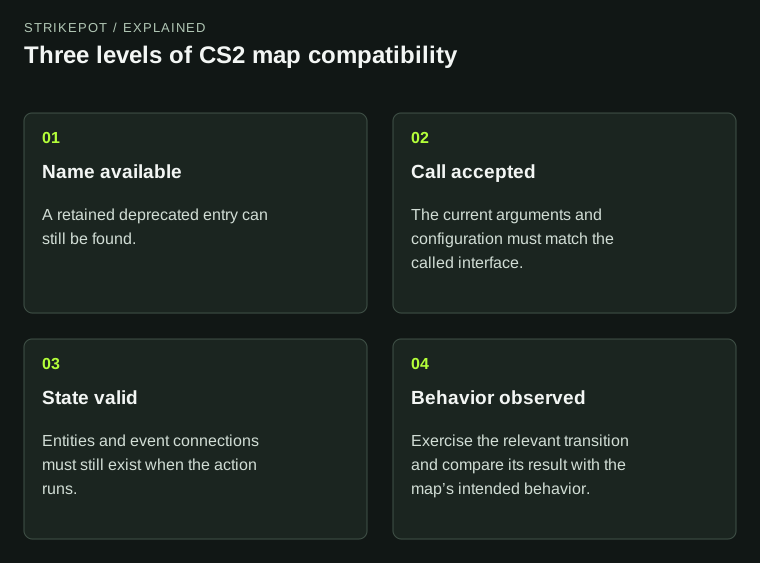
Loading proves only the path that ran. The diagram explains why compatibility review must include later state transitions.
Compatibility has more than one layer
In the official October and November update feed, Valve reorganizes scripting interfaces into top-level exports, including Console, GameRules and then Entities. Moved and renamed methods remain available in their previous locations as deprecated entries. That supplies a transition path; it is not a published promise that every older map has been exhaustively verified.
At the first layer, a script can locate a name it imports or calls. At the second, the call can accept the arguments supplied. At the third, the resulting action can be correct for the map’s current state. A successful first layer cannot establish the other two.
For a hypothetical training map, loading might initialize the room correctly. An objective that appears only after a player changes state may not run during startup. If that branch is wrong, the opening room can look perfect while the later activity fails. This is an illustration of event coverage, not a report of a known broken Workshop item.
A retained name does not answer every configuration question
The November notes move ConnectOutput into Entities and describe a configuration-object form. They also improve diagnostics around invalid entity handles and output names. These details make the distinction between name compatibility and behavior especially relevant.
Do not assume that a retained entry proves every old argument arrangement is appropriate in every context. Equally, do not assume that deprecation means immediate removal. Read the specific change against the actual call. A migration can involve a new location, a changed configuration or both.
A public patch note is not a complete migration specification. If it leaves a detail unresolved, consult the current supplied definitions and the map’s actual warning rather than inventing a universal replacement. This analysis does not provide a mechanically safe search-and-replace script.
Entities have lifetimes, not just names
A hypothetical map might create an object for one round, keep a reference to it, remove it at reset and later try to use the saved reference. The map can have loaded successfully because the reference was valid earlier. Its later validity is a different state question.
A clearer invalid-entity warning can make that existing lifecycle error visible. The warning’s appearance after an update does not, by itself, prove that the update first caused the underlying mistake. Improved diagnosis and changed behavior are different explanations to investigate.
The same reasoning applies to event connections. An expected event may never fire during a short launch check. To assess it, the relevant object, connection and triggering condition have to exist in the same test sequence. A quiet console before the event supplies little evidence about what happens afterwards.
Custom maps are more than downloaded geometry
Valve’s Maps Workshop FAQ describes support for custom settings and game-mode variants. That explains why two maps can place very different demands on the game’s scripting and state systems even when both are distributed through Workshop.
A downloaded package and a correctly running custom mode answer different questions. The Workshop launch guide covers a missing subscription or a map that does not start. Once the map opens, reinstalling everything is not a substitute for identifying which scripted interaction fails.
For a player, the useful report is therefore specific: the room loads, but the target does not return after the round reset, for example. Include the map identifier and version if available. That distinguishes a behavioral failure from an absent download without blaming either layer prematurely.
Review transitions instead of checking only the first frame
A maintainer can organize an existing development review around a small state matrix. It should describe the map’s own behavior, rather than copy every API name from the patch notes. The relevant tests are the paths that exercise affected code.
| Hypothetical transition | What startup alone cannot establish |
|---|---|
| First round to next round | Objects and connections reset without stale state. |
| Object removed and recreated | Later actions use the current object reference. |
| Player joins or changes control | The corresponding event updates map state correctly. |
| Objective completes | The expected output exists and the completion action occurs. |
These are review examples, not verified behavior of every map. A simple aim room may not need all of them. A complex custom mode may need others. Keep the matrix small enough that each row has an observable expected result.
A warning is useful when its context survives
Retain the exact warning, the action immediately before it, the relevant game build and the map version. A screenshot of a console line without the triggering sequence can lose the information needed to distinguish bad arguments from invalid state. The problem-report guide helps preserve that sequence.
A successful review supports a scoped statement: these named transitions worked in this build. It does not establish that every old script is permanently compatible or that deprecation can be ignored indefinitely. The November changes make a stronger question possible than does it load: does the part of the map that relies on this interface still produce its intended result?