
Rust’s November livestock rework makes routine care less punishing while making the history of early care more consequential. An adult animal being alive now is not the same thing as that animal having had a well-supported childhood. The new Potential stat preserves a difference that current survival alone cannot show.
This changes the question for a returning group. Instead of asking only whether the herd survived while everyone was away, also ask which animals are still developing and which qualities are already fixed. That is a change in how to interpret the system, rather than a new farm-building recipe.
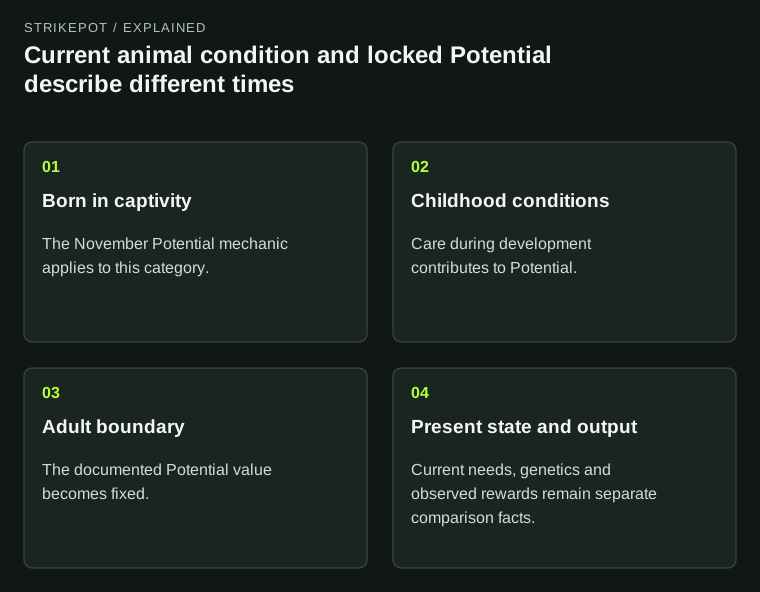
A conceptual timeline of the published rule, without inventing an exact happiness formula or predicting an animal’s rewards.
Survival and quality now have different time horizons
Facepunch’s November rework reduces several routine penalties, including old-age cow death and death from starvation. It also introduces Potential: childhood happiness is recorded and becomes fixed at adulthood, with the mechanic applying to animals born in captivity.
The resulting distinction is temporal. Current care describes the animal’s present condition. Potential describes a past developmental period. Improving current conditions may still matter for present needs, but it should not be assumed to rewrite a value the published rule says has already locked.
Imagine two hypothetical adults that are both currently fed. One experienced consistently good childhood conditions, while the other did not. Their present appearance as surviving adults is insufficient to establish equal Potential. This is an illustration of the rule’s logic, not a measured comparison of two in-game animals.
The original economy already had more than one output
The October livestock announcement introduced cows and sheep as sources of resources and described selling grown animals at a Stable. Its vendor explanation linked randomized offers to gene quality. That background matters because an animal already had several reasons to be kept, used or compared before Potential was introduced.
Potential adds another property to that interpretation. It should not be treated as a new name for genetics, current hunger or the amount already harvested. Those quantities describe different parts of an animal’s state and history.
For a hypothetical comparison, two animals could share the same visible genetic description while having different childhood records. Conversely, matching Potential would not establish identical genes or identical current needs. A single label cannot stand in for the full record.
Easier upkeep does not mean care has become irrelevant
The November notes improve trough information and allow cows to store more milk before collection. These changes reduce the need to infer every condition from repeated manual visits. They are quality-of-life changes around recurring attention, alongside the longer-term Potential mechanic.
The editorial consequence is a shift in attention rather than its disappearance. A group can distinguish routine maintenance from the developmental period that affects a lasting stat. Less frequent collection is not evidence that no care decisions remain, and a more forgiving survival rule is not a guarantee of maximum output.
Consider a hypothetical team with limited time. One member checks current supplies while another is responsible for noting which young animals are developing. Their roles answer different questions. A report that the trough is stocked should not be interpreted as proof that every adult reached a particular Potential earlier in its life.
Potential is a history-dependent state
A useful mental model is a value with an open period and a locked period. During the open period, the relevant conditions can affect its eventual value. After the boundary, the value records the past rather than tracking the present. That model follows from the published childhood/adult distinction; it does not supply an undisclosed growth formula.
This helps explain why a late intervention and an early intervention may not be equivalent. A hypothetical improvement made after adulthood can change the current environment without changing a childhood-locked property. A player who expects every stat to update immediately may misread that as a failure of the intervention.
| Observation | What it does not prove |
|---|---|
| Animal is alive | Its childhood conditions were consistently good. |
| Current supplies look adequate | A locked adult Potential value will rise. |
| Two animals share genetics | Their care history and Potential are identical. |
| One vendor offer looks larger | Every other relevant variable was equal. |
The table identifies inference limits. It is not a claim that the current interface hides these properties. Read the actual animal information where the game exposes it rather than replacing it with assumptions drawn from survival alone.
A vendor offer is still an observation, not a universal price formula
The November changelog says Potential affects animal sale price. Combined with the earlier genetics-based offer system, that gives a reason to preserve multiple properties when comparing offers. It does not provide a public coefficient that lets this article calculate every animal’s result.
If a hypothetical player changes animal, gene quality and developmental history at the same time, a different offer cannot identify the isolated effect of Potential. A fair comparison would need to hold the other relevant conditions steady and retain the exact offer. This review did not perform such an in-game experiment.
Nor should an in-world resource reward be relabelled as a Steam skin price. The patch describes livestock systems, not a new market asset carrying an animal’s childhood record. The Rust item-ownership guide explains the separate store and inventory context.
Keep the question attached to the animal and version
For an existing discrepancy, retain the server, current build, animal’s age stage, visible stats and the exact outcome being questioned. A screenshot of an adult taken today cannot reconstruct every earlier care condition. Say which historical detail is known and which is missing.
The support-record guide can organize that evidence, while the November briefing supplies the broader patch context. The lasting lesson is that a more forgiving herd and a higher-quality herd are different outcomes. Potential makes the timing of care part of the explanation, even when the animals look healthy now.