
A strong Rust clone cannot compensate for a growing room that is too dry, dark or unsuitable for the crop. Genetics influence what a plant can do; the environment determines how well it grows in the conditions you provide. Diagnose both before replacing clones or adding more planters.
The quickest useful question is often “Which condition is currently limiting this plant?” That gives you a specific variable to improve, while a search for one universally perfect gene string can leave the real bottleneck untouched.
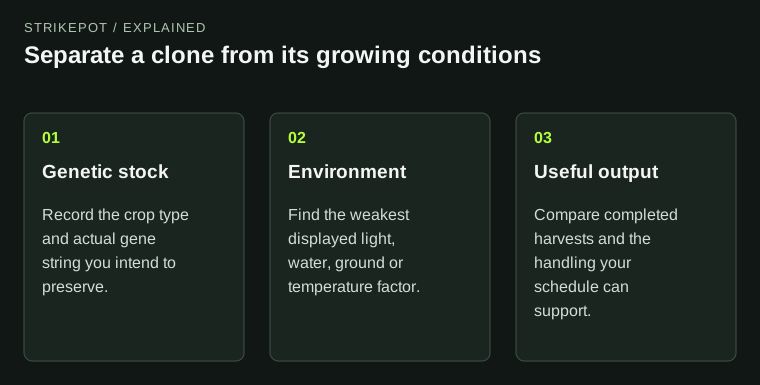
A good gene string describes potential; balanced conditions and completed harvests determine useful production.
Read the plant's conditions first
Facepunch's Farming 2.0 explanation identifies light, water saturation, ground condition and temperature as relevant inputs. It explains the displayed overall condition as following the weakest condition rather than the average of several good ones.
That design rewards balanced growing conditions. Improving an already strong factor while another remains poor may produce little benefit. Look at the actual plant information instead of judging the room by how bright or elaborate it appears.
The announcement is historical, so use the current in-game panel for the crop and server in front of you. The underlying diagnostic idea remains useful: find the limiting input, change it deliberately and observe whether the expected condition responds.
Genetics describe several different advantages
The Facepunch-hosted farming reference distinguishes genes associated with growth, yield, hardiness and water consumption, alongside empty slots. These are different effects. A preference for faster growth is not automatically the same preference as more output from each harvest or less repeated handling.
Start with the product you need and the way you can maintain the farm. A player returning at regular intervals may value a different rhythm from a group tending plants continuously. A clone should be judged against that plan, not just a label calling it ideal.
For example, a hypothetical player has enough time for one harvest visit before leaving. A faster cycle is useful only if it changes what that player can actually complete. If the farm is unattended at the relevant moment, part of the theoretical advantage may not become useful output during that session.
Cloning preserves a result; crossbreeding changes one
Facepunch describes a clone as inheriting the source plant's genetics. That makes cloning useful when you have a result you want to repeat. Crossbreeding is a different operation involving neighboring plants during the appropriate growth stage.
Keep a known clone separate from experimental stock. If the aim is to reproduce a chosen genetic result, label it clearly and avoid mixing it into a test you intend to alter. A collection of similar-looking plants is harder to reason about than a small, identified reference group.
This is a workflow suggestion, not a complete crossbreeding recipe. The exact arrangement and current gene behavior need their own check. A screenshot of a desirable final string does not explain every step that created it.
Plan the water path before increasing the plant count
Water supply is a system, not just a container in the room. Identify where the water comes from, how it reaches the planters and how you will tell when supply is falling behind consumption. The hosted farming reference discusses different supply arrangements and the relationship between layout and distribution.
Adding another group of plants can change demand without changing the supply. If the existing room was only just maintaining its conditions, expansion may expose a shortage that was previously hidden.
Imagine a fictional farm that grows well with one planter area but struggles after doubling the crop count. Compare the original and expanded water conditions before blaming the genetics used in both. The unchanged clone is a useful reference precisely because it helps isolate what the expansion altered.
Use a small comparison instead of changing everything
Choose a limited test using plants of the same type and known genetics. Keep the starting conditions and observation times clear. Change one relevant environmental factor, then inspect the condition panel and subsequent growth.
Do not call the result a measured yield improvement unless you actually recorded the harvests under comparable conditions. A healthier information panel is an observation about the plant's current state. Total useful production also depends on cycle completion, handling and what the player does with the harvest.
| Question | Evidence to compare |
|---|---|
| Is the room limiting growth? | The crop's current condition values |
| Did the clone change? | The actual gene string of the planted stock |
| Did expansion exceed supply? | Water and light conditions before and after adding plants |
| Did output improve? | Comparable recorded harvests and time spent |
Include the work needed to keep the farm running
A farm occupies space and creates recurring tasks. Before scaling, decide who replenishes inputs, who preserves clones and where the harvested stock goes. A production plan that depends on someone always being available should say so.
Unlocking the required equipment is another part of that preparation. Use the current blueprint guide to check learning routes rather than relying on old progression costs attached to a farm video. Confirm the server and its rules as well; the server guide helps if you cannot return to the environment where the build was planned.
Once the room provides stable conditions, genetics becomes a more useful optimization question. Preserve a known result, observe the limiting factor and expand only when the supply and maintenance plan can support the additional plants. That sequence makes the farm easier to understand as well as easier to run.