
A Rust circuit needs enough power at the device and enough stored energy for the period when generation falls short. Those are related requirements, but they are not the same. A full battery can still face an output limit, and a powerful source can still leave the system without reserve.
Start with the equipment you need to run. Then follow its demand back through switches, branches, storage and generation. This makes expansion easier because every added device has a visible place in the budget.
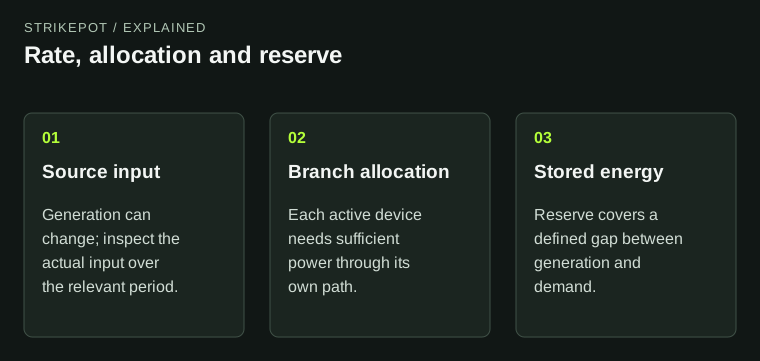
Power ratings and energy capacity describe different limits; the diagram keeps their roles separate.
Separate power from energy
Power describes the rate available or used at a moment. Stored energy describes how much a battery can supply over time. The current large-battery reference illustrates the distinction with an output rating of 100 Rust watts, abbreviated rW, and a capacity of 24,000 Rust watt-minutes, or rWm.
The units explain why “the battery is large” is an incomplete diagnosis. Output sets one boundary; stored charge sets another. A system can fail either because the load cannot be supplied at the required rate or because it has run for long enough to exhaust the reserve.
Use the live values displayed in your own game for a build. Item references are useful for planning, but modified servers and later changes can alter the context. Do not carry an old component number into every future design without checking it.
Measure the whole active load
List the devices that must operate at the same time. Include the relevant distribution and control components rather than counting only the final lamps, machines or defensive equipment. A neat diagram is not a power budget until it accounts for what is actually active.
As a hypothetical calculation, suppose a fictional circuit's measured active draw is 40 rW and its usable stored charge is 12,000 rWm. With no incoming charge and a constant draw, the simple energy calculation is 12,000 divided by 40, or 300 minutes. This is an illustrative calculation, not a tested runtime or a specification for a complete Rust build.
Charging behavior, changing loads and component configuration can make the real circuit more complicated. The point of the example is the relationship: increasing demand reduces the time a fixed reserve can cover.
A source's maximum is not its continuous contribution
The solar-panel reference describes generation as dependent on the sun's intensity and angle to the panel. It lists a production figure, but that number should not be read as a promise of uninterrupted supply through every part of the cycle.
Watch the actual input to your system under the conditions you intend it to survive. A demonstration made during strong generation answers a different question from an overnight reserve check. Both can be useful if they are described accurately.
Place variable generation and battery storage in the same plan. The source needs to support consumption and replenish the reserve over the cycle; the battery must bridge periods when that contribution is insufficient. Extra storage cannot fix a long-term generation deficit by itself.
A branch distributes power; it does not multiply it
The Electrical Branch reference describes allocating a chosen amount from a main line. Trace which output feeds which part of the build. A healthy upstream connection does not establish that the branch serving one device has enough available.
For a small hypothetical workshop, you might want one group of equipment to remain powered while an optional area is switched off. Naming those branches by function helps you understand the tradeoff. The exact allocation still needs to match the real components and their displayed demand.
When you add equipment, revisit the shared path. A new load can affect resources that other branches depended on, even when their own wiring was untouched. Checking only the newest device can miss that relationship.
Expand one requirement at a time
Before changing a functioning circuit, note its source, battery state, branch allocations and active load. Add the intended component, then observe the new load and result. This is a controlled comparison you can reproduce, rather than a claim that one universal layout suits every base.
If a device cannot yet be crafted, separate that progression issue from the electrical design. The current blueprint guide explains the learning routes. Owning materials and knowing a recipe still do not establish that the completed machine has power.
A camera provides a useful example of multiple requirements: the CCTV guide separates its identifier from its power and feed. When such a device stops working, trace the requirement that changed rather than replacing an otherwise correct address.
Reserve belongs to a defined objective
Decide what the circuit must continue doing and for how long. A lighting setup used only during a session has a different objective from equipment expected to remain active while the group is away. Label the requirement before choosing how much reserve to keep.
Then inspect the build at a useful low-generation point. Record the charge trend and active demand, and distinguish those observations from a forecast. A few minutes of stable charge does not prove that the circuit will maintain the same balance through a whole cycle.
The practical check is simple: enough power reaches each active device, the total draw fits the supply path, and the reserve covers the intended gap. Reading those three results separately is more useful than judging a system by the number of panels on the roof.