
An older Rust demonstration showing that a roof fits beside one building skin but fails beside another may no longer describe the current game. November’s update explicitly fixes several skin-dependent placement inconsistencies. A clip can accurately show what happened before the patch while giving the wrong expectation for the same layout now.
The useful question is which comparison the fix changes. The patch identifies overhangs, same-grade frame collisions and particular blocked placements. It does not announce that every visual difference, every deployable placement or every damage interaction is now identical.
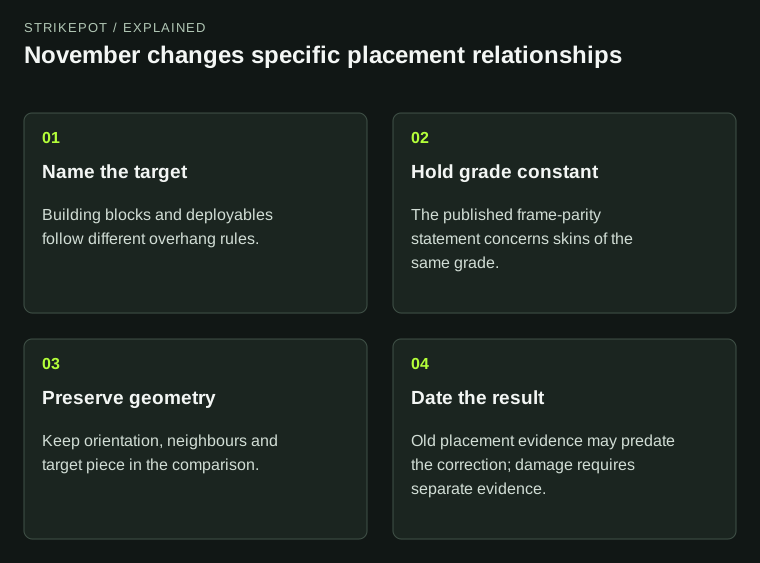
A comparison framework scoped to the documented November fixes, without claiming universal mechanical equivalence.
The published corrections have a defined scope
In Printed and Polished, Facepunch says roof overhangs now block deployables rather than building blocks, regardless of skin. Square roof side overhangs no longer block adjacent foundations. It also standardizes frame colliders across skins of the same grade, addressing triangle roofs blocked by stone frames in some orientations.
The November changelog lists those specific inconsistencies alongside separate ramp fixes. Together, these entries identify affected relationships between objects. They do not justify replacing the list with the much broader statement that skins have no mechanical differences anywhere.
This distinction matters when reviewing advice. A claim about a square roof’s side overhang should be assessed against that correction. A claim about an unrelated object needs its own evidence rather than inheriting certainty from a nearby patch-note heading.
A building block and a deployable are different comparison targets
The overhang change deliberately distinguishes categories. A building block fitting beside an overhang does not imply that every deployable can occupy the same nearby space. The documented rule still allows overhangs to block deployables.
Imagine a hypothetical comparison in which a foundation now places successfully while a storage object does not. Those outcomes need not contradict the fix because they ask different placement questions. A report saying “the overhang still blocks things” omits which category is being tested.
This also limits what an old video can prove. If its blocked target is a building block, the November correction may directly change the result. If it is a deployable, successful block placement elsewhere does not invalidate the observed restriction. The identity of both objects belongs in the comparison.
Same-grade frame parity is a controlled comparison
Facepunch’s frame statement includes a grade condition. Comparing frames with the same grade isolates the skin more effectively than comparing different grades while also changing appearance, position and orientation.
Take an invented pair of screenshots. The first uses a stone frame in one orientation; the second uses a differently graded frame rotated another way. A difference in triangle-roof placement cannot establish a skin-specific cause because several variables changed together. The screenshots are observations, but their explanation remains underdetermined.
A stronger comparison would preserve the frame type, grade, orientation, surrounding geometry, target roof and software version. Then a remaining difference has fewer competing explanations. This is an evidence standard for evaluating a claim, not a claim that this article performed a building experiment.
| Comparison detail | Why it matters |
|---|---|
| Target is a block or deployable | The published overhang rule distinguishes them. |
| Frame grade | The collider-standardization claim is scoped to equal grades. |
| Orientation and neighbours | The named historical failures depended on local placement. |
| Build and observation date | An older result may predate the correction. |
| Exact failure message or placement preview | A failed action alone does not identify its cause. |
Visual resemblance cannot substitute for placement evidence
A cosmetic outline tells the viewer how the object appears. The placement result tells the viewer whether a particular neighbouring object is accepted under the game’s current rules. The fact that Facepunch changed the latter without presenting a wholesale visual redesign is a reason to avoid treating appearance as the entire interaction model.
For a hypothetical overhanging roof, a visible projection may look as though it occupies the same space as before. The surrounding placement rule can nevertheless have changed. Conversely, a more open-looking frame is not evidence that an unrelated deployable now fits.
The building-skin guide explains selecting an owned appearance and its compatible tier. That selection procedure is separate from establishing what a current layout permits. Ownership evidence and geometry evidence should answer their own questions.
Placement fixes are not a universal damage-parity announcement
The same update separately addresses triangle frames taking explosive splash through walls in some placements. That is a damage-path correction, while the overhang and frame entries above concern placement. Sharing a release does not make their results interchangeable.
A roof placing successfully does not measure explosive damage. A corrected damage interaction does not prove that a deployable will fit. A report about one needs the relevant geometry and observed outcome for that interaction, rather than a screenshot demonstrating the other.
It would also be too broad to promise that all walls now block every form of damage in every situation. The published example is narrower. This article draws no raid-cost calculation, recommends no destructive test and does not infer unannounced durability changes from collision terminology.
An old comparison needs a date before it needs a verdict
When someone shares an older building demonstration, first identify what it actually shows and when. It may be useful evidence of the previous inconsistency. That does not make it evidence that the inconsistency survived the current update.
For a present disagreement, retain the build, server context, exact pieces, grades, orientations and visible error. A screenshot of two different skins is incomplete if the target pieces or surrounding space also differ. The support-record guide can organize those details without treating an interpretation as an observed fact.
The November briefing places these corrections in the broader release. The practical analytical change is that several old advantages or disadvantages need current evidence. A fair comparison begins with the specific interaction that changed, then holds the remaining variables steady.