
A Rust Workshop page is a proposal for game content. Its existence does not show that Facepunch has selected the design, released it through an official route or granted it to your account. Those are separate stages, each with different evidence.
For creators, that means a successful upload is a publishing milestone rather than a promised sale. For players, it means an appealing preview and a popular vote count are reasons to follow a design, not proof that it can already be equipped in ordinary play.
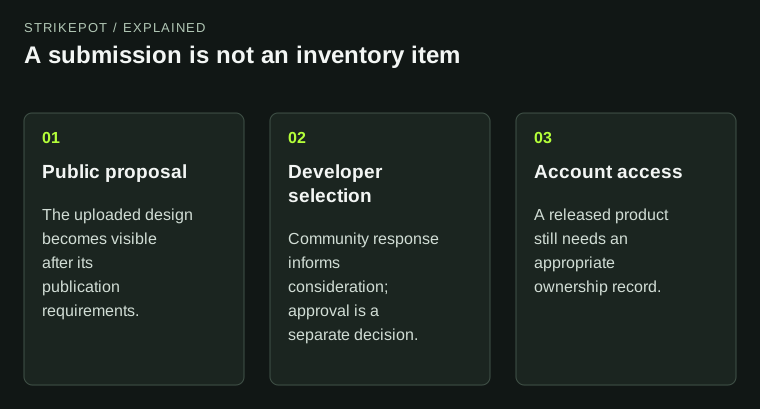
The stages explain why a vote, an approved design and an owned cosmetic prove different things.
The Workshop is a place for submissions
Valve's Workshop documentation distinguishes ready-to-use content from a curated model, where the developer approves entries and community voting helps evaluate interest. It also separates content files from the inventory system that tracks who may use a sold item.
That distinction explains a common Rust misunderstanding. A Workshop entry can have a creator, preview images, comments and an identifier while still being an entry for consideration. The page's identity is the identity of the submission. It is not automatically the identity of a cosmetic held in your Steam inventory.
Use a Workshop page to assess the work being proposed: the base item, artistic idea, creator and supporting presentation. To establish official availability, look for the game's accepted-item context and the actual product or inventory record.
Visibility has its own requirements
The Facepunch-hosted Workshop FAQ identifies acceptance of the contributor agreement as a prerequisite for an item to be publicly visible or added to the game. This addresses a submission that is not appearing, before anyone reaches the question of artistic selection.
Keep those problems separate. If a creator's entry is not public, improving the thumbnail does not establish that the publication requirements have been completed. If it is public but has not been selected, repeatedly checking whether it uploaded will not answer why the design has not advanced.
The hosted FAQ is marked as old and community-maintained. It is useful for this distinction, but it should not be treated as a current contract about earnings, store runs or selection timing. Creators should read the agreements and notices actually presented to their account.
Votes express interest, not an entitlement
A vote measures an action on a submission page. It is not a purchase receipt, a release date or a commitment from the developer. The curated model exists precisely because publishing and approving are separate decisions.
Imagine two hypothetical designs for the same item. One attracts many votes through a striking promotional image. Another has fewer votes but makes the base item easier to recognize and is presented more clearly. A vote total alone cannot tell a reader how the developer will weigh those differences. Turning the count into an acceptance probability would invent data the public page does not supply.
The same caution applies to age. A submission remaining online for months does not create a queue position or a promised review deadline. It can remain useful as a portfolio piece without becoming an officially released Rust item.
Presentation should make the actual design assessable
A good submission helps a viewer understand what is being proposed. Show the intended base item clearly and distinguish images of the actual work from any decorative presentation. If an image is a concept or mockup, identify it as such.
The skin-acceptance guidance discusses presentation alongside fit and originality. A practical reading is to reduce uncertainty: which item is this, which parts changed, and how does the finished treatment look? A dramatic scene may attract attention while obscuring those questions.
Keep your working files and the published entry organized so revisions can be understood. A changed preview should represent the version being discussed. That recommendation is an editorial workflow suggestion, not an extra published Facepunch selection rule.
Official release and personal access are different checks
After a design is officially available, a player still needs the access appropriate to that product. A friend's screenshot, an entry marked as accepted or a video showing the design does not establish what the viewing account owns.
| Stage | What it establishes | What it does not establish |
|---|---|---|
| Public submission | A proposal is visible for consideration | Official selection |
| Community response | Users reacted to that proposal | A promised release or revenue |
| Official availability | The design has a supported release context | Ownership by every viewer |
| Account record | The account has the recorded item or access | Every possible in-game action or resale right |
The Rust store and Market guide handles acquisition routes and restrictions. Once access is established, the reskinning guide covers the relevant application controls. Those later steps cannot be replaced by clicking a Workshop vote.
Describe the stage you can prove
Creators can accurately say an entry has been submitted or made public when that is what happened. Players can say a design is under consideration when that is all the record supports. Neither needs an invented acceptance deadline to make the work interesting.
When comparing two pages with similar artwork, retain the creator and exact submission reference. Similar titles or thumbnails can hide different entries, revisions or base items. Follow the identity through the official product record before assuming they refer to the same release.
A useful next step is therefore specific: resolve visibility for a hidden submission, assess design clarity for a public entry, or inspect the account record for an available cosmetic. Knowing the stage prevents a creative proposal from being mistaken for an owned, playable item.