
When a game is retired from the Steam store, an existing owner's Library access and the game's online services are separate questions. Valve's ordinary retirement guidance says existing players can continue to download, install and launch the game. That does not establish that a publisher's login service or multiplayer servers will keep operating.
The useful question is therefore more specific than whether the game has disappeared. Ask what disappeared: a purchase button, an entry in your own Library, a downloadable installation or a service the game needs after launch.
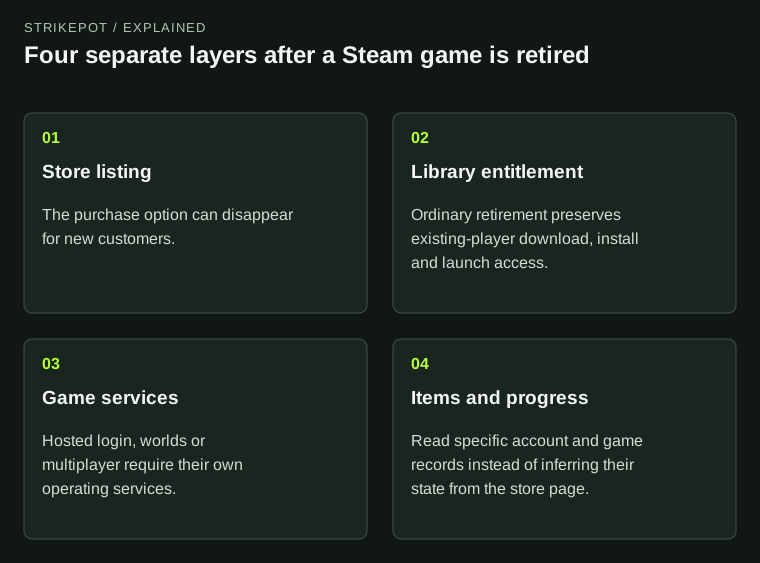
Store retirement and service shutdown can affect different parts of a player's access on different dates.
Store retirement concerns availability to new customers
In its product-retirement documentation, Valve describes removing a game's purchase option and keeping the retired game in existing players' Libraries. The store page can remain accessible even though the game is removed from store listings. Steam Community access also remains part of that documented process.
This describes an ordinary store retirement. It should not be expanded into a promise about every possible account or product dispute. A refunded purchase, a revoked entitlement and an account restriction are different situations that require their own records.
For a hypothetical example, you bought a single-player game several years ago. Its publisher later stops selling it after losing a distribution license. If the game follows Valve's retirement process, the missing purchase button does not itself mean your existing installation has been removed. Start from the Library and the original account rather than shopping for another copy of something you may already have.
Launching software and reaching its services are different outcomes
Valve specifically asks retiring developers whether their games rely on servers or other functions customers will no longer be able to access. That is a separate operational dependency. A client can start successfully, display its menu and still fail when it attempts to authenticate or enter an unavailable online world.
Imagine another fictional game whose main activity runs on the publisher's hosted service. The publisher retires the store listing and announces a later shutdown date. Downloading the game's files after that date would not recreate the hosted world. The files and the service were different parts of the experience.
Steam's multiplayer documentation describes several possible network arrangements, including peer-to-peer and dedicated servers. Those options explain why games can have different dependencies. They do not establish that any particular retired game supports community hosting, a replacement service or an offline mode. Look for a developer statement about the actual title.
Offline Mode does not replace a closed online game
Steam Support's Offline Mode reference excludes games that require an active connection or an external launcher from its offline procedure. Changing Steam's connection state is not a way to replace a game's required servers.
This distinction matters when a suggested fix sounds plausible because the files are already installed. The installed client may contain graphics, sounds and interface code while the world state, login permission or match session lives elsewhere. Having the local portion does not prove the complete activity can run locally.
If the developer documents a supported offline activity, the Offline Mode preparation guide explains the preparation process. Test the intended activity while you can still investigate it. A main menu opening is a narrower result than loading the campaign or mode you actually plan to use.
Inventory items need their own answer
A retirement notice about game sales does not, on its own, explain every item's status. An account can have a Library entitlement, game progress and Steam inventory items associated with the same title. Those records do different jobs. Treat an item's visibility, permitted transfer and in-game use as separate observations.
For example, a player might still see a cosmetic in Steam inventory while the game mode in which they used it is no longer operating. That observation would not prove the item can still be equipped in a functioning session. Conversely, an absent purchase button is not evidence that a previously acquired item was deleted.
Do not infer a universal Market consequence from the word delisted. Read the relevant Steam item description and any specific developer notice. If an expected item is actually missing, use the inventory investigation guide with its acquisition record. Reinstalling game files is not a substitute for identifying where an account-side item should have arrived.
Keep the notice's dates and promises separate
A publisher may announce an end to sales, an end to support and an end to online services on different dates. Read which event each date names. An announcement posted in March with a service closure in June describes two moments, not one immediate shutdown.
In a hypothetical notice, sales stop on the first day of a month while existing users can play online until its last day. Someone reading only the headline might assume access ended at once. Someone relying only on the still-working menu might assume nothing will change. The full notice gives both readers a more accurate plan.
Preserve the official announcement URL and the affected mode or platform. Avoid treating a forum prediction as the publisher's commitment. If the notice says nothing about a feature you need, the accurate answer is that its future is not established by that notice.
Match the next action to the missing layer
| Observation | Next useful check |
|---|---|
| No purchase option | Read the official sales-retirement notice and check existing Library access. |
| Game missing from your Library | Confirm the owning account and acquisition record. |
| Installation works; online mode fails | Check service status and the developer's shutdown or support notice. |
| Refund already approved | Follow the recorded destination and payment state. |
Valve's retirement guidance leaves room for case-specific refund treatment, but does not promise every owner an automatic refund. For an approved request, the refund destination guide covers the payment record. Keep that separate from deciding what the game can still do.
A clear answer names the layer: still in the Library, still downloadable, launches locally, or reaches the required service. Establishing those facts gives you a useful picture of access after retirement without assuming that one surviving part guarantees all the others.