
A game appearing in your Steam Library does not always mean you bought continuing access to it. A demo, a Steam Playtest and a Free Weekend can all put something playable on your computer, but they grant different kinds of access. Early Access describes an unfinished product you can buy; it is a different arrangement again.
Before committing a weekend to a new survival game or multiplayer shooter, establish which of those arrangements you joined. That determines why access might end and which questions you need to ask about progress.
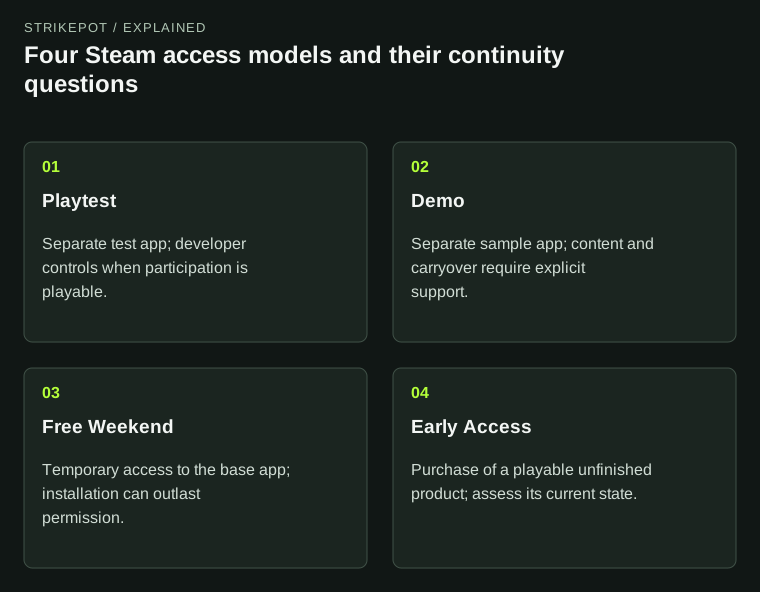
The access model identifies the right ownership and progress question before a trial becomes a longer play plan.
Start with the exact product, not the word beta
Players and developers use beta in several ways. It can mean a separate test application, a testing branch of an owned game, or simply an unfinished build. The word alone does not establish a license, a time limit or whether the full release uses the same save.
Read the actual Steam product name and the developer's description. Keep the name of the installed application alongside the offer you accepted. If you received a code, confirm whether it activates the main game or a named test. The distinction between an activation key and an inventory item also matters: a code granting game access is not a tradable cosmetic.
A Playtest grants participation in a test
Valve's Playtest documentation describes an associated but separate application. Developers can accept applicants in groups or open access more widely, and they can make the test unavailable when their testing period ends. Steam Playtest itself is free for players.
A useful distinction is the difference between having been admitted and having an active session available. Receiving access does not require the developer to run its test indefinitely. If a previously playable test closes, that event alone is not evidence that your Steam account has lost a purchased game.
For a hypothetical example, Alex requests access to a survival-game test on Tuesday, is admitted on Friday and plays during a server test on Saturday. On Monday the developer ends the test. Alex's participation record does not establish ownership of the eventual retail game. The next relevant source is the developer's test schedule, not a missing-item search through Steam inventory.
A demo is a separate sample of the game
A Steam demo normally offers a selected part of an experience under a separate associated application ID. Its content can be shorter or otherwise different from the main product. Valve's demo documentation allows developers to describe the demo's own supported modes and features rather than presenting every main-game feature as included.
That matters when a friend has bought the full game. The shared title and artwork do not prove that a demo can join the same servers or access the same campaign. Check the demo's actual multiplayer description and the developer's instructions for that combination.
Progress transfer is another separate question. Steam provides a way for developers to share Cloud storage between a demo and the full game, but the existence of that option is not a universal carryover promise. A character created in a demo may transfer, transfer only selected progress, or require a fresh start according to that game's implementation.
A Free Weekend lends access to the base game for an event
Unlike those separate applications, a Free Weekend temporarily grants access to the base game's application and installation content. Valve says the game can remain visible in a participant's Library after the event, while continued play requires purchasing it.
Think of installed files and permission as two different records. A completed download can remain on your drive after the event permission expires. Reinstalling those same files would not create a new entitlement. Read the event's own end time rather than assuming that a sale countdown is also the play-access countdown.
In an illustrative scenario, Bea downloads a game on Saturday, plays on Sunday and finds a purchase prompt on Tuesday. If the Free Weekend has ended, the prompt is consistent with temporary access ending. Bea should check the event and purchase records before treating the change as account damage. Any later purchase should be evaluated on its own terms, including the edition and content actually included.
Early Access is a purchase decision about the current build
Steam Early Access is a way to sell a playable game while development continues. It does not mean the same thing as joining a free Playtest. Valve tells developers to explain the unfinished state and avoid definite promises that development will finish or planned features will arrive.
The practical question is whether the available build is something you want at its current price. A roadmap helps explain intent, but a future feature is not something you can play today. Consider the game that exists, its disclosed limitations and your tolerance for changes to systems or saves.
Do not confuse Steam Early Access with an edition that allows advance play shortly before a scheduled release. Valve distinguishes those products too. An offer saying that a Deluxe edition starts several days earlier should be read as that particular pre-release arrangement, rather than as proof that the game is in Steam's Early Access development program.
Use a short handover record before leaving a trial
| What you joined | What to establish before continuing |
|---|---|
| Steam Playtest | The test application, current playable period and any reset policy. |
| Demo | The included content and explicit save-transfer or multiplayer instructions. |
| Free Weekend | The access end time and whether you separately bought the main game. |
| Early Access purchase | The current build, known limitations and the exact purchased product. |
For progress you care about, record the application, save slot, last session and developer's carryover statement. If Steam actually presents a synchronization warning, use the Cloud conflict guide before accepting a replacement save. A trial model does not tell you which copy is newest.
Your next decision should follow the evidence you have: wait for the next test, continue the sample, review the full product or resume an owned game. Keeping those choices separate prevents a temporary Library entry from becoming an assumption about ownership or an unsupported promise about your progress.