
Two people can open the same Steam bundle and see different prices because they already own different parts of it. A Complete the Set bundle charges for the included products the recipient is missing. A Must Purchase Together bundle follows a different rule: the customer must own none of its included products.
Before comparing screenshots of prices, compare the bundle type, included content and intended recipient. The edition's name is a useful label, but it does not explain those rules by itself.
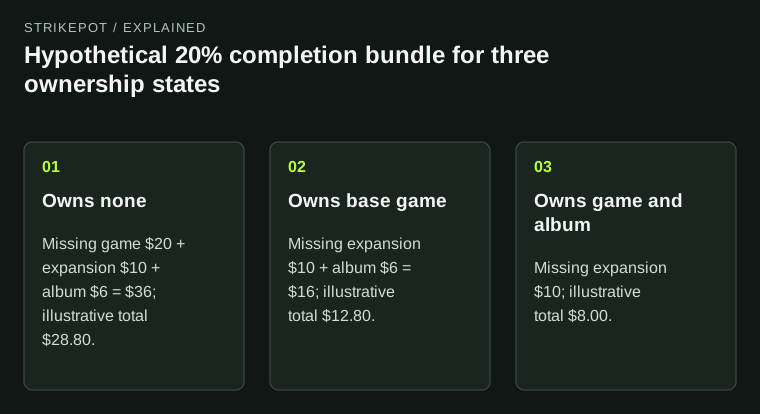
Invented prices show how the same completion discount applies to different missing-content subtotals; these are not current offers.
Complete the Set is a calculation around missing content
Valve's bundle documentation describes Complete the Set as a way to pay for and receive only the included products not already held in the relevant account. Its discount applies to the current prices of those missing components.
That makes the bundle personal to its recipient. A friend who owns the base game is answering a different purchase question from someone who owns none of the series. Neither person's displayed total should be used as the universal price for everyone.
Also distinguish ownership from installation. Uninstalling a game you own does not turn it into missing content for the purpose of a purchase comparison. A Library entry supplied by a sharing arrangement is another separate case; use the actual account entitlements and final cart rather than guessing from which games appear playable.
Work through a deliberately fictional bundle
Assume a hypothetical bundle contains a base game at $20, an expansion at $10 and a soundtrack at $6. Its bundle discount is 20%. These are invented prices used only to explain the calculation, with taxes and regional differences left out.
| Recipient's existing ownership | Missing component subtotal | Illustrative total after 20% discount |
|---|---|---|
| Owns none | $20 + $10 + $6 = $36 | $28.80 |
| Owns the base game | $10 + $6 = $16 | $12.80 |
| Owns the game and soundtrack | $10 | $8.00 |
The arithmetic is missing subtotal multiplied by 0.80. It is not a refund of 20% of what the recipient paid in the past. If the base game was purchased years ago at another price, that historical payment does not enter this constructed calculation.
Nor does the lower total mean the expansion became a different edition for the existing owner. In this example, the remaining products are the same. The difference is which products still need to be granted.
A sale on one component can affect buyers differently
Keep the same hypothetical bundle, but reduce the base game's current price to $10 during a fictional promotion. For someone who owns none of the content, the component subtotal becomes $26 and the 20% bundle discount produces $20.80.
For someone who already owns the base game, the missing subtotal remains $16, so the result remains $12.80. That person receives no further reduction from a component they were not going to buy in this transaction.
This is a useful reason to compare the cart rather than the headline percentage. A discount on the whole product image can attract attention while the particular content you need has barely changed in price. The relevant question is the total for your missing, wanted content.
Must Purchase Together is not a completion offer
Valve's second bundle type, Must Purchase Together, is available only if the customer owns none of its included products. It can be used for an edition grouping such as a base game and related additional content. An owner should not assume that this type will automatically remove the base game and sell the remainder.
If an edition is unavailable because you own one component, inspect the publisher's other purchase options. There may be a separate add-on, an upgrade or another bundle, but those possibilities must be established from the actual store page. Do not buy an unrelated product because its name sounds like the missing upgrade.
A soundtrack also needs to be identified correctly. Valve documents soundtracks as audio products; their presence in an edition does not mean the edition includes an additional map, character or usable inventory item. Compare the included product descriptions with what you actually want.
A package is a different kind of container
Steamworks calls a package a collection of applications and content permissions sold through Steam or granted through a key. That underlying license container is different from an ownership-aware store bundle.
This matters when an offer is described informally as a pack. The word pack does not establish Complete the Set behavior. Check the exact included products and purchase conditions. If the product comes through an activation code, also verify its platform and edition with the key-delivery guide.
Do not count on receiving spare copies of already owned products unless the actual offer explicitly provides them. An ownership-aware completion purchase in particular is charging for missing content, not manufacturing duplicate gifts from the parts it excludes.
Use the intended recipient's final cart
The current bundle documentation allows Complete the Set gifts and says the calculation follows what the recipient does not yet own. Older explanations that describe every such bundle as ungiftable are therefore not a reliable account of the documented current rule.
For any gift, review the current cart for the selected recipient. Your own ownership history may be irrelevant to that person's missing-content calculation. Confirm the content and total before committing; a screenshot taken while shopping for yourself is not a quote for a friend.
After acquisition, an owned add-on can still have separate installation and in-game requirements. The DLC access guide covers those later stages. For the purchase decision itself, keep three facts together: the exact bundle type, the recipient's ownership and the wanted content remaining in the cart. Those facts explain far more than a comparison of edition names or discount badges.