
A CS2 Souvenir commemorates a tournament context. The event, teams, map or player attributes can describe that connection, depending on the system used for the named Major. They do not, by themselves, prove that a professional player owned the inventory object or used that individual weapon in the match.
The distinction is especially important because Major systems have changed. A convincing provenance description starts with the specific event and the actual item's attributes, then limits its conclusions to what those records support.
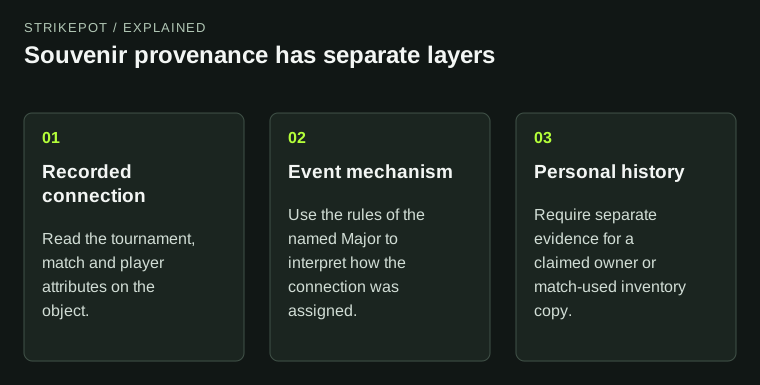
A commemorative match connection does not establish every story about the object.
Commemoration and personal ownership are different claims
A tournament-connected item can carry a story about a match without being a physical remnant of the match. In a digital collection, the game can assign commemorative attributes through a documented event process. That process establishes the intended connection.
Imagine a hypothetical weapon whose description names a final and a player. You can research that match and understand why the combination interests a collector. You still need separate evidence before saying the player traded the item, equipped that individual copy or personally selected its later owner.
This is not a criticism of the collectible. The official commemorative relationship is meaningful on its own. Adding an unsupported ownership story makes the description less precise rather than more interesting.
Older package systems had their own boundaries
Valve's Cologne 2014 announcement described match-linked packages containing weapons from the played map's collection with tournament and team stickers. That is evidence for how that event's system connected objects to matches.
It is not a universal template for every later Souvenir. If a reader applies the older package description to an item created under a different system, they may infer a collection rule or acquisition story that does not belong to the newer event.
Keep the event name in your research notes. “A Major Souvenir” is too broad a starting category for a detailed provenance claim. The useful record identifies which Major, which process and which actual item description are being discussed.
Cologne 2026 makes the ownership distinction particularly clear
The Cologne 2026 announcement and FAQ described converting a selected normal or existing Souvenir weapon using a completed match and chosen player. A previously owned object could therefore receive a new commemorative identity through that event process.
The implication is specific: the match attributes cannot independently prove that the original inventory object was carried by the selected player during the match. The conversion process itself supplies another documented explanation for the relationship.
This article is not an invitation to make a current conversion. For purchase periods and event entitlements, use the event-specific Souvenir guide. The provenance question concerns what an existing record means, not whether an old shop remains available.
A highlight attachment records another kind of connection
Valve's Austin 2025 announcement described playoff packages with an attached video highlight related to the selected playoff map. That adds a clip-based commemorative element, not a general proof of personal ownership by the player shown.
A useful description names the clip relationship accurately. It might say that the attachment links to a highlight from the selected map. It should not silently become “this is the weapon used in the clip” unless independent evidence establishes that stronger claim.
When several attributes appear together, preserve them as separate fields. Event, match, player and attached highlight can each contribute context. Their presence in one item does not mean that every conceivable story connecting them is documented.
Build a provenance note in layers
| Layer | What belongs in the note |
|---|---|
| Item identity | The actual weapon, finish, variant and visible configuration |
| Event connection | The tournament attributes recorded on the object |
| System context | The official process used by that particular Major |
| Additional history | Separate evidence for any claimed previous owner or use |
Leave a layer incomplete when the evidence is missing. An unknown ownership chain should remain unknown rather than being filled with a seller's appealing narrative. The comparison record can hold the item's exact properties while your research note explains the event context.
If the visual configuration matters, preserve it before changing anything. The sticker guide explains why later scraping or removal is a separate action with its own consequences.
Distinguish a current attribute from a preserved historical note
An item description is a record of the object in the state you are examining. Your personal archive can retain earlier states, but those notes should remain dated observations rather than being presented as unchanged current attributes. If a craft or commemorative configuration has changed, preserve the before-and-after evidence separately.
Valve's May 2026 notes, included in the Cologne update archive, explicitly describe removal of Souvenir attributes when such items are used in a contract. The contract guide covers that action; the provenance lesson is that an available operation can end the original object's documented configuration. A saved image can preserve evidence of an earlier state without making the later result the same commemorative collectible. State which record you are describing before attaching a historical story to it.
Use the strongest accurate story
A well-supported account can explain the match, the official event process and why a particular combination appeals to you. It does not need a claim of professional ownership to be interesting.
When evaluating a description, ask which sentence is an observation, which comes from the event documentation and which is an interpretation. If a claim moves from commemoration to personal history, identify the additional record that supports the move. That method respects both the collectible and the limits of its evidence.