
A case is a container with a defined content pool. An official weapon collection is a grouping recorded in the game's item system. A finish family is a visual or naming relationship between designs. These can overlap, but they do not mean the same thing, and one does not reliably tell you everything about the other two.
This distinction matters whenever someone describes an item as part of a set. Are they identifying its official collection, the container associated with obtaining it, or simply other objects that share a recognizable treatment? You need the answer before using the grouping to explain an item's identity.
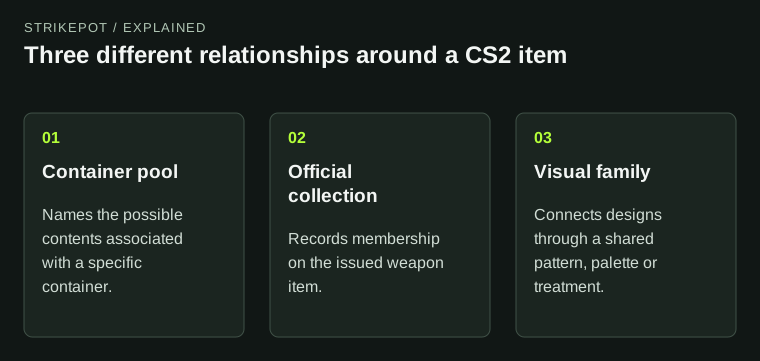
The three labels answer different questions even when the same item belongs to all of them.
Read the item before reading the family story
Start with the base weapon and the exact finish. Then read any variant designation, exterior and collection line. Steam Support's contract documentation points readers to collection membership on the inventory item. That explicit record is stronger evidence of membership than a resemblance between two designs.
In an editorial collection, you might arrange a blue rifle, a blue pistol and a blue knife together because they look good as a loadout. That is a valid personal theme. It does not create an official collection or show that those objects share an acquisition route. The distinction is between organizing your inventory and describing the game's own object relationships.
A nickname can add another layer of ambiguity. Players may use a short community term for several finishes, while the actual item descriptions distinguish them. Record the full names first; shorthand is easier to use accurately after the objects are identified.
A container pool can combine different kinds of relationships
Valve's historical Prisma Case announcement gives a useful example: it described community weapon finishes alongside Horizon knife models wearing Chroma finishes. The announcement names a container, a model grouping and a finish grouping in the same short description. Those words perform different jobs.
Reading them as interchangeable would lose information. The container name identifies the release pool being discussed. The knife label identifies the models. The finish label identifies an appearance family applied to those models. An item can participate in all three relationships without those relationships becoming identical.
This is a historical example of the vocabulary, not a statement about which containers currently drop or what any particular opening will produce. Use the actual container description for its contents. The name of a familiar family is not a substitute for that list.
Shared artwork does not force shared collection membership
Finish families are attractive because they make a large inventory understandable. Related colors, motifs or material treatments can connect weapons with very different shapes. A family can remain recognizable even when each version has been adapted to its receiving model.
Valve's color-harmony documentation also shows why the relationship is more flexible than one picture: changing the palette can produce a new finish from a pattern. The important inference is modest. Shared construction is not the same claim as identical appearance, and neither establishes official collection membership.
Consider a hypothetical creator who uses an original geometric pattern on a pistol and a rifle. One application is muted green, the other bright orange. You could reasonably discuss them as a design family. Until they are released, that family is a creator's portfolio grouping. Even after release, you still read each issued item's collection rather than assigning one based on the portfolio.
Keep four useful questions in separate columns
| Question | Record to use |
|---|---|
| What object is this? | Base weapon, exact finish and variant |
| Which official collection contains it? | The item's collection field |
| Which container pool is being discussed? | The named container and its contents |
| What makes it visually related to other items? | The actual pattern, palette or material treatment |
The table is a reading aid, not an attempt to build a complete database. You can add a release source beside each row when researching an older object. If a source establishes only the visual family, leave the acquisition claim unresolved instead of filling it from memory.
The item comparison record is useful for preserving exact details. Put your own theme or family note in a separate description so it does not overwrite the official identification.
Why this matters beyond terminology
Different actions consult different parts of the object. A collection can matter in a documented exchange system. A base weapon matters when choosing what you will use in a match. A finish family matters when deciding whether two items suit the same visual theme. Treating every decision as a collection question makes the wrong information look decisive.
For exchange eligibility, use the current contract input checks. This taxonomy does not establish a recipe or calculate an outcome. For appearance, compare the actual item; the wear and pattern guide explains why matching names still leave individual differences.
A personal checklist can use both kinds of grouping. You might track completion of an official collection in one column and note a matching color theme in another. Keeping both labels explicit lets the same inventory serve a collecting goal and a visual goal without confusing their definitions.
Use precise language when describing a set
Instead of saying that three weapons are from the same case when you only mean that they share a style, say that they form a matching visual loadout. If you mean official collection membership, name that collection. If you mean a container pool, identify the specific container.
That small change makes a collection description more informative without adding jargon. It also helps you spot a missing fact: an attractive group photograph can demonstrate a coordinated theme, while the item records establish what each object actually is.