
A matching CS2 finish family needs a shared idea and a separate application for each weapon. Reusing a palette or pattern can create a recognizable relationship, but the receiving models have different proportions, visible surfaces and material regions. A design that fits one weapon does not automatically fit another.
For a creator, the task is to decide what stays constant and what must adapt. For a collector, the same distinction explains why two related skins can feel convincingly coordinated without showing an identical graphic at an identical size.
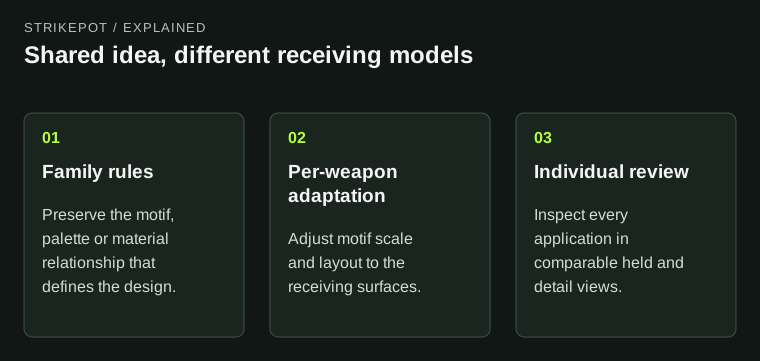
A visual family connects finished applications without requiring identical layouts.
Choose the family resemblance deliberately
Write down two or three features that make the idea recognizable. An imaginary finish family might share a muted navy base, an original wave motif and a narrow warm accent. Those features can persist even if the motif has a different composition on each weapon.
Do not make every detail equally essential. If the entire artwork must remain unchanged, a small receiving surface may force it into an unreadable patch. A family with a clear hierarchy has more room to adapt: the palette can carry the relationship at a distance, while a repeated symbol rewards closer attention.
It helps to distinguish a true design rule from a habit. Perhaps the warm accent always marks a boundary between materials. Perhaps it was simply placed on the magazine in the first version. The first is transferable logic; the second may be accidental placement that should not constrain the next weapon.
Compare the receiving surfaces
Use the official model resources to make a small surface study before extending the texture. Compare long uninterrupted panels, curved parts, narrow strips and the portions visible in hand. You are looking for useful equivalents, not identical pieces.
A wide rifle receiver might support a long flowing wave. A compact pistol might work better with one strong curve and more empty space. Repeating the entire rifle image on the pistol would preserve the source file while losing the visual idea. Adaptation preserves the idea by changing the arrangement.
Keep a common reference view for the family. If one design is judged in a large side render and another in a tiny held view, apparent consistency may be a product of presentation. Compare the same kinds of views first.
Scale has more than one meaning
Valve's scale documentation describes per-weapon adjustment for differently sized models. The art decision behind that system is easy to understand: a motif that feels like a broad stripe on one surface can become a dense texture on another.
Separate physical-looking motif size from coverage. You may want individual waves to feel similarly sized across the family while allowing different numbers of waves on larger and smaller weapons. Alternatively, you may want one large emblem on every model, accepting that it occupies different proportions of the surface.
Neither goal is universally correct. Problems arise when the source texture implies one goal and the actual application produces the other. State which relationship you intend, then inspect it on every receiving model rather than assuming a single scale setting proves consistency.
Material regions can interrupt the plan
In Valve's region-based system, the weapon contributes information about where finishes apply. That means a family is built through a relationship between the design and the prepared model, not through the artwork alone.
Imagine that the rifle version uses its brightest accent on a large panel while the pistol exposes that color only on a small component. The palette is technically identical, yet the visual balance can differ dramatically. The smaller version might need a different distribution to retain the family resemblance.
Use temporary diagnostic colors during development. A deliberately contrasting palette can make region boundaries easier to see before you commit to subtle final tones. Keep those diagnostic views out of finished promotional art, but preserve them as working evidence when discussing a technical problem.
Review consistency without erasing individuality
Place the family side by side and describe each member separately. What is the first shape you notice? Where is the accent? Which material dominates? If every answer is identical, the group may be coherent, but it might also be ignoring useful differences between the weapons.
A coordinated loadout can be stronger when each item has a distinct role. One might carry the most detailed illustration; another might use the family motif as a quieter surface pattern. This is an original design recommendation, not an assertion about which official rarity the items would receive.
Players can apply a similar method when choosing existing objects. Keep the full item identity through the comparison record, then describe the visual relationship in your own words. Family resemblance does not establish that items share an official collection.
Pay particular attention to the accent that carries the family relationship. A thin warm line on a long rifle can read as a strong directional gesture, while an equivalent line on a compact pistol may feel like a border. You can preserve the shared color while changing the line into a smaller shape. The family rule survives because its purpose survives, even though the literal mark changes.
Finish each application as its own object
Review the final held view, hidden surfaces and material response for every weapon. A family is not complete because the first version works. One awkward application can make an otherwise thoughtful set look mechanically repeated.
If the work is a Workshop proposal, the submission-status distinction still applies to every member. A creator's portfolio grouping does not become an official issued collection through naming alone.
The useful deliverable is a family with explicit shared rules and individually resolved applications. That approach lets the same idea remain recognizable while respecting the different objects that carry it.