
A StatTrak weapon count is a statistic attached to an item under the game's counting rules. It is not a complete ledger of the weapon's lifetime, every player who held it or every match in which it appeared. Valve also provides a tool for moving counts between compatible StatTrak weapons, which is a direct reason not to treat the number as inseparable from one finish's personal history.
The counter can still be meaningful. Its meaning becomes clearer when you describe the event it measures and keep claims about ownership, skill and chronology separate.
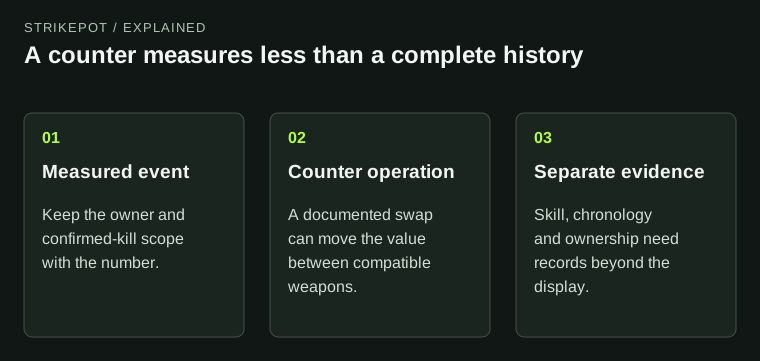
The number remains useful without being treated as a full lifetime ledger.
Read the measured event first
The official StatTrak USP-S description identifies confirmed kills and tracking when equipped by the owner. That is a narrower statement than counting every possible use of the object.
Do not extend the label into rules it does not state. A screenshot of a number alone does not establish the modes, dates or sessions behind it. If a particular increment is disputed, record the actual item, owner context and event being examined rather than assuming every visible elimination in every setting is interchangeable.
Also keep the type of counter with the object. The Music Kit guide explains a different StatTrak measurement. Sharing a brand name does not make weapon kills and Music Kit MVPs the same statistic.
The swap tool breaks a simple lifetime story
Steam's swap-tool documentation and the current tool description document moving or swapping values between compatible item types. The important implication here is about evidence, not how to perform the action.
Consider a hypothetical owner with two compatible StatTrak rifles in different finishes. A counter associated with one can be moved through the documented tool process. A later screenshot of the receiving rifle's count therefore cannot, on its own, establish that all the counted activity happened while that particular finish was being used.
The swap-tool guide covers compatibility and confirmation checks. You do not need to use the tool to understand the evidence limit. The documented existence of the operation is enough to rule out a universal claim that count and finish history are permanently identical.
A count does not supply a denominator
A large kill total is not a kill-to-death ratio, a win rate or a measurement of current skill. Those comparisons need additional information. The item number alone does not provide deaths, rounds played, opponents, time period or the circumstances of the events.
Imagine two purely hypothetical players whose weapons show the same count. One may have accumulated activity over a much longer period. Another may have used the weapon under different conditions. The equal totals do not prove equal performance because the comparison lacks the relevant context.
This is a general measurement issue. A cumulative total answers how much was recorded within its own scope; it does not explain the rate or difficulty of the underlying activity. Keep that distinction when a caption tries to turn a counter into a competitive credential.
A number also does not prove an ownership chain
To claim that a particular person previously owned an item, you need evidence connecting that person to that item. A familiar nickname, a memorable count or an attractive screenshot is not the same record.
A counter can be part of a personal archive when it is accompanied by dates, item references and contextual captures. It should not be asked to carry the entire archive alone. If the item changed hands or the counter changed through another operation, record that separately rather than smoothing the events into a continuous story.
For the current configuration, use the exact-item inspection workflow. It helps establish what is being offered now. Historical claims require their own supporting material.
Keep a useful personal record
If the counter matters to you as a record of play, preserve a simple milestone note: the item identity, the displayed value, the date and the context you want to remember. A milestone can be personally meaningful without being a complete statistical dataset.
If you later change the counter arrangement, add that event to the note. The record can then explain what the count means to you rather than pretending that the current display contains the whole story.
For a support question, identify the first mismatch precisely. Did the wrong item receive a value? Was the expected event within the documented scope? Is the evidence a before-and-after comparison of the same item? Those are answerable questions. “The history is wrong” leaves too much unspecified.
A before-and-after difference is useful but still needs context. In a purely hypothetical record, a display rising from 120 to 125 gives a change of five. To connect that change to a particular session, you also need confidence that the same item was compared and that no counter operation intervened. The arithmetic is simple; the identification is the substantive part of the evidence. A saved total alone cannot establish where its events originated. Keep those observations with the figures so a later reader can understand what the difference actually supports.
Describe the counter at its real scope
A careful description might say that the item currently displays a particular confirmed-kill total. It might also include a separately documented personal milestone. Avoid adding that it proves all-time use, professional ownership or a player's present ability.
The counter is most useful when its boundaries are clear. It can enrich an item's personal meaning and help you follow a specific statistic, while remaining only one piece of evidence about the object carrying it.