
A Steam Trading Card is a Community collectible. Completing its set lets you turn the cards into a profile badge and associated rewards. The badge contributes Steam experience points, but it does not mean you earned a weapon, skin or gameplay advantage in the game pictured on the cards.
That distinction matters when a new item notification appears after a session. A card themed around a familiar weapon can look related to your in-game inventory while belonging to a different system entirely.
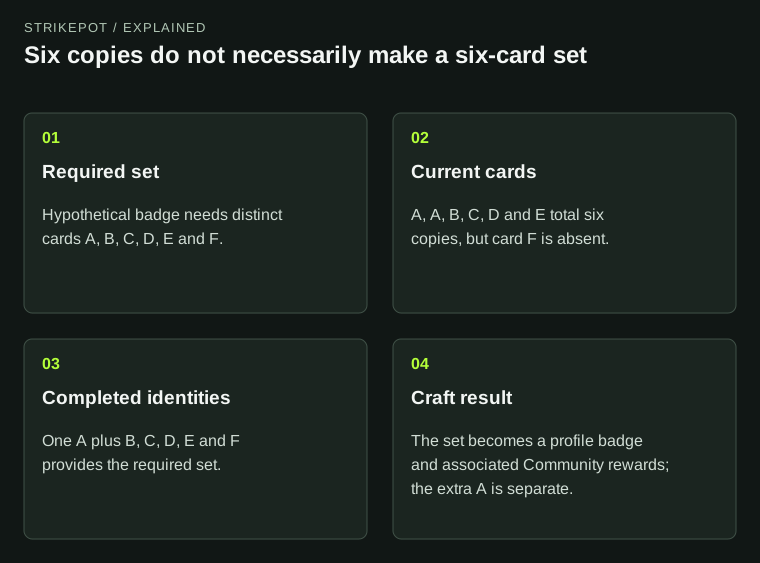
The invented card labels show why quantities, complete sets and in-game item ownership are different concepts.
The game name connects the artwork, not every item system
Valve describes Steam Community items as ways to decorate a profile or express yourself in Steam Chat. Cards, backgrounds and emoticons can use a game's characters or artwork without becoming equipment that the game can load.
For example, a TF2-themed card should be identified by its actual item type rather than by the familiar artwork. The fact that it depicts the same universe as an in-game item does not establish the same use, rarity rules or crafting recipe.
The same reasoning applies to Workshop pages. A favourite design, a card and a released cosmetic can share a subject while recording different actions. The Workshop ownership guide explains that separate distinction. Start with the item's category before looking for an effect inside a game.
A complete set means the required card identities, not a total count
Valve's Trading Cards overview describes turning a collected set into a game badge. The set has required entries; duplicate copies of one entry do not replace a different missing entry.
Consider a hypothetical set with six distinct cards, labelled A through F. You hold A, A, B, C, D and E. You have six cards in total, but you do not have the complete set because F is missing. Adding another A would increase the quantity without completing the required identities.
That is why your badge progress page is more useful than a quick inventory count. Read which cards are present and which are still needed. If an export groups items by name, keep quantity and distinct card identity separate. Six rows, six copies and six required cards are not necessarily the same thing.
Crafting changes the form of the collection
Crafting turns a full set into an account-tied badge and the relevant rewards. It is a conversion, so do not treat the craft button as merely selecting which card artwork to display. Valve's overview says collecting the set again is how you level a badge further.
For the fictional A-to-F set, completing one set gives you one available craft. If you intend to keep a particular extra card as a collectible, count that separately from the copy needed by the set. Decide what you want to keep before carrying out the conversion.
| Record | What it represents |
|---|---|
| Trading Card | A collectible entry that can help complete a card set |
| Game badge | An account-tied profile record created from the set |
| Steam XP and Level | Profile-system progress contributed by badges |
| Background or emoticon | A Community customization item, with its own inventory status |
The badge and the reward item should also be distinguished from each other. Having the badge does not mean every possible background or emoticon for that game was granted. Read the actual craft result rather than treating the game theme as a promise of a complete reward collection.
Steam XP belongs to the profile, not a campaign or competitive rank
The official FAQ says a normal game-badge craft grants 100 XP and describes profile-related benefits such as customization and friends-list capacity. It also explains that later Steam Level ranges require more XP per level.
Do not translate that into one badge always equals one level. Whether a particular craft crosses a level boundary depends on the account's existing XP and the relevant range. A 100 XP increase and a one-level increase are different measurements.
Likewise, Steam Level is not your CS2 rank, a Rust character attribute or TF2 gameplay progress. It can communicate participation in Steam's profile systems, but it is not evidence that an account's owner is trustworthy in a transaction. Evaluate the actual trade and its recipient instead of using a visible level as a substitute.
More playtime does not promise unlimited card drops
Valve's FAQ describes limited gameplay drops for most participating games, commonly around part of the set rather than all of it. Free-to-play titles use a different eligibility arrangement linked to in-game purchasing. The account's badge information is the relevant place to check remaining drops.
This means another long session is not a general solution for every missing card. First check whether any drops remain. Do not spend in a game solely because a card might eventually appear; the profile collectible is a separate optional outcome from the content purchase.
Booster packs are also described as random awards for eligible users. Eligibility is different from a scheduled entitlement. A player seeing no pack after a particular number of days has not established that Steam missed a guaranteed delivery.
Use the inventory result for any later trade or sale
Cards and some Community rewards can have trade or Market routes, but check the specific item's current description and account restrictions. Having a profile badge does not make every related item available for every action.
If you independently decide to trade a duplicate, follow the trade-offer checking guide. If something you expected from a craft or transfer is absent, distinguish the badge, the reward and the card before using the missing-inventory guide. That gives the investigation a concrete target.
The useful choice is about the form of collection you want: keep cards, complete a badge or use a particular Community reward. Read the set and the result in those terms. There is no need to treat profile crafting as a route to game content that it does not promise.