
A Steam review percentage is the share of the counted reviews that recommend a game. It is not an average score out of one hundred, and it does not mean that the same percentage of all players had a good experience. Read the time window and review count before deciding what the headline tells you.
When a game's recent and overall labels disagree, neither has to be wrong. They describe different slices of its history. The next useful step is to learn what changed and whether that change affects the way you want to play.
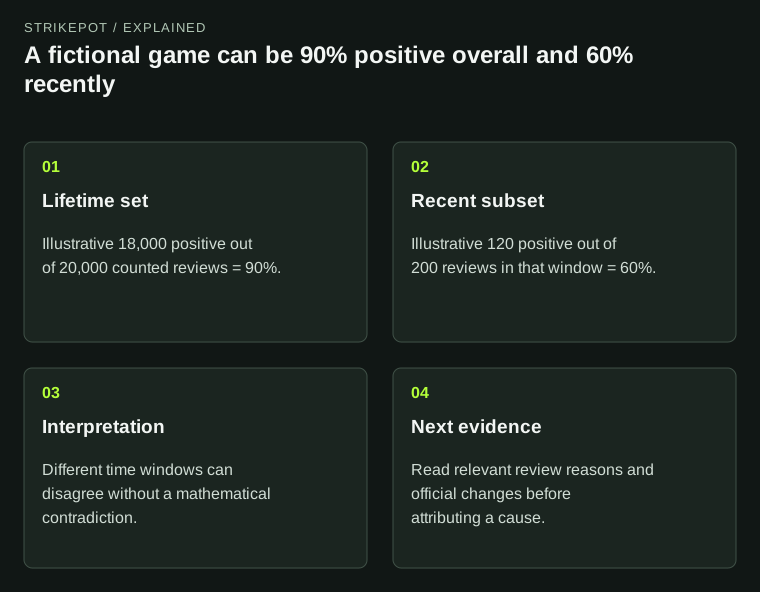
Invented counts explain the relationship between a recent subset and the lifetime total; no current game's score was measured.
A recommendation compresses a complicated opinion
Steam's review explanation frames reviews around whether a player recommends the product. Two positive reviews can therefore have very different meanings: one player may love everything, while another recommends it despite a specific limitation.
Read the text to recover that context. A positive recommendation can still describe performance problems or an unsupported mode. A negative recommendation can praise the core game while objecting to its current value, technical condition or a change that matters to that author.
For a player choosing a survival game, those differences are practical. A complaint about the exact co-op feature you need may be more relevant than a general compliment about the art. The headline is an efficient signal for where to look, not a replacement for the question you are trying to answer.
Recent and overall results can move in different directions
Valve's review documentation describes a recent summary covering the past 30 days and another covering the product's lifetime. A long-established title can retain a strong overall result while a smaller recent group is much less satisfied.
Consider a fictional game with 20,000 counted reviews, of which 18,000 are positive. Its overall share is 90%. Suppose 200 of those reviews fall in a recent window and 120 of those are positive. The recent share is 60%. These invented figures are mathematically compatible: the recent group is only a small part of the lifetime total.
The comparison raises a question rather than answering it. Did a release change the game? Did a particular server problem affect recent players? Are expectations different for a new group? To establish a cause, compare the recent review text with the developer's actual announcements. The percentages alone cannot prove one.
Counts and selection affect the story
A percentage based on twenty reviews and the same percentage based on twenty thousand describe very different amounts of recorded opinion. Neither is automatically representative of everyone who played. Reviews come from people who chose to write them.
That last point is an editorial interpretation of the evidence, not a claim that Steam publishes a satisfaction survey. A review system records expressed recommendations. It does not observe every silent player's experience or show why every nonreviewer stayed silent.
In a small illustrative sample, changing one recommendation out of twenty changes the share by five percentage points. In a set of twenty thousand, one changed recommendation has a much smaller numerical effect. That is why a small recent count can move sharply without establishing that an entire community suddenly changed its mind.
The displayed text and headline score can use different populations
Eligibility to write a review and inclusion in a paid game's headline score are different questions. Valve allows reviews from people who played products acquired through routes such as keys, while its scoring documentation distinguishes those reviews from qualifying Steam purchases.
A useful review does not become useless because its purchase label differs. The label tells you something about the acquisition route and score treatment, not whether the author's description of a menu or mode is accurate. Assess the claim on its evidence and relevance.
When comparing an article, exported dataset or filtered page, preserve the selection used. Valve's review-data documentation separates purchase type, language, dates and off-topic filtering. A count taken under one selection should not be presented as though it were automatically identical to another page's headline.
Playtime needs a date and a question
Steam's review records distinguish lifetime playtime from playtime at the moment a review was written. They also distinguish the review's creation and update times. A screenshot showing a large current playtime number may therefore omit the author's experience when the original text was posted.
Do not use time alone as a credibility test. A short session can reveal an immediate launch failure. A long session can give context about a later progression issue. Those are different claims, and each should be evaluated at the point where the relevant experience occurs.
A long-playtime negative review is not necessarily self-contradictory either. The author may have enjoyed an earlier version, disliked a later change or concluded that the game no longer suits new players. Read the reason and version context before replacing it with an assumption about their motives.
Turn the disagreement into a specific investigation
Start by naming your intended use: a particular online mode, a supported operating system, a campaign or a certain control setup. Read recent positive and negative accounts about that use, then compare any claimed change with primary developer information.
For performance complaints, separate reports about installation from reports about play. The download guide covers one stage, while the CS2 file-verification guide addresses a specific installation check. Neither guarantees that a review's underlying game-performance concern is solved.
Also match the product you are evaluating. A demo, an older edition or a key listing may have a different content scope. The product-delivery guide helps establish that identity before a purchase.
A good reading ends with a concrete conclusion: this recent complaint affects my intended mode and is still unresolved, or this limitation concerns a feature I do not plan to use. That conclusion is more useful than choosing one percentage and treating it as a verdict for every player.