
Three websites displaying the same skin price do not necessarily provide three independent pieces of market evidence. They may be showing one underlying feed, an estimate derived from that feed or different summaries of overlapping transactions. Count the underlying observations before counting the screens.
This is not a claim that any undisclosed provider relationship exists. It is a way to read documented source labels and keep unknown provenance unknown. Agreement is more useful when you can explain what actually agrees.
The conceptual provenance map describes a hypothetical chain and makes no claim about undisclosed provider relationships.
Distinguish the display, the dataset and the estimate
A display is where you read a number. A dataset is the collection of records used to produce it. An estimate is a calculation made from inputs and assumptions. One dataset can support several displays and several estimates without creating additional transactions.
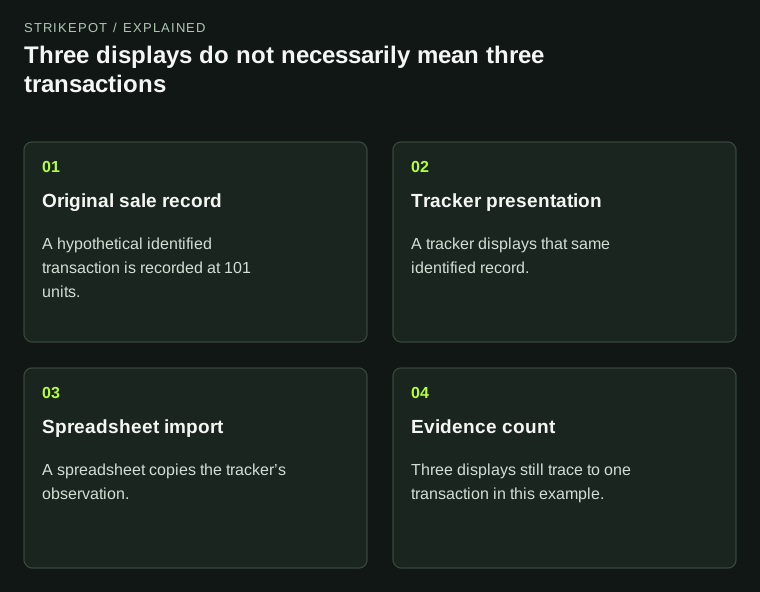
Imagine a hypothetical marketplace sale recorded at 101 units. A tracker copies that record, and a personal spreadsheet imports the tracker. You now have three places showing 101. You still have one recorded sale in this example, not three matching completed transactions.
If you cannot trace a displayed amount, label its source as unconfirmed. An identical number does not prove copying, just as a different number does not prove independence. Rounding, timing and the choice of summary can create either agreement or disagreement.
Published models can share inputs with their references
CSFloat's October 2023 appraisal explanation describes a blended marketplace reference and a model trained on its sales. That is a dated description of a derived estimate. It should not be counted as an additional completed sale merely because it appears beside a listing.
The appraisal guide explains that particular model's published limits. For an evidence map, the key question is which inputs support the prediction. A model can add useful interpretation without adding a new transaction observation.
Do not assume the 2023 feature list completely describes the model currently serving a page. Preserve the publication date and avoid inventing present input weights. If a newer specification is unavailable, the exact current dependence remains unconfirmed.
Duplicating a source can change a combined result
Consider two invented, genuinely separate observations of the same compatible measure: Source A reports 10 units and Source B reports 14. An equally weighted mean across those two observations is 12.
Now add a third display that merely repeats Source A. Treating all three displays as separate sources gives (10 + 10 + 14) ÷ 3, or about 11.33. The duplicate has shifted the result toward A, despite adding no independent observation in the constructed example.
This does not mean equal weighting is always the correct market method. It isolates one error: a calculation can change because you duplicated an input. A more complicated weighted model can suffer the same problem if one underlying dataset enters under several labels.
Do not solve that by automatically deleting matching values. Independent observations may legitimately be equal. Deduplication needs a record identity or documented provenance, not a rule that every repeated price must be a copy.
The kind of number can reveal its lineage
CS Deals' price documentation distinguishes a Steam-derived reference from its lowest live listing amount. That label establishes different meanings within one response. It does not imply two independent cash transactions occurred.
When a comparison combines a marketplace's live ask with a Steam-derived reference, preserve both labels. If another tracker uses that same underlying reference, the tracker may be another view of the reference rather than a new marketplace sale.
The Wallet-versus-cashout guide supplies the separate balance distinction. Source lineage and balance type both matter: even independent observations can answer incompatible questions if one describes Wallet credit and another a cash-sale basis.
Separate organizations do not automatically supply statistically independent samples either. Their records may concern overlapping periods, the same narrow item population or different measures of a shared reference. You do not need to resolve every relationship to report a comparison. You do need to avoid claiming a known number of independent observations when the available documentation identifies only a number of displayed estimates.
Build a small provenance record
For each important number, record the visible provider, named underlying source where disclosed, price type, item identity, period and timestamp. Add whether it is copied, aggregated, converted or model-derived. Leave a field unknown when documentation does not establish it.
| Hypothetical record | Underlying evidence | What it adds |
|---|---|---|
| Marketplace sale row | One identified completed sale | An observed transaction |
| Tracker displaying that row | The same identified sale | Another presentation |
| Model using that sale and other inputs | A derived calculation | An estimate with stated assumptions |
A model may use many additional records, but you should not invent how many or how independent they are. Documented provenance is more informative than a confident “three sources confirm” statement with no account of their relationships.
Use agreement as a question, not a confidence score
If several sources agree, ask whether they concern the same item, time, currency and price basis. Then ask whether their underlying data is distinct. Agreement after those checks may strengthen a descriptive comparison, but it still does not guarantee a future selling price.
If they disagree, trace the same fields before deciding which is wrong. One may summarize older sales while another displays a current ask; one may use a model while another has a direct transaction record. The website-comparison guide helps establish the task first. A useful evidence record then explains the sources' roles instead of awarding confidence for the number of open tabs.