
A blank skin-price cell can mean that no listing amount exists in a valid response, that the item could not be matched or that the refresh failed. A zero count may be a meaningful observation. None of those states automatically means a skin traded for zero.
If a price board or spreadsheet converts every blank into a number, it can draw a dramatic market move that never occurred. Preserve what happened to the observation as well as what happened to the amount.
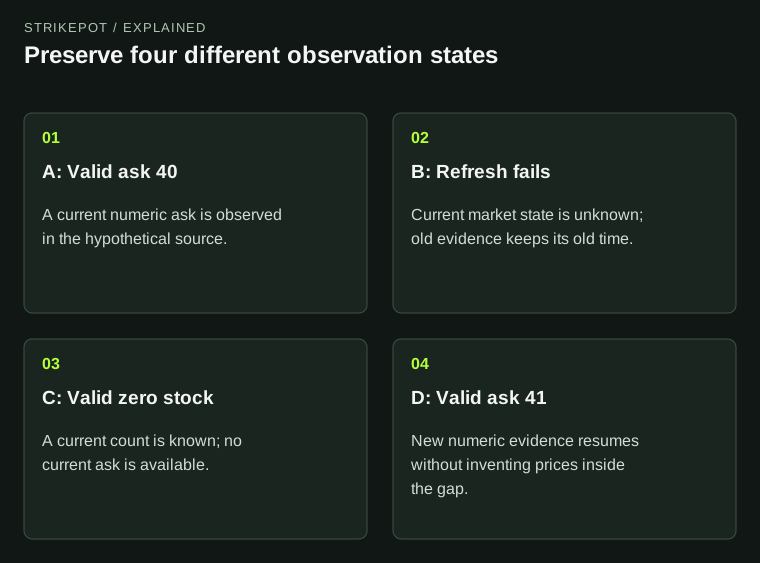
A state-aware log avoids fabricating the 40-to-zero-to-41 crash created by filling missing prices with zero. Values are hypothetical.
Separate the response state from the market state
First ask whether you obtained a valid new record. Only then ask what that record says about price or availability. An unavailable response cannot establish the current stock level, even if your spreadsheet displays zero because it needs something to put in the cell.
Skinport's error documentation distinguishes request and server errors using identifiers and messages. Those are collection outcomes. They do not describe completed sales or a new valuation of the affected items.
By contrast, a valid record may explicitly report no available copies. Skinport's item schema pairs zero quantity with null listing-price measures. Preserve those different fields: the count can be known while the current listing amount is absent.
A four-observation example
Consider a hypothetical research log for one item and one currency. All figures are invented. At the first check, a valid current asking amount is 40. At the second, the source is unavailable. At the third, a valid record shows zero current stock and no asking amount. At the fourth, a valid asking amount of 41 appears.
| Check | Collection result | Current amount | What you can say |
|---|---|---|---|
| A | Valid record | 40 | An ask was observed |
| B | Refresh failed | Unknown | No new market observation |
| C | Valid empty-stock record | Not available | The selected source reports no current stock |
| D | Valid record | 41 | An ask was observed again |
A chart that substitutes zero for both B and C draws 40, 0, 0, 41. It depicts collapses and rebounds created by the substitution. The source never supplied a zero-unit asking amount in this example.
A chart that carries 40 forward through both missing amounts avoids that false crash, but creates another risk: it may look as though a fresh 40-unit offer existed throughout. If you carry a value for continuity, identify it as the last observed amount and retain its age.
Different gaps need different follow-up checks
For a failed refresh, preserve the last valid observation and the failed attempt time separately. Retry only under the provider's documented limits. Do not overwrite the source time with the retry time if you still have the same old data.
For a valid empty-stock record, check whether your question requires a current offer or a historical reference. An older transaction measure can supply context, but it cannot fill the missing current-offer field without changing the meaning of that column.
For an unmatched identity, check game, full name and any relevant version. “No row matched my lookup” is a statement about the lookup, not a demonstrated stock count of zero. The out-of-stock guide explains why historical evidence can remain available separately.
Validate the response shape before reading a price field. A successfully downloaded error message can still be an error, and a missing field can signal a changed schema rather than an empty market. Retain the response status and interpretation so a later review can distinguish those cases.
A cache confirmation is another distinct state
Some interfaces can confirm that the previously retrieved representation has not changed instead of sending a new body. CS Deals documents this behavior through ETags and a 304 response. In that documented situation, an absent body is not an instruction to delete the cached data.
This is different from a failed request and different from a new empty-stock record. The cached representation remains the relevant representation, with its own generation time. Keep the confirmation time separate so the display does not pretend the underlying record was newly generated.
Read the actual supplier's rules. Do not apply one provider's cache interpretation to an unrelated error code or an ordinary empty array. Similar-looking gaps can arise at different stages of data collection.
Missing-data policy changes calculations
In the invented four-check log, replacing both missing amounts with zero creates an average of 20.25. Averaging only the two observed numeric asks gives 40.50. Neither is the average transaction price, because the observations concern asks and the log contains no completed-sale records.
The second calculation is accurately labeled an average of the two observed asking amounts. It does not establish what happened during the gap, and it may not represent an evenly sampled period. A large missing interval cannot be repaired simply by ignoring it.
If the total concerns an inventory, show the priced subtotal and unpriced remainder instead of burying blanks in zeroes. The inventory-coverage guide helps distinguish operational eligibility from a loading or matching problem. The data-state diagnosis comes first.
Make the board readable when evidence is incomplete
A practical display can say “last observed ask 40,” “no current ask in valid response,” or “refresh unavailable,” according to the record. These short labels tell a reader more than a precise zero that has no supporting observation.
Keep raw records and status fields in your saved data. A later successful refresh can restore current information, but it does not retroactively establish what occurred during the missing interval. If a surprising chart movement coincides with a change in collection state, inspect that change before writing a market explanation.