
If an inventory tool prices 15 of your 20 items, the number it adds up is a priced subtotal. Calling it the value of the whole inventory hides the five unresolved items. Replacing their missing prices with zero hides the gap even more completely.
A useful valuation reports both the arithmetic and its coverage. You need to know which items were seen, which were matched to an appropriate reference and which remained unknown. A neat total cannot compensate for an incomplete population.
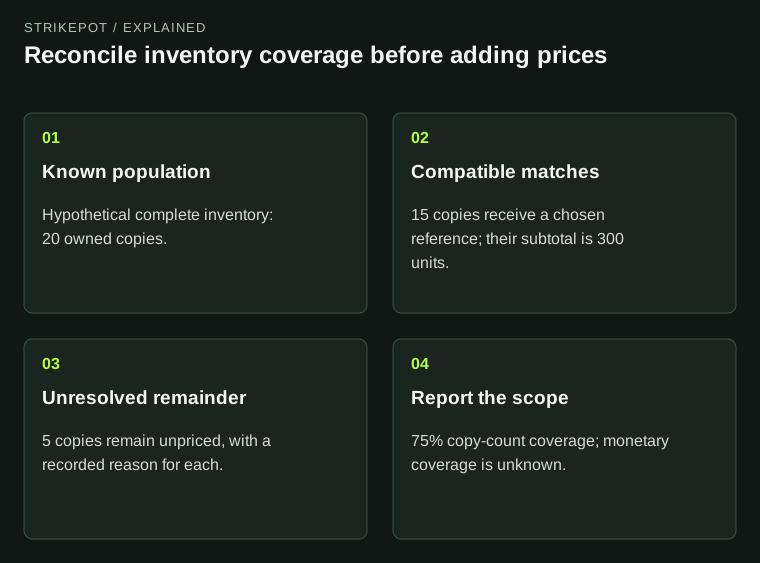
The coverage diagram prevents a priced subtotal from being presented as a complete inventory value. Figures are hypothetical.
Reconcile the item count before the money
Begin with the inventory list you intend to value at a stated time. Keep the game, full item identity, quantity and relevant restrictions. Record whether the list itself is complete. A partial inventory view and a complete inventory with partial pricing are different problems.
Suppose a hypothetical complete list contains 20 copies. Fifteen receive compatible prices and five do not. The matched reference subtotal is 300 currency units. Report “300 units across 15 priced copies; five copies unpriced.” You can also state 75% coverage by copy count.
Do not report “inventory worth 300” without the qualifier. Nor can you claim that 75% of the inventory's monetary value is covered: the missing values are exactly what you do not know. The five unknown copies might be ordinary, unusual or outside the source's coverage.
Separate the reasons a price is missing
An unmatched name, a valid out-of-stock record and an unavailable response need different follow-up work. Treating them all as one blank cell makes it harder to see whether you need a corrected item key, a different reference basis or a later successful retrieval.
| Pricing state | What is known | Useful follow-up |
|---|---|---|
| Matched current reference | The chosen source supplies a compatible amount | Retain its basis and timestamp |
| Matched record, no current listing amount | Identity exists; that amount is absent | Keep any historical basis separate |
| No suitable identity match | Coverage is unresolved | Check game, full name and variant |
| Source unavailable | No valid new observation was obtained | Retain the last valid record with its age |
For a documented example of separate availability and price fields, CS Deals' price snapshot distinguishes stock from a missing lowest listing amount. Skinport's out-of-stock data separately retains historical sale information. Neither circumstance means an owned item has zero value.
High coverage by count can still miss the main item
Imagine a second hypothetical inventory with 90 ordinary copies priced at one unit each and one unusual copy without a suitable reference. Ninety of 91 copies are priced: about 98.9% count coverage. The priced subtotal is 90 units.
That high coverage percentage tells you almost nothing about the unknown copy's contribution. If it is the reason the owner requested a valuation, the analysis has missed its central question despite matching nearly every item.
Highlight unresolved items individually when their characteristics make a broad reference unsuitable. Do not assign an invented premium to make the table feel complete. Equally, avoid treating a generic finish reference as a precise appraisal of a distinctive craft or pattern. Document why the match is broad.
A correct join matters as much as a correct price
Inventory valuation often combines an owned-item list with a separate price table. A match on a shortened name can assign one variant's price to another. A price table with more than one matching row can multiply the inventory rows and inflate both count and subtotal.
Check that each owned copy receives the intended number of matches. Usually that is one chosen reference, although an analysis may deliberately retain several alternative bases in separate columns. It should not silently create two owned copies because a reference source has two variants.
The catalogue-data guide explains grouped records. Retain game and the necessary full identity fields through the matching process. After the join, reconcile back to the original owned quantity before trusting the total.
Do not fill every gap with a different kind of number
You may find an asking price for one item, a historical average for another and a current direct sale quote for a third. Adding them produces a numerical subtotal, but it mixes questions. It is neither a consistent replacement estimate nor a complete cash-sale quote.
If different bases are necessary, label each row and keep separate subtotals. You could show a current-reference subtotal, a historical-reference subtotal and unpriced rows. Explain why they were not combined into one supposedly comparable amount.
A transfer restriction is another separate field. It may affect whether an item can enter a particular sale now, but it does not turn its reference price into zero. The mixed-inventory coverage guide helps distinguish game support, item eligibility and batch rules before you seek actual quotes.
Publish a valuation record someone can audit
Keep four quantities visible: the known inventory population, the observed population, the priced population and the unresolved remainder. State whether each counts rows, copies or distinct item types. Three repeated copies and three different skins are different descriptions even if both sum to three.
Then attach currency, valuation basis, source time and any carried-forward amounts. A known subtotal can be useful for tracking, but it is not automatically a minimum cashout or an achievable offer. Selling costs, eligibility and buyer availability are outside that particular sum.
The next useful action is the one that resolves the biggest gap: recover an incomplete inventory list, fix an identity mismatch or seek a suitable reference for an unusual item. A transparent subtotal gives you that direction. A falsely complete total conceals it.