
A sale quote for eight of ten items cannot be compared directly with a quote covering all ten. The partial quote leaves you with both money and unsold inventory. To compare complete alternatives, account for that remainder without pretending it has already sold.
This is a scope problem before it is a fee problem. Start with a fixed list of the items you want the comparison to cover. Then establish exactly which copies each offer accepts and what happens to everything else.
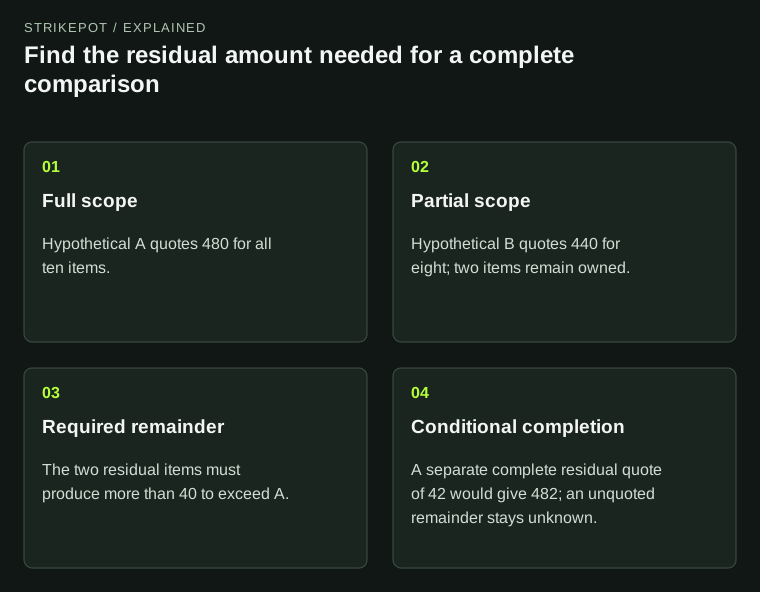
The comparison accounts for every original item and keeps conditional residual proceeds distinct from an established quote.
Keep the original inventory list beside both quotes
Give every intended item a stable reference and record its game, full identity and quantity. Mark each quote as accepted, excluded or unconfirmed for that item. A headline total does not explain whether the service priced the whole selection.
Current acceptance can be narrower than general game support. For a documented example, CS Deals' Rust instant-sell schema includes accepted capacity and reasons a row cannot currently be sold through that route. That is item-level information, not a promise that an entire inventory will receive an offer.
The mixed-inventory guide explains game, item and batch eligibility. Once those checks identify the eligible sets, this comparison calculates what the different scopes mean for the outcome.
A partial quote can look stronger per accepted item
Use an entirely hypothetical ten-item batch in one currency. Route A offers a complete receiving amount of 480 for all ten. Route B offers 440 for eight and leaves two unaccepted. These are constructed net amounts, not current platform prices or fee schedules.
| Hypothetical route | Accepted items | Quoted receiving amount | Remaining items |
|---|---|---|---|
| A | All 10 | 480 | 0 |
| B | 8 of 10 | 440 | 2 |
Dividing gives 48 per item for A and 55 per accepted item for B. Those averages do not identify the better complete alternative. B may simply be accepting the eight items with stronger individual quotes while leaving the difficult remainder.
You still own the two remaining items under B. Their value is not zero, but their sale proceeds are not established. Describe B as 440 quoted plus two retained items, until you have enough evidence to price a separate completion route.
Calculate the remainder needed to change the comparison
For B's complete cash outcome to exceed A's 480, the two residual items must together produce more than 40 in additional complete receiving amounts. That is the arithmetic threshold: 480 minus 440.
If a separate eligible quote for the remainder gives 42 after its disclosed deductions, the constructed complete alternative is 440 + 42, or 482. It exceeds A by two under the stated assumptions. If the remainder gives only 35, the complete alternative is 475.
Without a suitable residual quote, do not insert an old market average and call the result confirmed proceeds. You can show a scenario: “If the remainder produced 42, the total would be 482.” Keep the conditional wording attached to the number.
No probability of obtaining that remainder is established here. The threshold tells you what additional evidence would matter. It does not tell you that the residual sale will occur, how long it will take or which route you should choose.
Do not prorate a whole-batch quote without permission from its terms
To compare only the eight-item overlap, you need an appropriate eight-item quote from A as well. Taking 80% of A's 480 assumes its amounts are linear across items. That may be false if items have different prices, a fixed payment deduction applies or eligibility changes with the batch.
The same issue applies when adding a separate remainder route. Check whether each receiving amount already includes its own fixed costs. Do not subtract a cost twice, and do not assume one batch's payment terms carry over to another.
The net-amount guide handles that arithmetic within each actual quote. The complete-scope comparison begins with those resolved amounts rather than applying a generic rate to every item.
The output type must also match
A partial quote credited as site balance is not automatically comparable with a complete bank receiving amount. Keep the destination and spending restrictions attached to every total. A numerical sum across unlike balance types can conceal the very difference you need to evaluate.
SkinSwap's current selling instructions distinguish its selected-item Sell route and payout method from selling for site balance on its Trade page. That documentation is an example of why the route label matters; the hypothetical A and B calculations do not represent SkinSwap or CS Deals offers.
If the residual items would be exchanged for replacements rather than sold, describe that as a different final outcome. Do not add the replacement's asking amount to received money and label the sum a cash payout.
Choose from complete records, including the unfinished work
Keep the complete-item list, both original quotes, any residual quote, output types and observation times. State whether each alternative ends with all items sold or leaves a named remainder. Refresh expired quotes before relying on their combination.
A two-unit difference between invented complete outcomes should remain a two-unit conditional comparison, not become a universal platform ranking. Extra listing actions, uncertain residual acceptance and separate receiving stages may matter to the person completing the sale even when you have not assigned them invented monetary values.
The useful result is a precise next check: establish whether the remainder can produce more than 40 under a compatible receiving basis. Until then, you know the confirmed scope of each offer and the condition that would change the comparison. That is a stronger answer than choosing whichever per-item average looks higher.