
An inventory can have a replacement estimate of 190 units, a historical reference subtotal of 174 and a current sale quote of 143 without any arithmetic error. The totals answer different questions. Trouble starts when all three are presented under the single label “inventory value.”
Choose the question before choosing the price field. What would comparable items cost to obtain? What do selected past transactions describe? What does a particular eligible sale route currently quote? A consistent inventory report can show all three while keeping their meanings separate.
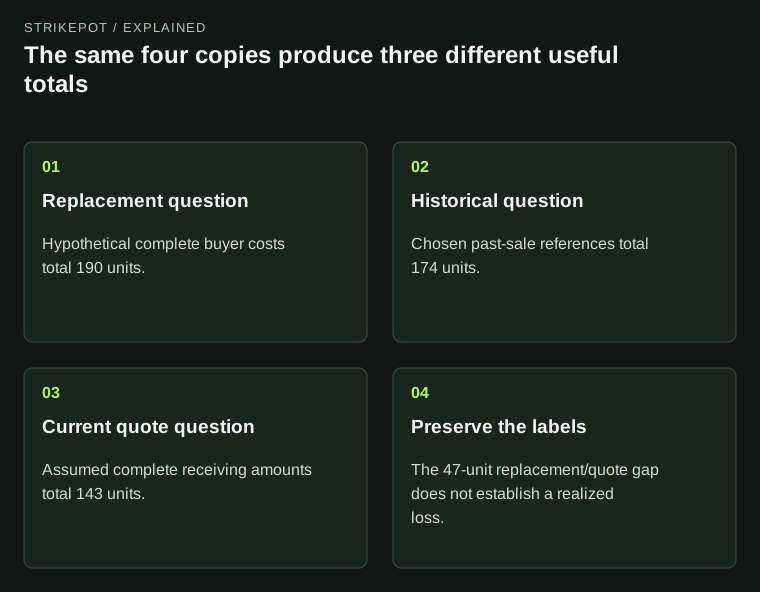
All three columns cover the same invented inventory; only the valuation basis changes.
Replacement cost asks what obtaining the items would require
A replacement estimate starts from suitable current offers for the items you want to reproduce. It concerns buying, so the relevant basis is the buyer's total cost, including the disclosed costs that belong to that purchase.
It also needs enough suitable copies. One inexpensive listing does not establish the price of replacing four copies, and a generic offer may not reproduce an unusual float or craft. Set the replacement specification first: identical item, close substitute or ordinary example of the same finish.
Record what remains unmatched. A cosmetically acceptable substitute can answer a practical equipment question, but it is not evidence that the original exact item can be replaced for that amount. The listing-evidence guide helps turn those preferences into checks you can actually verify.
A historical reference describes a selected past sample
A transaction reference uses completed-sale evidence from a stated source and period. Its usefulness depends on relevance, sample size and age. It may be a reasonable context for an ordinary item while remaining weak evidence for a distinctive variant.
Skinport's documented history feed supplies sale summaries. Those observations belong to their stated periods. Multiplying a selected historical measure by owned quantities creates a reference subtotal, not a promise that every copy can sell at that measure now.
A model estimate is another possible basis, but it should have its own label. CSFloat's October 2023 appraisal explanation calls the output a prediction. Do not quietly replace absent completed-sale evidence with a model output and continue calling the column observed sales.
A sale quote concerns a particular route and scope
A current quote asks what a service offers for the actual eligible items under its stated conditions. Keep its validity, receiving currency, deductions and output type. A proposed listing price is different: the owner chooses an amount and still needs a transaction.
The quote and net-amount guide explains deductions within a quote. Once that arithmetic is resolved, preserve the resulting basis. An amount already quoted after deductions must not be reduced again simply to make the report look more cautious.
Current quotes can expire or cover only part of a batch. They are evidence of what was offered under particular conditions, not a timeless valuation of the entire account. Keep unaccepted items and unavailable methods outside the quoted total until their treatment is established.
One inventory, three complete calculations
Consider an invented four-copy inventory: two copies of Item A, one B and one C. All figures use the same hypothetical currency. Replacement amounts are assumed complete buyer costs; the sale column is assumed to contain complete receiving amounts under a fictional eligible quote. No figure is a live price or provider rate.
| Item | Copies | Replacement per copy | Historical reference per copy | Sale quote per copy |
|---|---|---|---|---|
| A | 2 | 30 | 27 | 22 |
| B | 1 | 90 | 85 | 70 |
| C | 1 | 40 | 35 | 29 |
| Quantity-weighted total | 4 | 190 | 174 | 143 |
The replacement total is 2 × 30 + 90 + 40. The historical subtotal is 2 × 27 + 85 + 35. The quote total is 2 × 22 + 70 + 29. All four copies are included in each calculation, so this example isolates valuation basis rather than missing coverage.
The 47-unit difference between replacement and quote is not automatically a loss. You have not supplied what the owner originally paid, and buying replacements is not the same operation as selling the existing items. The difference shows that the questions have different price inputs.
Source field names reveal some of the distinctions
CS Deals' price documentation separates a Steam-derived reference, a recommended amount and a lowest live listing amount. The existence of several fields is a reminder to preserve their labels rather than choosing whichever number fills a blank.
Do not infer more precision than the field provides. A grouped minimum is a starting point for finding an offer, while an exact-item quote identifies a specific proposed transaction. A reference price can remain populated even when no compatible current offer is available.
Store the source, date, quantity and basis for every row. If one column mixes currencies, normalize them with explicit rates before summing. If one row uses a different valuation basis, isolate it rather than concealing the difference inside the total.
Acquisition cost belongs in a separate record as well. An item received as a gift can still have a replacement cost and a sale quote. Neither amount tells you what the owner paid. Keep purchase history available when that is the actual question.
Use the total that fits the next decision
For replacing a playing loadout, inspect suitable current offers and complete buyer costs. For describing historical context, retain the sample and its limits. For evaluating an actual sale, examine the eligible current quote and receiving amount.
You can display several totals together as long as their captions state what each one means. The useful question is not which number looks most flattering. It is which measurement answers the task in front of you, with enough evidence to reproduce it.