
The cheapest listing tells you the starting price for one suitable copy, if that offer is still available. It does not establish the cost of buying ten copies. A complete basket needs enough eligible items, with each remaining copy priced at the level where it is actually offered.
That distinction matters when replacing several Rust skins, acquiring matching ordinary items or comparing the cost of rebuilding a collection. Multiplying a headline minimum by your desired quantity ignores both price depth and the conditions that make a listing usable.
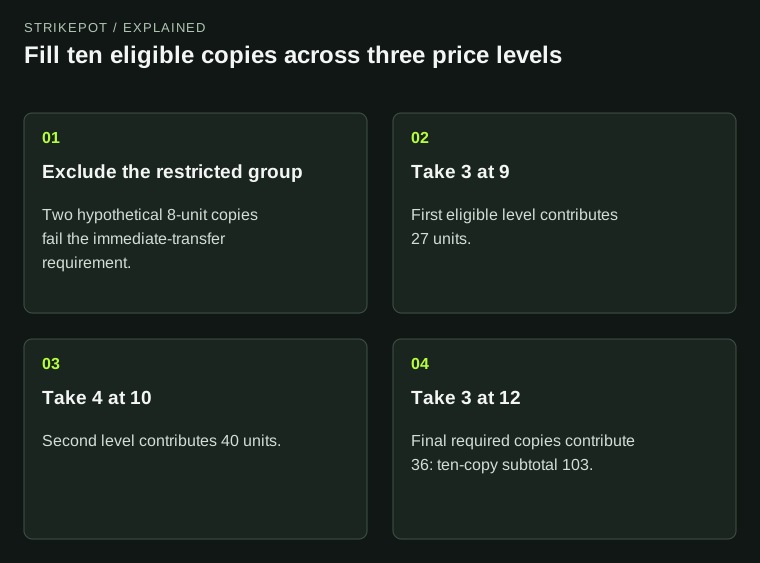
The basket fills the requested quantity using eligible offers; a minimum alone cannot produce this total. All amounts are hypothetical.
Define a suitable copy before counting supply
Decide what the basket must contain. For a commodity-like item, copies may meet the same practical requirement. For a distinctive CS2 item, float, pattern, category and attached details can make one listing an unsuitable replacement even when the finish name matches.
Also define availability. Are items needed for immediate transfer, or can the basket include a stated restriction period? This is a selection condition, not a prediction that every currently restricted offer will remain available until you can use it.
The listing-evidence guide helps make those requirements explicit. A price calculation should begin after unsuitable candidates have been removed, while preserving the reason for their exclusion.
Build the basket from price levels
Use this entirely hypothetical offer set, in one currency. You need ten suitable copies. Every listing meets the same item specification, but the first group fails your requirement for immediate transfer.
| Group | Copies offered | Price per copy | Eligible for this immediate basket? |
|---|---|---|---|
| A | 2 | 8 | No, assumed restriction |
| B | 3 | 9 | Yes |
| C | 4 | 10 | Yes |
| D | 5 | 12 | Yes |
The immediate basket takes three copies at 9, four at 10 and three at 12. The total is 27 + 40 + 36, or 103. Its average unit cost is 10.30. There are enough eligible copies, but not ten copies at either headline minimum.
Multiplying the unrestricted group minimum of 8 by ten produces 80 and includes unusable assumptions. Even multiplying the eligible minimum of 9 by ten produces 90, which assumes seven additional copies exist at a price where only three are offered.
A changed availability rule changes the basket
If you deliberately allow the two restricted copies, and assume they are suitable under that new requirement, the constructed basket changes. It takes two at 8, three at 9, four at 10 and one at 12, totaling 95.
The eight-unit difference between 103 and 95 belongs to different eligibility assumptions. It does not prove that one calculation was wrong or that waiting will save eight units. The offers could change, disappear or have conditions you have not yet established.
Skinport's Items documentation includes a tradable filter. When recording its summary, save the setting explicitly. Do not compare two minima as though they describe the same available set when one dataset includes items excluded by your basket specification.
A fixed budget makes the changed specification concrete. With an invented budget of 100, the 103-unit immediate basket does not fit, while the 95-unit restricted-item scenario does. That does not make the latter a substitute unless its timing meets your requirement. Keep the quantity, budget and eligibility conditions together.
A group count is not a complete price ladder
A row showing a minimum of 9 and quantity of 12 does not reveal how the other 11 copies are priced. You cannot recover the basket total from those two fields alone. A mean or median adds context but still may not identify the cheapest eligible ten-copy combination.
For an example of more detailed supply records, CS Deals documents a book snapshot with one row per copy. Its listing interface supplies item details separately. Those are examples of the information distinction, not a claim that any recorded basket is reserved or executable.
Use listing-level evidence where available. If all you have is a grouped minimum and quantity, label the complete basket cost unknown. A lower bound under stated assumptions is different from a priced basket, and neither is a checkout confirmation.
Price the unfilled remainder honestly
Suppose your immediate-eligibility filter leaves only seven copies, rather than the twelve in the table. You can calculate the cost of those seven if their offers are known. The remaining three are unfilled, not free and not automatically available at the last visible price.
Report the quantity shortfall beside the subtotal. If a broader specification would supply replacements, calculate that as a separate basket and name the compromise. Do not silently replace an exact requirement with a cheaper substitute to complete the total.
The Steam chart and order-depth guide explains cumulative quantities. This basket task goes a step further: allocate a required quantity across eligible individual offers, then identify any remainder the snapshot cannot fill.
Keep snapshot arithmetic separate from execution
A basket built from observed offers is a research result at a particular time. It may become stale while you check item details or move between pages. Separate checkouts may also introduce different disclosed costs, so a sum of item amounts is not automatically the complete purchase total.
Recheck the exact offers and final confirmation before any real purchase. Record which costs the table already includes and which remain unconfirmed. Never add an invented payment charge merely to produce a supposedly conservative total.
The practical result is a quantity-aware comparison: ten eligible copies would cost 103 under the invented immediate-basket assumptions. That statement explains its scope. A bare “price 8” cannot do the same work, however prominently the minimum appears on a market page.