
A Rust group has several kinds of membership. A player can be part of the conversation, visible on a group map and trusted to help without yet having the access needed for a particular room. Teams and clans organize people. A base still needs deliberate decisions about doors, building privilege and who is responsible for keeping it usable.
The practical mistake is to treat one successful invitation as a complete onboarding process. Instead, define what the person needs to do, grant the relevant access and verify it. The same distinction matters when someone leaves: removing them from a social group is only one part of reviewing what they could previously reach.
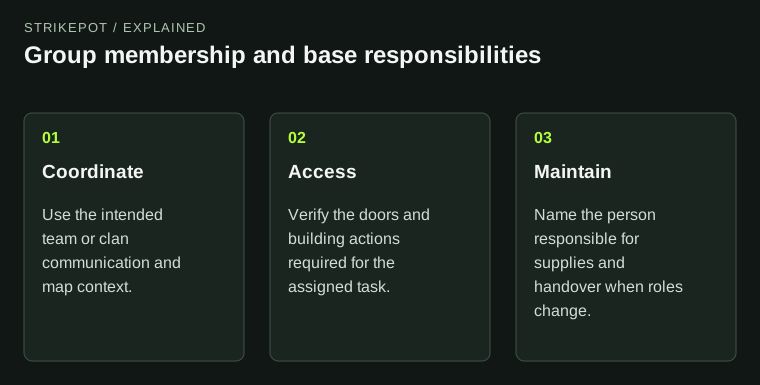
Social membership, physical access and ongoing work require distinct checks.
Coordination is the first layer
The Facepunch-hosted Teams page describes map information, shared markers and team chat. These tools help answer where the group is and what it is trying to do. They reduce the need to repeatedly describe a location in public conversation.
Facepunch introduced the Clan System in July 2026 as a larger organization with roles, separate communication and management at Clan Tables. It also provides group identification and nearby member information. The system is disabled in Hardcore mode.
Those features help a group coordinate, but a membership panel is not evidence that a particular door or building action works for a member. Check the actual action at the actual object. This is especially useful when the group uses a server whose additional systems differ from familiar vanilla behavior.
Give each permission a purpose
The cupboard documentation explicitly says teammates must authorize separately. A code lock controls an entrance through its own credential. To reason clearly about a new member, separate the group relationship from these physical access decisions.
| Question | Evidence to check |
|---|---|
| Can this player coordinate with us? | The intended team or clan membership and communication channel. |
| Can this player enter the required room? | The relevant entrance and its current lock access. |
| Can this player perform the building task? | The cupboard and the privilege shown at that location. |
| Who keeps this area usable? | A named responsibility for supplies, upkeep and handover. |
The last row is a social agreement rather than a separate game credential. It belongs in the same discussion because a room can be accessible to everyone and maintained by nobody. Technical permission is only useful when someone understands the work it enables.
Onboard around a real task
Consider a hypothetical group recruiting a player to help run a farm. The player needs to find the group, enter the intended farming area and understand the supplies and storage arrangement. That is a more precise onboarding goal than giving them every code used anywhere in the compound.
Walk through a normal task together while the group has time. Verify that the player can reach the relevant area, find the supplies and finish without opening an unrelated part of the base. If something fails, describe the exact action. Being unable to enter and being unable to modify an object have different causes.
If the task involves applying owned appearances, use the reskin context guide for that interface. If it involves block appearances, the building-skin guide covers the hammer controls. The group's invitation is not an explanation of either procedure.
Roles work best when they describe decisions
A role title is useful when it tells members which decisions the holder is expected to make. Someone coordinating a supply run may decide the departure time. Someone managing the workshop may decide when its stock needs replenishment. Those responsibilities can be agreed without claiming that every title automatically changes every physical permission.
Keep the role understandable to new members. A long hierarchy that nobody can explain is less useful than a small set of clear responsibilities. When a task crosses areas, arrange a handover rather than broadening access by habit. The goal is to make ordinary cooperation easy to perform and easy to review.
Communication channels also need context. Group chat is useful for current coordination, while a short standing note can explain recurring work. Avoid hiding essential procedures in a message that only one member saw several sessions ago. A member's first successful task should not depend on reconstructing the entire history of the group.
Leaving the group triggers an access review
When membership changes, review what the person actually used: entrances, building areas and any other shared system that mattered to their role. Make deliberate changes through the relevant interfaces and verify the result. Do not infer that every old capability disappeared merely because the person's name left a list.
The review also needs a continuity check for remaining members. Who now supplies the room the player managed? Who understands its layout? Who can complete the next maintenance task? Removing access can be technically successful while leaving an important responsibility unassigned.
Keep any evidence shared with an operator focused on the behavior in question. The screenshot privacy guide helps avoid exposing credentials or unrelated private information while documenting a problem.
A well-organized group can explain three things about a member: how they coordinate, what they can access and what they are expected to maintain. Teams and clans improve the first conversation. Deliberate permission checks and clear responsibilities complete the arrangement.