
Rust Softcore changes the cost of recovering from loss and the timing of some attacks. It still asks players to maintain a base, plan a journey and decide what they are willing to risk. The useful question is which setbacks the mode softens, and whether those rules fit the hours when you can actually play.
Read its recovery rules and raid rules separately. A feature that helps after death does not necessarily protect a structure. A building protected outside a raid window does not make every deployed object untouchable. The mode becomes easier to evaluate when each protection is tied to its trigger and its limits.
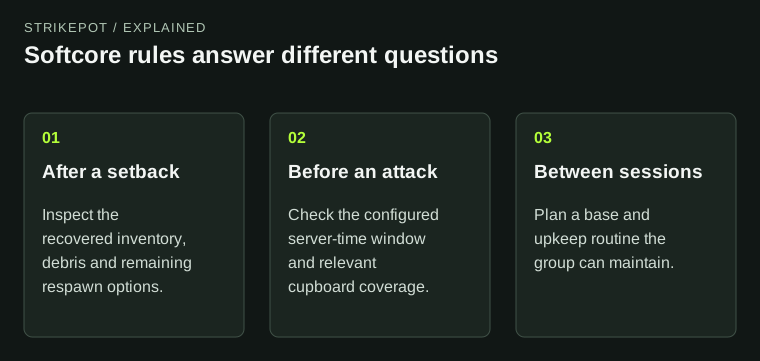
Recovery features, raid conditions and ongoing maintenance influence different parts of the mode.
Use the later recovery system
The April 2025 Soft Refresh removed the Outpost reclaim terminal. It introduced automatic return of 50 percent of inventory after death outside building privilege, calculating stackable recovery from item counts rather than simply half the stacks. A launch-era instruction to run to the terminal describes the older system.
This changes the immediate recovery task. A player should first inspect what actually returned, then decide what is still needed. In a hypothetical failed supply run, the remaining materials might be enough to continue a smaller project at home. Returning to the death location is one possible choice, rather than the only way to regain useful momentum.
Recovery percentages should not be translated into a promise that every death costs only half of whatever matters to the player. Location conditions, the particular inventory and the next task all influence the result. Verify the current outcome and plan around the items present instead of a broad impression of being insured.
Destroyed objects can leave work to recover
The same refresh added repairable debris for selected deployables. The documented split drops half their contents and keeps half for owners. Cupboard debris preserves authorization for 48 hours and restricts repair to previously authorized players. Destroyed bags and beds can provide one final respawn, marked by a skull icon.
These systems create recovery opportunities, not a reason to ignore the layout of a base. A usable remnant still needs the player to return, assess what survives and complete the necessary work. If the area remains contested, the existence of debris does not by itself make reaching it practical.
After a raid, prioritize the function needed next. That could be restoring a workable home, recovering supplies or re-establishing a place from which the group can coordinate. Treat an emergency respawn as a limited opportunity. Select it with a purpose rather than assuming the familiar marker represents an indefinitely available home.
A raid window uses the server's clock
In July 2026, Facepunch added a default Softcore raid window of 18:00–21:00 in the server's local time. Operators can configure the system. Outside the window, qualifying cupboard coverage protects blocks and doors; deployables remain attackable. The cupboard must be at least an hour old. The update also introduced doubled gathering for resources including wood, ore, food and animal loot.
The timezone matters more than a familiar hour printed without context. A group spread across countries should translate the actual server schedule into each member's available hours. A window that suits one player can fall during another's workday or sleep. Your own computer clock does not redefine the server's window.
For an explicitly hypothetical example, two friends each have a two-hour evening session, but their evenings occur at different times. Choosing a server with a nominal evening window does not prove either can be present for it. They need the server's timezone and configured hours before deciding that its schedule fits their group.
Coverage is a condition, not a mood
A raid restriction projected through a cupboard should prompt questions about the actual structure. Is the relevant area covered? Is the cupboard old enough? What objects remain exposed? These checks are more useful than thinking of the whole compound as generally protected because the clock is outside the window.
Build a maintenance routine around the relevant conditions. After moving or establishing a new area, inspect it again. A structure that felt secure yesterday may have a different role today after expansion, damage or replacement. The announced rules themselves give no reason to treat every new object as covered automatically.
The building-appearance guide answers a separate question about changing block skins. A visual change is not evidence of a different raid window or coverage state. Evaluate protection through the mode's applicable rules and current server information.
Progression is faster, but responsibility remains
Soft Refresh also changes the balance through higher door upkeep and reduced player bullet damage. Those differences reinforce the need to read the mode as a package. Faster gathering and recovery opportunities do not eliminate the importance of a manageable base or clear group responsibilities.
Consider the time needed between sessions. A smaller project that the group can maintain may suit its schedule better than a large expansion chosen simply because materials arrive faster. More resources can increase options while also encouraging commitments that take longer to inspect, replenish and recover.
If a death seems inconsistent, the combat-log guide helps examine recorded damage. Keep that evidence separate from an assumption about mode rules. Identify the server and configured game mode before comparing an encounter with a video from another environment.
Softcore is most useful to evaluate through three practical questions: what comes back after a setback, what remains exposed, and when the group can play. Current server rules answer the details. Those answers let players choose a suitable pace without mistaking a gentler recovery system for an absence of loss.