
The best Rust respawn point is the one that offers a useful next action after death. It might be the home base with replacement supplies, a route back to the group or a place from which to restart elsewhere. A long list of bags is less helpful when several entries lead to the same problem and their names no longer mean anything.
Build a respawn network around choices rather than raw coverage. Each point uses attention and, depending on the server, a limited slot. Its value comes from location, availability and what the player can do after arriving. Those three considerations make placement a small part of a broader recovery plan.
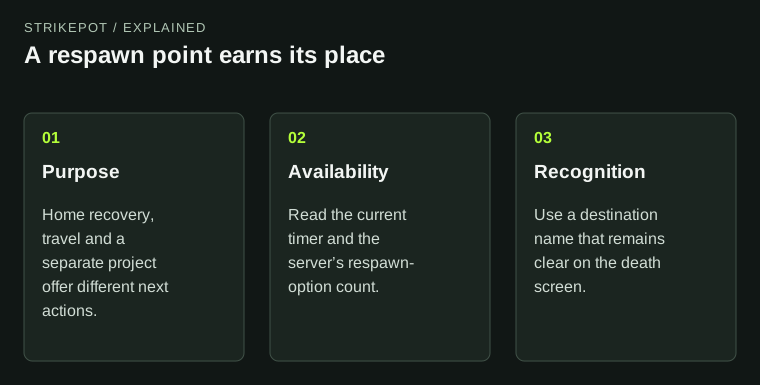
A useful network combines distinct destinations with readable, currently available options.
Separate the point from the recovery it enables
A bag places a respawn option in the world; it does not promise a ready inventory or a safe return to the previous body. The Sleeping Bag documentation describes the assigned location and its cooldown. The Bed documentation describes a more frequently usable indoor alternative.
That gives each placement two questions. Can the point be used when needed, and is its destination useful? A bed can be available sooner while still being poorly placed for a particular task. A bag farther away can offer a better way to regroup when the nearest route is contested. Neither item type is automatically the right answer everywhere.
In a hypothetical three-point network, one point serves home recovery, one serves a routine travel route and one serves a separate project. They are useful because they support different decisions. Placing three objects around one doorway might increase the count without creating a comparable range of choices.
Limits make obsolete bags worth removing
Facepunch's June 2023 respawn update introduced a default maximum of 15 respawn options per player, along with map visibility while alive, unclaiming and count displays. Operators can change or disable the maximum. Treat the current server's count and rules as the applicable limit rather than assuming the launch default is universal.
A quota turns an old placement into a maintenance decision. Once the group has moved its main activity across the map, a point near an abandoned starter may have little purpose. Keeping it merely because it already exists can crowd the list and make future placement more awkward.
Review respawn points after a major move, a lost base or a change of project. The useful question is whether each point still supports a plausible recovery. Removing an obsolete option can improve the list even when the player is not close to the server's maximum, because fewer misleading choices are easier to evaluate under pressure.
Use names that survive a stressful death screen
A name should tell the player where the point is and why it exists. A private joke can be memorable, but several nearly identical jokes are a poor map legend. Think about what will still be clear when the player is trying to coordinate with teammates and decide whether to return.
For example, a group could use distinct names for the main home, the northern travel route and a farm project. The exact wording is a preference, not a game mechanic. Its purpose is to connect each entry to a real destination and prevent a player selecting the wrong one from memory.
Keep that vocabulary consistent in group conversation. Saying that a teammate should use the farm point is more actionable when everyone knows which farm and what that point currently supports. If the project moves, update the group's description along with the placement.
Cooldowns are part of the choice
Read the current respawn interface before committing to a recovery plan. A visible point may still be unavailable on its timer. This article does not assign one universal cooldown or calculate the independence of nearby points from an assumed distance. The current screen supplies the availability that matters to the immediate decision.
Plan for an alternative that is useful in a different way. If the home option is unavailable, does another point allow regrouping, collecting basic supplies or continuing a separate task? An alternative does not have to be the fastest route back to the same fight to have value.
After repeated deaths, pause long enough to evaluate whether the destination still makes sense. Choosing the closest available point automatically can repeat the same failed recovery without changing the circumstances. A planned retreat is also a use for a respawn network.
Assigned points need consent and context
The 2023 update also added a Bag Gifting setting so players can control who may assign points to them: anyone, teammates and friendly contacts, or nobody. That helps keep the list aligned with the player's intended network. Check the setting when an expected assignment fails or unwanted points appear.
When giving a teammate a point, explain its purpose. A location shared without context may be mistaken for a stocked home or an immediate route into a fight. A short description of where it leads and what it supports is more useful than an instruction to respawn there immediately.
New players can use the beginner resource hub to connect recovery planning with the rest of their learning. After an unclear death, the combat-log guide helps examine the recorded damage. Knowing what happened and deciding where to restart are related but separate tasks.
A manageable respawn list gives the player a few clear responses to loss. Review it while alive, retain points with distinct purposes and judge each destination by the next action it makes possible. That produces a more useful network than adding another anonymous bag whenever cloth is available.