
A Rust modular car is a collection of working parts in the server world. Finding one gives you a starting point, not a permanent transport entitlement. The engine, modules, fuel, locks, condition and parking arrangement all influence whether the vehicle will still be useful after the first drive.
This makes a car a small logistics project. Before repairing a roadside find, decide what it needs to carry, where it will be maintained and how the trip ends. A vehicle can save time on a route while creating new work at home, especially when the group has no suitable place to alter or store it.
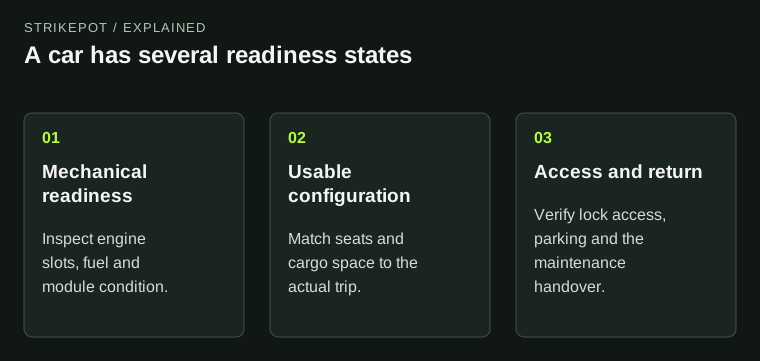
A drivable car is only one stage of a dependable transport plan.
Inspect the actual engine, not an old spawn checklist
Facepunch's original vehicle explanation identifies the basic dependencies: suitable working engine components, Low Grade Fuel and serviceable modules. Repairs and lift access are part of that system. Those dependencies remain more useful than memorizing the exact condition of a car shown in an old launch video.
Before a long journey, inspect the particular engine you intend to rely on. Make a list of the missing or unusable components rather than bringing an assortment and hoping it covers the job. If more than one player is preparing the trip, give one person responsibility for that list. Two people assuming the other supplied the final component can leave a repaired vehicle stranded.
It is useful to separate a first departure check from a return check. The first asks whether the vehicle can do the planned job now. The second asks what the next journey will require after fuel use and damage. Keeping both questions visible turns a one-off repair into a manageable maintenance routine.
Take the same approach to condition. A damaged component, an empty slot and an empty fuel supply are different causes of a car failing to serve the trip. Diagnose the specific dependency before gathering replacements. More fuel cannot fill an empty engine slot, and an installed component is not evidence that every module is healthy.
Choose a configuration for a job
The shipped modular vehicle update made modules craftable while keeping chassis as objects obtained from the world. A vehicle lift is where configuration becomes manageable. That distinction separates having a chassis from having the particular transport layout the group wants.
For a hypothetical supply run, list passengers and cargo before changing modules. A layout that carries the entire group may leave less room for the intended goods; a cargo-focused layout may require a second travel plan for some members. These are choices about the task, not a claim that one configuration is universally optimal.
Crafting knowledge is also separate from possessing the relevant materials and a usable chassis. If research progression is the bottleneck, the current blueprint guide explains the progression system. Learning a recipe does not by itself complete a vehicle project.
Use current lock advice
Car-key instructions from the first vehicle release are obsolete. Facepunch replaced those keys with code locks in December 2022. A lift supports adding, changing or removing them. The documented system restricts mounting and storage access, with specific taxi behavior and central-locking controls.
A lock limits ordinary access; it does not establish permanent possession. The same developer explanation describes ways a damaged or lift-accessible car can be taken over. Parking therefore matters alongside the code. A group should consider who can physically reach the vehicle, not just who was told its credential.
Before leaving on a shared journey, verify the intended passengers can use their seats and the driver understands the current lock state. This is easier to resolve at a planned departure point than during an urgent pickup. A temporary unlocking action should have a clear purpose and a clear end.
Parking is part of maintenance
The original vehicle documentation distinguishes indoor and outdoor decay and gives operators controls over it. That is enough to reject the assumption that a car left outside is a permanent mount. Exact timers from a historical announcement should not be treated as a universal promise for the present server.
Inspect condition as part of returning home. A successful trip can still end with a damaged module, depleted fuel or a vehicle left in an exposed place. The next player who wants to drive should not discover all three only when the group is ready to leave.
A simple handover can state where the car is parked, what remains in it and what needs attention. Avoid treating the vehicle as permanent storage for every valuable item from the trip. Its continuing usefulness depends on the world around it as well as its mechanical state.
Evaluate the route and the fallback together
A road vehicle changes movement, but terrain and the intended destination still matter. Plan where passengers get out, where cargo is unloaded and what the group does if the car cannot make the return. The fallback does not need to be elaborate; it needs to exist before all essential supplies depend on one object.
If controls have been customized, check them in a suitable situation before a demanding journey. The keybind review guide explains how to inspect and preserve deliberate changes. A binding problem is a separate investigation from a missing engine part or locked seat.
The practical question is whether the car improves a repeatable job enough to justify its dependencies. A maintained vehicle with a clear role can do that. A roadside find repaired without a parking, access or return plan may create an extra recovery task at precisely the wrong moment.