
Rust’s November update gives randomly spawned modular cars a more helpful starting inventory. That does not make their supplied engine parts an immediately removable pile of salvage. The update pairs partial pre-equipping with a lock that lasts until the car reaches a lift for the first time.
Those two changes serve different purposes. The first reduces how much assembly is missing when a player encounters a generated car. The second prevents the same starting assistance from becoming freely stripped components at the roadside. Understanding both is essential when reading older vehicle advice or estimating what a discovered car actually provides.
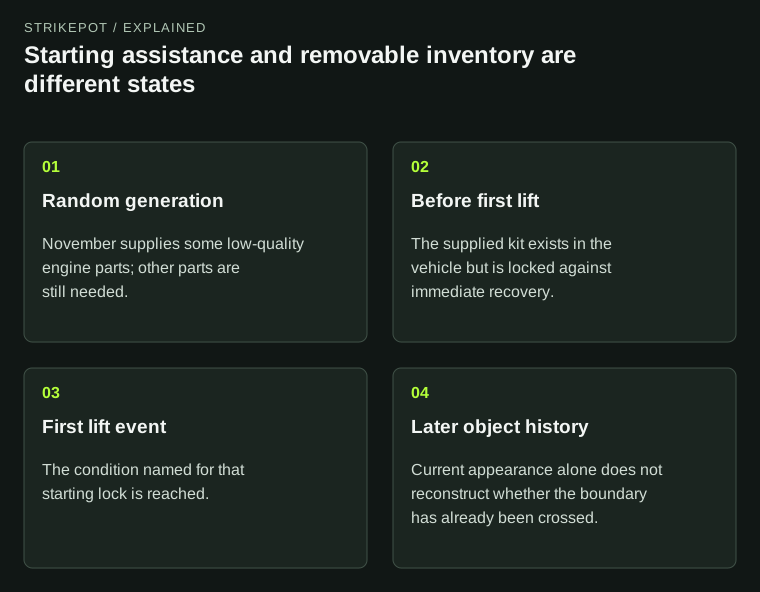
A conceptual state sequence for the November change, without a vehicle-operation tutorial or a forecast of resource prices.
The update changes an initial condition
Facepunch’s November starting-inventory section says randomly spawned modular cars now begin with their engines half-filled with low-quality parts. It expressly says players still need to provide some parts. The supplied components are locked until the vehicle has been loaded onto a car lift for the first time.
The important phrase is “randomly spawned.” The announcement describes how a category of vehicle begins. It does not say that every existing car is refilled whenever someone encounters it, that a previously used car is returned to its initial state, or that every empty slot has become optional.
A starting-state rule and a restoration rule are different designs. Confusing them creates the expectation that a changed generation system should repair an arbitrary object already in the world. The published section does not establish that broader behaviour.
Older instructions can be accurate history and obsolete assumptions
The original 2020 vehicle beta explanation described cars arriving without engine parts. That is useful historical context: it identifies the assembly burden the later update is reducing. It should no longer be used to insist that a November-generated car must have an empty engine.
Consider a hypothetical player reading an old checklist before inspecting a newly generated car. If the checklist assumes every required part must be sourced separately, its initial inventory assumption is now incomplete. The later note changes that assumption without automatically replacing every other vehicle system.
This is why a dated source can remain valuable without remaining current instructions. Preserve the distinction between how the system began and which part of it a newer update explicitly changed. A guide’s publication age alone does not tell you which sentence has been superseded; the actual change does.
Partial completion is not half the total effort
The patch’s “half” describes the supplied starting parts. It does not measure half the time needed to obtain a usable vehicle, half the total material cost or half the inconvenience for every player. Those would require information about what is missing and what the player already has.
Imagine two hypothetical players encountering the same partly equipped engine. One already has the missing types nearby. The other has none of them. The generated starting state is identical, but the remaining effort is not. An equal inventory improvement need not produce an equal reduction in time.
Nor does the low-quality description establish a precise performance increase. The announcement does not publish a before-and-after travel benchmark. It establishes that some assembly work is supplied, leaving a stronger numerical claim about journey time or server-wide vehicle use unmeasured.
The recovery lock separates two kinds of availability
A component can be present in a vehicle while not being freely available as an inventory item. Presence answers whether it contributes to that object’s initial configuration. Recoverability answers whether the player can remove and use it elsewhere at that moment.
Facepunch gives an explicit design reason for the lock: preventing the prefilled components from simply being taken for recycling. The analytical consequence is that the change favours progress toward a functioning vehicle over immediate extraction of the supplied kit. This is an interpretation of the paired rules, not a claim about every player’s actual behaviour.
| Observation | Supported reading | Unsupported shortcut |
|---|---|---|
| Some parts are present at generation. | The initial assembly gap is smaller. | The vehicle is ready for every journey. |
| Supplied parts are locked. | Presence does not yet mean free removal. | The same parts are permanently unusable. |
| The first lift condition is met. | The named starting lock reaches its boundary. | Every other restriction or resource need disappears. |
The table keeps an object’s immediate use and the portability of its contents separate. Neither should be inferred solely from a screenshot showing installed components.
The first lift visit makes history relevant
The rule names a first-time event rather than an indefinitely repeating countdown. Two cars that look similar now can therefore have different relevant histories: one may never have reached a lift, while another may already have crossed that boundary.
That observation changes the evidence needed for a report. “Both engines contain parts” does not establish that both are in the same recovery state. A meaningful comparison includes whether the supplied parts are the ones in question and whether the named first-lift condition has occurred.
This article does not infer the exact interface treatment of every possible replacement, modified-server rule or later transaction. Those behaviours would need their own current documentation or observations. The published initial lock is sufficiently specific to explain why appearance alone is incomplete evidence.
Do not turn a design constraint into an economic forecast
More complete generated vehicles might influence how often players consider using them. Preventing immediate component stripping might influence how that assistance reaches the wider resource economy. Both are plausible consequences; neither is a measured population result in the announcement.
Claims such as “cars will now be twice as common” or “component prices must fall” would need server data, observation periods and a definition of the item being compared. The documented change supplies no such result. It also does not describe a Steam skin reward or a new tradeable entitlement.
For an existing discrepancy, retain the server, build, object history and exact component state. The branch guide explains why matching the software environment matters, and the support-record guide can organize a factual report. The November briefing supplies the surrounding update. The defensible conclusion is specific: generated cars begin closer to assembly, while the supplied parts’ immediate recovery remains deliberately constrained.