
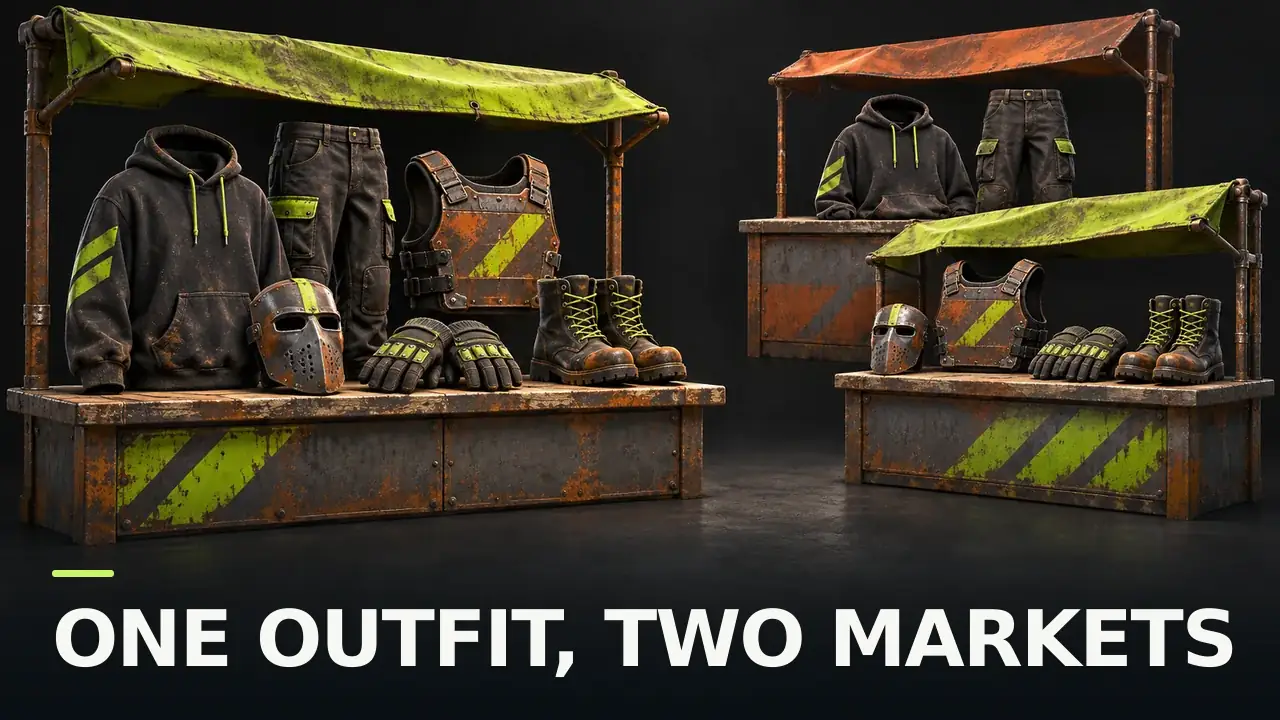
The sum of each Rust skin's cheapest listed price can be lower than the total you would pay to assemble the outfit. A split basket can involve several checkouts, different currencies, funding charges or listings that cannot all be obtained together. Compare the completed outfit in one currency, including the costs of the route you can actually use.
This is a purchasing analysis with a fictional example. It does not report current Rust prices, identify a cheapest operator or promise that the pictured combination is available.
Lock the outfit before comparing the markets
Write down the exact skin required for each clothing or armor slot, with its full item identity and quantity. A lower price for another item in the same slot changes the outfit. Likewise, an unpriced component leaves a partial basket rather than a complete total.
A reference feed, a live listing and the final checkout answer different questions. A reference can help estimate a budget; a listing identifies an offer at the moment it is visible; a checkout incorporates the selected transaction's conditions. The comparison of reference values and executable quotes explains why these numbers should keep their labels.
Check the output too. Steam Wallet spending and an external cash purchase do not use freely interchangeable balances. Valve's Wallet guidance describes that balance's limits. A dollar symbol does not make a Wallet-funded route equivalent to a bank-funded one.
A fictional basket shows where the saving can disappear
Imagine an outfit with four exact components. The numbers below are invented monetary units in one currency. They are not observations from Steam or another market.
| Exact required component | Market A | Market B | Lowest item entry |
|---|---|---|---|
| Head item | 4.00 | 3.50 | 3.50 at B. |
| Chest item | 6.00 | 6.50 | 6.00 at A. |
| Leg item | 3.00 | 2.50 | 2.50 at B. |
| Boot item | 2.00 | 2.50 | 2.00 at A. |
| Item subtotal | 15.00 | 15.00 | 14.00 across A and B. |
Suppose, only for this example, each market adds a 0.75 checkout charge and both let you buy the selected items together. One complete market basket costs 15.75. Splitting the minimum entries costs 14.00 + 0.75 + 0.75 = 15.50. The final saving is 0.25, rather than the 1.00 suggested by the item subtotals.
If an extra 0.50 funding charge applies only to the second route, the split costs 16.00. That reverses the result. The assumed charges exist only to demonstrate the comparison; real marketplaces may include fees in their prices or apply them on a different basis.
Compare the extra cost of splitting, not every fee twice
A useful decision rule is to compare the item saving with the additional cost caused by using more than one route. If both baskets already include the same charge, it does not belong on only one side. If a fee is included in a quoted item total, subtracting or adding it again distorts the result.
Currency conversion can also erase a small saving. Use the rate and conversion charge available for the actual purchase, with their observation time. A feed's converted reference number and your payment provider's final charge need not match. Do not present an unknown conversion cost as zero.
Minimum funding can leave a remainder on a service. Record the cash needed to complete the purchase and any balance left afterward separately. The remainder may still be usable under that service's rules, but it is not the same result as keeping that money in your original payment account.
Availability can break an apparently complete basket
A split plan remains conditional until every required listing is available on the terms assumed. Buying the first two pieces can leave a different problem if the last piece disappears or carries an unexpected transfer restriction. Save the unfilled components rather than substituting a different skin without showing the change.
Quantity matters even when the outfit is repeated for several players. The basket-depth analysis explains why one low listing cannot price several required copies. Here, the separate question is whether spreading a complete set across different purchase routes improves its final cost.
Keep the item list, price type, currency, observation time, fees and availability notes together. If any component is unknown, show a known subtotal with the missing item named. A trustworthy outfit comparison makes its incomplete pieces visible.
Choose the completed route you can justify
One-market buying may be convenient, and splitting may reduce item prices. Neither property establishes the better total by itself. Compare the same exact outfit, account for the additional work and charges, and keep the chosen payment and delivery conditions in view.
The Steam Market fee guide is useful when reading buyer totals versus seller proceeds. For external services, use their own current checkout and terms. A clear budget can include an estimated outfit, but a claim about the cheapest available completed outfit requires current comparable evidence.
Sources and references
The outfit, markets, prices and charges in the example are hypothetical. They illustrate basket comparison and do not constitute a live price survey.