
Rust’s November optimization report contains several different kinds of improvement, not one universal speed increase. Median framerate, memory use, severe hitches and server network traffic measure different things. A computer can show an improvement in one while another remains the limiting factor.
Facepunch explicitly presents its headline figures as staging data. The right interpretation is that the developer observed benefits in that context. Establishing what changed on your own PC requires a separate comparison with its own scene, settings and limits.
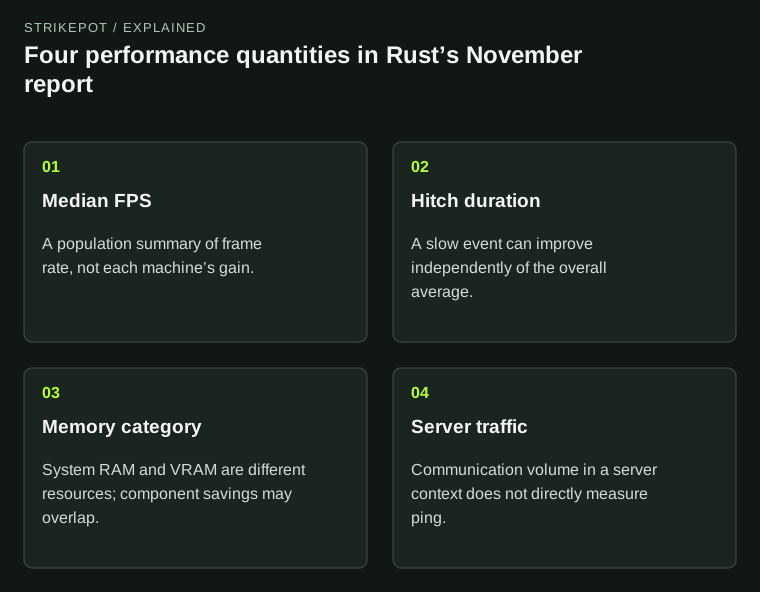
The quantities are deliberately separated so the reader can match a reported optimization to a comparable observation.
A population median is not a personal multiplier
In Printed and Polished, Facepunch reports roughly 10% higher median framerate, around 1.6GB less memory and up to 25% less network traffic on a 500-player server. Those statements have different units and scopes. None says that every individual player receives the same percentage improvement.
A median describes the middle of a distribution. It is not a list of paired before-and-after results for every machine. Even a carefully measured population change cannot tell an individual reader which bottleneck dominates their system or whether their usual scene resembles the observed workload.
That does not make the report unhelpful. It tells players which kinds of work the developer has done and supplies a reason to examine a particular symptom again. It becomes misleading only when a population statement is rewritten as a guaranteed personal result.
Average speed and a hitch can move differently
A framerate describes how many frames are produced over time. A noticeable hitch concerns an unusually long interval. Two sessions can have similar average framerates while one contains a few much longer pauses. Conversely, a higher average can coexist with an isolated bad frame.
Consider a hypothetical scene producing a steady 60 frames per second. The corresponding frame interval is about 16.67 milliseconds. At a steady 66, it is about 15.15 milliseconds. That ten-percent increase in rate corresponds to roughly a nine-percent reduction in interval, not a ten-millisecond saving. This is arithmetic for steady rates, not a measurement of Rust.
Now imagine an occasional 100-millisecond stall in either scene. The average alone cannot tell you whether that stall has improved. A report targeting stutters therefore deserves a different observation from a report targeting the general framerate. Record the event where the hitch happened as well as the rate around it.
Memory savings are not extra frames held in reserve
The official changelog describes changes to loaded assets, audio and other memory use, and separately identifies freeing a map image from video memory. System memory and video memory are different resources. A number in one category should not be silently added to a number in the other.
Nor should every per-system saving automatically be added to the headline total. Different descriptions can overlap, depend on settings or concern different scenes. A component-level explanation is not a spreadsheet of independent savings guaranteed to occur simultaneously.
Lower memory use can create more headroom, particularly where capacity was tight. It does not establish a fixed conversion into frames per second. If the limiting work lies elsewhere, the visible effect may be fewer resource-pressure problems rather than a proportionate framerate increase.
Less traffic does not mean proportionately lower ping
The server-traffic figure describes an amount of network communication in a stated server context. Ping measures time for a network exchange. Reducing the quantity of data does not imply that a distant server becomes geographically closer or that every network delay falls by the same percentage.
Likewise, a client rendering hitch and a server-side delay can feel similar to a player while originating in different places. A clip that freezes briefly is an observation, not a diagnosis of which machine paused. Keep client performance and server/network symptoms in separate columns.
The November changelog’s base, audio and network work gives several plausible areas to examine. It does not identify the cause of an individual report. Calling every pause network lag would erase the very distinctions the update’s different optimization categories make useful.
A personal comparison needs a comparable workload
For an illustrative comparison, choose one recurring situation: entering the same large base, moving along the same route or repeating a particular visual action. Keep resolution, graphics settings and recording conditions fixed. Note the server, population and nearby activity, because a crowded scene can differ from a quiet one even on the same route.
If no comparable pre-update record exists, label the result as a post-update observation. A memory of how slow it felt is not an equivalent baseline. It is still possible to describe current behavior accurately without attaching an unsupported percentage improvement.
| Observation | Useful context |
|---|---|
| Typical framerate | Scene, settings and the period sampled. |
| Hitch | Exact action and whether it repeats. |
| Memory use | Measurement category and loaded environment. |
| Network symptom | Server, population, time and available network evidence. |
This is a comparison design, not a published test result. It avoids changing several settings at once and then attributing the entire difference to the patch. It also leaves room for ordinary variation between sessions.
The strongest report says exactly what changed
A useful statement might be that the same base-entry hitch became shorter in repeated observations, or that current memory use was lower in a named scene. Both are more informative than declaring every optimization successful or unsuccessful from one counter.
If the game crashes, preserve the separate evidence covered by the Rust crash-dump guide. For a continuing slowdown, the problem-report guide helps retain the build and repeatable action. The November briefing supplies the patch context. The developer’s report identifies the work; your comparison establishes the result you can actually observe.