
An inventory total can rise because its item references increased, because you added more items or because you replaced inexpensive copies with expensive ones. Comparing only the two grand totals mixes those effects. A fixed basket lets you ask what changed in the prices of the items you originally held.
This is useful even if you have no interest in trading. A loadout owner may simply want to understand why an inventory dashboard changed after a gift, a purchase or an item leaving the account. The explanation starts with quantities as well as prices.
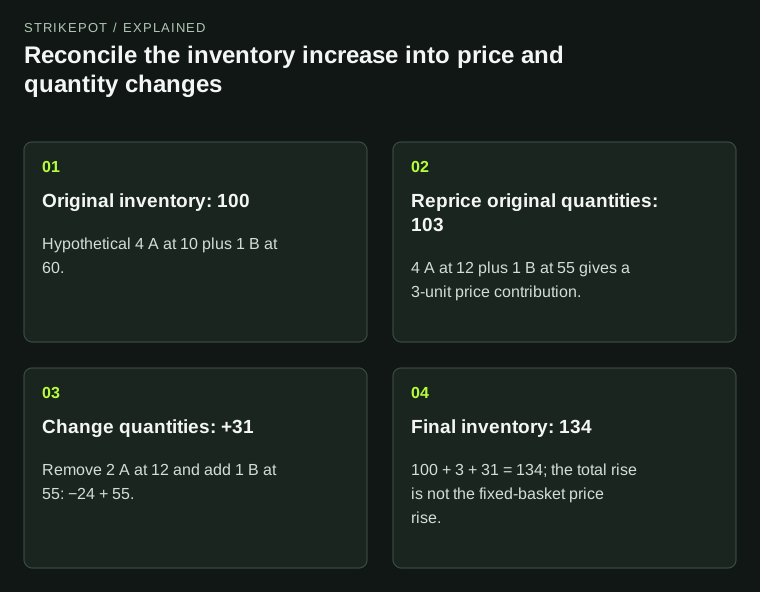
The bridge updates prices first, then quantities. Its values are hypothetical and do not establish a profit.
Save two complete snapshots on the same basis
Each snapshot needs item identity, quantity, chosen price basis, currency and time. Use comparable references on both dates. A historical median on the first date and a current ask on the second can create an apparent change that belongs to the measurement method.
Keep the original snapshots intact. They are the evidence for what was recorded. Your later calculation should create a separate bridge between them, rather than overwriting the earlier inventory with today's item mix.
Provider fields help define that record. CS Deals' price-snapshot documentation separates generation time from individual records. Skinport's item schema preserves variant identity. Keep the appropriate identity and timing context for whichever references you actually use.
A larger total with only a small fixed-basket change
All quantities and prices below are hypothetical and use one currency. At Date A you hold four copies of Item A with a reference of 10 each and one Item B with a reference of 60. The total is 100.
At Date B you hold two A copies, now referenced at 12 each, and two B copies, referenced at 55 each. The new total is 134. A dashboard comparing the totals might show an increase of 34%, but that is not a like-for-like price change.
| Item | A quantity | A price | B quantity | B price |
|---|---|---|---|---|
| Item A | 4 | 10 | 2 | 12 |
| Item B | 1 | 60 | 2 | 55 |
| Actual inventory total | 100 | 134 | ||
To isolate prices on the original basket, retain four A copies and one B but apply the later references. The counterfactual total is 4 × 12 + 55, or 103. The original basket's reference value rose by three units, or 3%, under those inputs.
Bridge from 100 to 134 without losing a unit
Now account for the quantity changes at the later prices. Removing two A copies subtracts 24. Adding one B copy adds 55. The net quantity contribution is therefore plus 31. Add that to the three-unit price contribution and the total change is 34.
The bridge is: original total 100, price change plus 3, quantity change plus 31, final total 134. It reconciles exactly because you have stated the order: update the original basket's prices first, then change the quantities at the later prices.
This allocation is not unique. Change quantities first at the original prices and the quantity contribution becomes plus 40. The later price change on the final basket becomes minus 6, again giving plus 34. The different allocation reflects the interaction between quantities and prices, not an arithmetic disagreement.
Choose one order and label it. If you publish a tracking method, keep that order consistent across periods so readers can compare its contributions without a hidden change in convention.
A fixed basket is a constructed measure
The counterfactual 103 does not say you still own the original items. It asks what their recorded quantities would be referenced at using the later prices. It is useful precisely because it holds one part of the calculation still.
You can express that basket as an index beginning at 100. A later value of 103 then indicates a 3% reference-price change for that specific basket. It is not a universal CS2, Rust or TF2 market index, and a different starting basket may behave differently.
Do not substitute sale proceeds into the reference column after an item leaves. Proceeds are evidence for a different event. Preserve the reference method for price comparisons, and track actual acquisitions and disposals separately when you need to reconcile account activity.
Handle changed or unmatched items explicitly
If you cannot find a suitable later reference for an original item, the fixed-basket comparison is incomplete. Do not assign zero simply to finish the index. Show a matched subset and identify the unpriced remainder.
Also decide how an item modification affects identity. If the earlier and later records differ in a detail that changes your comparison specification, treat that as a changed item rather than automatically attributing the entire difference to market movement. The exact-item inspection guide helps identify what needs verification.
Use the transaction-history reconciliation guide when you need to establish which item or money operation actually occurred. A valuation bridge explains totals; it does not prove the underlying transfer history by itself.
Read the dashboard increase in context
In the example, the owner ends with a larger reference total and a different set of copies. That is all the 134 establishes. The fixed original basket rises to 103, while quantity changes explain the rest under the chosen bridge.
Neither number establishes profit: the acquisition costs, any actual sale proceeds and other relevant flows have not been supplied. The useful next step is to decide whether you want to track the value of the current collection, the reference prices of a stable basket or completed account activity. Keep those records connected, with each answering its own question.