
Faster CS2 Retakes can give you more situations to play in a fixed session without proving that your decisions have improved. Valve’s November update reduces time between rounds and allows a conditional immediate defuse finish. Those changes affect the structure of the session as well as the actions inside it.
The useful question is therefore not simply whether your next session contains more wins or kills. It is whether you handled comparable opportunities better. That requires keeping repetition count, decision quality and the mode’s ending rule separate.
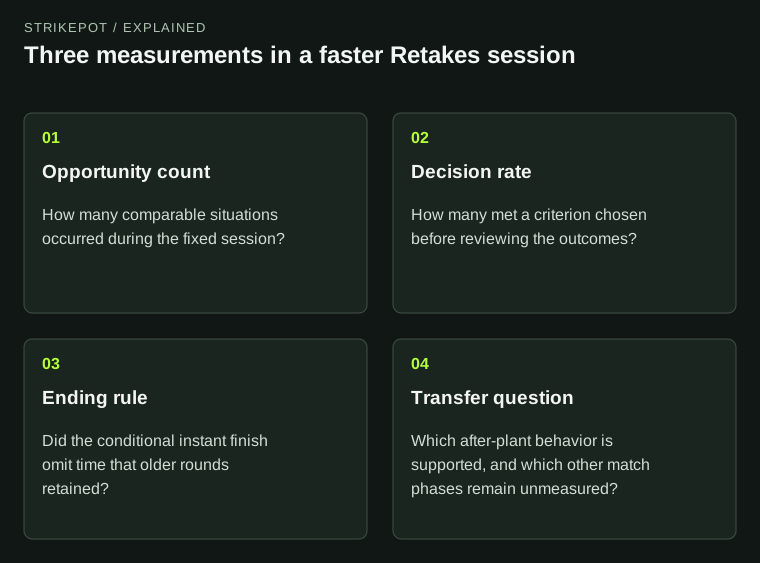
A comparison framework derived from the update’s scope. No personal performance gain or exact time saving is asserted.
More opportunities can change a total without changing a rate
The official November notes reduce Retakes freeze time and round-restart delay. They do not give exact replacement values. It is reasonable to infer that less downtime can allow more repetitions in a fixed period, but the notes do not measure how many extra rounds a particular player will complete.
Consider two hypothetical twenty-minute sessions. One contains 30 relevant opportunities and nine successful decisions. The other contains 40 and twelve. The success counts differ, but both are 30%. If someone reports only the increase from nine to twelve, they have hidden the larger number of opportunities.
That is not a reason to dismiss the second session. More useful repetitions can have value in their own right. It is a reason to describe that value correctly. A larger sample of the same behavior and an improvement in that behavior are separate findings.
| Hypothetical session | Comparable opportunities | Successful decisions | Rate |
|---|---|---|---|
| First | 30 | 9 | 30% |
| Second | 40 | 12 | 30% |
These invented counts illustrate a denominator problem. They are not measured patch results, a performance target or evidence that every Retakes session now runs at a particular pace.
A terminal shortcut changes what a round records
The same patch makes a Retakes defuse finish immediately when sufficient time remains and no active utility prevents it. Keep both conditions attached to the rule. It is not a new universal competitive defuse timer, and it does not establish that every Retakes ending is immediate.
For analysis, this introduces a distinction between resolving the meaningful contest and observing the full ending sequence. A round can record success without making a player sit through the same final interval that an older clip showed. Comparing end-to-end round duration alone may consequently mix a gameplay decision with time the mode now omits.
If your learning question concerns the approach to the site, examine that approach. If it concerns recognizing whether a defuse is possible, examine the information and utility state at that decision. A faster ending should not be used to infer a faster approach when the two intervals were never separated.
Retakes deliberately starts partway through the match problem
Valve’s official return announcement describes a 4v3 after-plant scenario with loadout cards. That context is the reason the mode can concentrate repetitions around a narrow situation. It is also a limit on what its results demonstrate.
Handling a particular after-plant angle well does not automatically demonstrate improved opening-round choices, economy management or the process that produced that planted-bomb situation. Those are different questions outside the specific scenario described. An isolated practice result can be useful without being a complete measure of competitive performance.
The November pacing change strengthens the reason to choose one learning objective. With less time between attempts, it becomes easier to accumulate many outcomes without remembering which decision was being evaluated. A short objective such as check teammate spacing before re-entering gives the observations a common meaning.
Compare opportunities that actually resemble each other
A round count alone is still too broad. For an illustrative review of spacing, record situations where a teammate was in a position to trade. A round where no such teammate was nearby does not answer the same question. For a utility decision, preserve the available equipment and observed state rather than comparing only the final result.
This is an editorial method for reading evidence, not a claim that a particular tactic guarantees success. Choose the outcome criterion before viewing every result. Otherwise it is easy to call a fortunate win a good decision and an unfortunate loss a bad one, even when the decision itself was similar.
The demo-control guide explains the available replay views and their limits. Use a broader camera to understand positions, then return to the player’s actual information when judging the choice. Knowledge revealed by replay should not be credited to the player retroactively.
Preserve a small comparison record
A useful note contains the game build, mode, map, session length, chosen decision and count of comparable opportunities. Add a few representative moments: one that met the criterion, one that did not, and an ambiguous example. Keeping the ambiguous case prevents the record from becoming a highlight reel.
If you need a shareable clip, the Steam Game Recording guide covers that output. A clip is evidence of the captured moment, not proof of how often it occurred in the whole session. Keep the full count beside the selected example.
Take one claim out of the next session
After the update, a defensible observation might be that a session contained more attempts, or that a chosen decision improved across comparable opportunities. Either is more precise than saying faster rounds made you better. They can also be checked again without assuming a published patch benefit must appear in every session.
Use the patch briefing for the changed rules and your own record for the changed behavior. Retakes can shorten the path to another attempt; evaluating that attempt still requires a question, a denominator and the information the player actually had.