
The colored-metal effect in a CS2 anodized finish is a visual treatment, not proof that the digital weapon represents one literal manufacturing process. Valve describes an effect resembling a transparent colored coat over a reflective base. Related finish styles then vary the patterning, application and wear behavior.
That matters because a metallic-looking family can contain more than one construction. Similar shine does not mean the same source artwork, mapping or exposed surface beneath it.
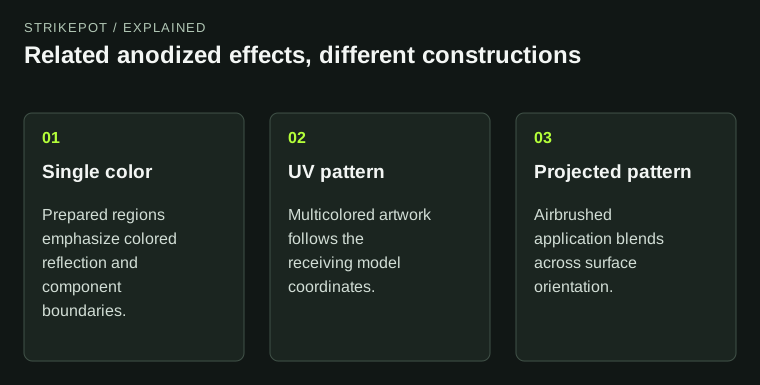
The common colored-metal impression does not make the three application systems identical.
Separate the color from the reflective impression
On a reflective-looking finish, the eye reads the color and the surrounding light together. A bright region can look almost pale while the same material appears strongly colored elsewhere. The visual impression depends on more than a flat swatch.
For an imaginary deep-red treatment, a broad highlight might communicate a polished surface while quieter areas retain the red identity. If the color is made darker merely to suppress that highlight, the rest of the weapon may lose its intended character. Diagnose the surface response and color relationship separately.
Valve's finish-style explanation is useful here because it frames the technique as an appearance model. Do not use the label as evidence about a real alloy or as a promise that every surface of the weapon receives the same effect.
Single-color Anodized emphasizes prepared regions
The single-color reference describes a selected color applied through the weapon's prepared regional system. That puts emphasis on the receiving shape and the boundaries between treated and untreated areas.
A restrained palette can therefore still produce an interesting object. The weapon's curves, edges and contrasting components help organize what the viewer sees. Adding a complicated pattern is not the only way to create visual structure.
For a creator, inspect whether the color distribution supports the intended balance. A small component receiving the strongest visual accent may become a focal point even if you originally cared more about a broad panel. The material and model collaborate in determining attention.
Multicolored and Airbrushed are not interchangeable
Valve's Anodized Multicolored page describes a pattern applied through original UVs. Its Anodized Airbrushed page describes triplanar projection. Those methods can make the same general pattern idea wrap differently.
Imagine a fictional design with broad color ribbons. One application might follow the prepared parts as though each was treated separately. Another might feel projected across surfaces with a more sprayed appearance. The right choice depends on how the ribbon is meant to relate to the weapon.
Review a recognizable motif as it crosses a corner or component break. Does it behave like the design you intended? If not, changing only the palette will not resolve the underlying application choice.
Wear can reveal different intermediate relationships
The official references also distinguish their wearing descriptions. The single-color and airbrushed examples describe a chrome base before the underlying substrate, while the multicolored example describes direct substrate exposure. Do not assume that every shiny finish passes through the same visible layers.
This gives the artist another reason to review a progression. A clean preview may establish the main color, but the worn presentation reveals what the material model contributes beneath it. Those revealed tones should be part of the planned palette.
For the imaginary red ribbons, perhaps a pale intermediate area supports the polished idea. In another treatment, a darker exposed substrate may create a different kind of contrast. These are conceptual examples, not descriptions of a named skin's settings or a prediction of any particular inventory copy.
Compare style, item and scene on separate levels
| Level | Useful question |
|---|---|
| Style | How is the material applied and what does wear expose? |
| Individual item | Which exact finish and visible application are being shown? |
| Viewing conditions | How do the scene and angle change the reflective impression? |
A style explanation cannot replace individual evidence. Use the pattern and wear checks when comparing copies. Keep the exact finish name with the record rather than identifying a variant from a single bright patch.
Likewise, keep the scene comparable. A promotional image designed to celebrate the reflective effect may not show the surface as you normally see it in play. The inspection workflow helps connect attractive presentation with the actual item.
Use the label as a starting point, not a visual verdict
A creator or collector may use metallic as an informal description for several surfaces. That broad word can be useful in conversation, but it does not identify an official finish style or explain the application method. Check the complete finish identity before assigning the technical behavior of one family to another.
For an artistic comparison, write down which part of the impression you want to retain. Perhaps the important feature is a narrow colored highlight that follows the upper edge. Perhaps it is a broad field whose color stays recognizable while the reflection moves. Those are different goals, and they may favor different pattern scales or distributions. A comparison becomes more useful when it tests that goal rather than asking which image looks most luxurious. This also keeps material preference separate from a market-value claim.
Choose the treatment that explains the design
For creators, a useful decision names both the idea and its material behavior: a quiet colored-metal surface, a UV-based patterned treatment or a projected airbrushed effect. Then check whether the model, palette and worn progression support that choice.
For players, the same vocabulary makes preferences more precise. You may enjoy a broad reflective color, a particular pattern rhythm or the contrast of exposed layers. Describing that preference gives you something concrete to inspect, instead of treating every anodized-looking surface as an identical kind of shiny skin.