
A Vintage or Genuine label can tell you something about the version of a TF2 item. It doesn't tell you that its current owner played at launch, bought a particular promotional product or kept the item ever since it was issued. The object and the person now holding it have different histories.
These labels are useful when treated as evidence with a defined scope. They identify distributions that the game distinguishes. The mistake is turning that limited fact into a complete story about age, ownership or monetary value.
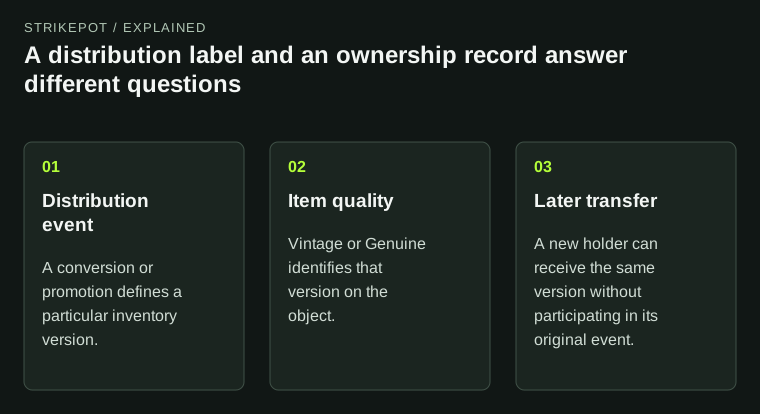
Read item provenance separately from claims about the present owner.
Vintage began as recognition for older inventory
Valve's Mann-Conomy launch FAQ explains the original conversion: older items received Vintage versions as the new store made corresponding items easier to obtain. The label preserved a distinction between existing inventory and later copies.
That source is a historical explanation, not a current manual for every TF2 restriction. Other answers on the same page describe launch-period policies. Reading its Vintage explanation doesn't justify carrying all of those old rules into today's trading system.
More importantly, the original conversion isn't the entire definition of every Vintage object. The official Wiki's Vintage history records another conversion in March 2011, when certain expensive crafting recipes became cheaper and affected previously crafted weapons were upgraded. A blanket claim that every Vintage item must predate the store therefore goes too far.
For a collector, the relevant question is specific: what event produced the Vintage version of this base item? The category narrows the research, but an item's own distribution history supplies the answer. A general release date for TF2 cannot substitute for that history.
Genuine identifies a promotional version
Genuine quality was introduced with the RIFT promotion to distinguish promotional acquisition from other routes to the same item. The distinction concerns the distributed version. Its corresponding ordinary version can look and function the same.
Valve's February 2013 update gives a concrete illustration: a correction ensured that certain action-figure redemptions granted the intended Genuine items. This wasn't a promise that the weapons would do more damage. It was a correction to which inventory version the qualifying redemption should produce.
The English word genuine can also mislead a new buyer. In this context it is a game quality label, rather than a universal certification of the seller's trustworthiness. A correctly labeled item doesn't authenticate a private message, a website or a proposed payment route.
Similarly, a promotional item's ordinary version isn't automatically a counterfeit because it lacks that quality. The game may support multiple legitimate distributions of the same base design. Determine which version you want before comparing them.
Transferable provenance doesn't follow the owner's biography
Consider a hypothetical player who first installs TF2 this month and receives a Genuine promotional cosmetic through a trade. The recipient now owns that version without having taken part in the promotion. There is no contradiction: transfer moved the object, rather than recreating the original qualifying event.
The same reasoning applies to a Vintage weapon acquired years after its conversion. The current owner's account age is not the weapon's creation date. Conversely, an old account does not prove that every object it holds has remained there since the beginning.
This gives provenance two layers. A distribution label describes the family of object. A personal ownership claim describes a chain of custody. Evidence for the first does not automatically establish the second. To document a particular transfer, keep its actual trade record; to explain an edition, consult its documented release or conversion.
That distinction is useful even when nobody is making a sales pitch. A player cataloging a sentimental backpack can describe an item as a Vintage version received from a friend, without claiming it was originally earned on that account. The clearer description preserves both facts.
Equivalent gameplay can coexist with different collectible identity
The Wiki describes these versions as functionally and cosmetically equivalent to their corresponding ordinary versions. A historical quality therefore doesn't provide an extra combat statistic merely because the name color changes. Read the underlying weapon's attributes for gameplay behavior.
Collectors can still care about the distinction. Someone collecting promotional versions is pursuing a different goal from someone who wants a weapon's mechanics. Neither goal needs a prediction about future prices to be meaningful.
A hypothetical pair of otherwise matching cosmetics may fill those goals differently. One reader wants a particular appearance for a class loadout; another wants the version associated with a named promotion. Comparing only their thumbnails hides the second requirement. Comparing only quality hides the first reader's practical question.
Other attributes may remain relevant to either person. The existing item-quality and special-property guide explains why the entire item specification matters. Historical distribution is one field in that specification, rather than a replacement for all the others.
Build a claim the evidence can actually support
For a particular item, record the base name, its quality, the distribution event documented for that version and the properties visible on the actual copy. Then write any owner-specific claim separately. If the only evidence is the quality label, leave the owner history unknown.
When a trade is proposed, use the final-offer review to confirm that the object being transferred matches the version discussed. If you intend to use a duplicate in a recipe, review crafting eligibility and inspect the exact ingredient before proceeding.
A precise collector's note might say that an item is the Genuine version associated with a documented promotion and was later received in a recorded trade. That is a useful, verifiable description. Claims about the first recipient, uninterrupted custody or a future resale premium need their own evidence.