
A Skinwaste screenshot showing Tokens and Coins does not show two interchangeable cash balances. The platform assigns different uses and reward consequences to the two units. Adding their numbers may describe a quantity of displayed units, but it does not establish an amount that can be redeemed.
This is more than a naming issue. A result can be correct in the selected game balance while a reader’s expectation about withdrawal or reward progress is wrong. The first question is which unit changed. The second is what actions that unit permits. The unit-comparison guide introduces that general principle; Skinwaste adds a concrete distinction between two playable modes.
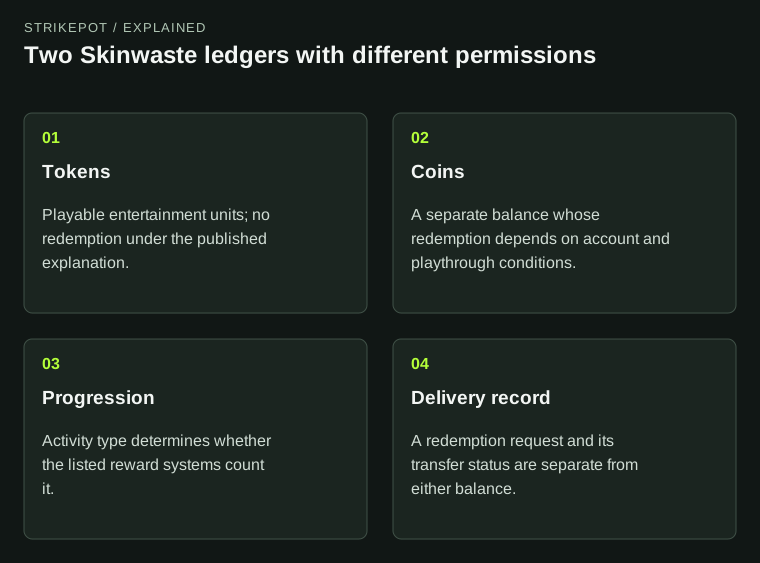
The conceptual ledger keeps unit balances, progression and delivery from being collapsed into one cash amount.
The unit is part of the amount
The official FAQ distinguishes Tokens, which cannot be withdrawn, from Coins, which can become eligible for skin or crypto redemption after the relevant requirement. It also says Token activity does not generate the listed progression rewards, including XP and Drops. Selecting a balance therefore changes more than the number shown in the header.
The platform-mode terms independently say Fun Tokens cannot be redeemed and that virtual units do not automatically guarantee redemption. These statements support a cautious reading of the interface without requiring a conclusion about the service’s legal classification.
| Question | Tokens | Coins |
|---|---|---|
| Does the FAQ describe game use? | Yes | Yes |
| Does the unit itself establish redeemable funds? | No | No; eligibility still applies. |
| Can activity count towards the listed Coin rewards? | The FAQ excludes Token activity. | The FAQ includes Coin activity. |
The table is an interpretation aid, not a complete set of account conditions. A current offer or redemption screen can add requirements. It cannot be replaced by a screenshot of a large number beside a familiar coin-shaped icon.
Use two ledger columns, even when the numbers look similar
Imagine a hypothetical account showing 100 Tokens and 20 Coins. The arithmetic sum is 120 displayed units. Calling that 120 redeemable units would incorrectly give the Token column the permissions of the Coin column. Calling it 120 dollars would add an unverified conversion as well.
Now suppose a hypothetical Token result changes that column from 100 to 140 while Coins remain at 20. The account’s total displayed units have risen, but nothing in that observation establishes a larger eligible Coin amount. There is no missing Coin credit merely because a result occurred in another ledger.
The same reasoning applies to a negative result. A Token decrease is not evidence that Coins were spent. Preserve the selected balance and transaction labels rather than inferring the debit from the visual similarity of the counters.
This two-column method is useful for a support record because it describes the observation before explaining it. Write expected change, actual change and unit. A line such as balance went down omits the information needed to compare the record with the rule.
Progression is another output, not a third wallet
Reward progress can appear beside both balances and still follow only one of them. If the relevant public rule excludes Token activity, a Token result without XP or Drops does not, by itself, demonstrate failed progression. The activity and the reward use different eligibility conditions.
Consider a hypothetical session history with ten Token actions and one Coin action. Counting eleven actions as eleven eligible reward events ignores their types. A proper review would classify each entry before asking how the progression system treated it. This does not mean one action is advisable; it means the count needs a valid denominator.
The accepted-code guide explains a related distinction between activation and delivered reward. Here, the source of confusion can arise later: the code may be unrelated to whether the selected currency generated the progression the reader expected.
Coin balance is not the final delivery record
The current public redemption explanation says eligible Coins can be redeemed for available CS2 skins or crypto after account and playthrough requirements, with possible review and delivery processing. That wording describes a conditional route. It does not turn the current Coin counter into a completed Steam trade or a blockchain receipt.
A hypothetical reader might therefore have Coins visible, a requirement remaining, no redemption request, and no transfer. Those are compatible observations. The absence of a Steam offer would not yet establish a failed Steam delivery because no delivery event has been shown.
Even when an existing request is present, keep its amount and status separate from the playable balance. A successful request, a provider’s sent status and arrival at the destination are different records. The transaction timeline tool can organize those stages without assuming that the first screenshot proves the last one.
A conversion should never be inferred from a selector
The FAQ describes choosing which balance to play with from the header. A selector is not evidence of a transfer or an exchange rate between the balances. Switching the visible context may change which number is prominent while leaving both underlying ledgers unchanged.
To demonstrate a conversion, there would need to be a documented action and corresponding debit and credit entries. Without those records, do not describe selecting Coins as turning Tokens into Coins. Equally, no amount of Token arithmetic can establish a hidden cash-out value that the published rules exclude.
Read the screen in the order the permissions work
For an existing discrepancy, identify the selected unit, its before-and-after amounts, the relevant history entry and the specific expected result. If the question is about reward progress, add the reward category. If it is about delivery, add the existing request and destination status. These are different cases even if they began on the same balance menu.
The offer-terms guide helps retain the conditions attached to the unit. The useful result is a statement such as 20 Coins remain, with redemption conditions unconfirmed, rather than an inflated combined cash total. It is possible to describe what the account shows accurately without guessing what every displayed unit can become.