
A daily case can remain on CSGORoll’s rewards page after the entitlement to open it has changed. The published system separates a finite budget of Opens from the Picklock chance available after that budget runs out. Seeing the case every day therefore does not establish that every visit includes a guaranteed opening, much less a guaranteed item value.
This distinction matters when an older screenshot shows a long-running daily reward. It may describe a different system, a different rank or a different stage of the same budget. The useful comparison is the account’s opening entitlement and remaining balance, rather than the number of case pictures on the screen.
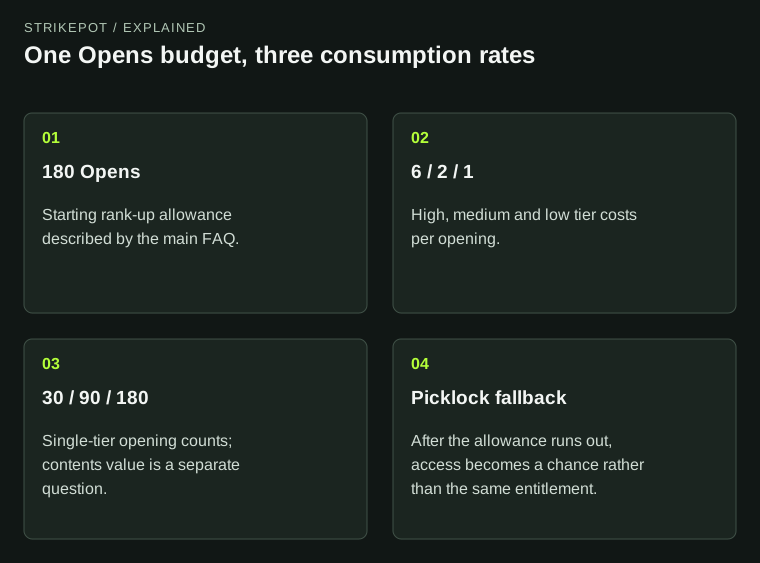
The diagram separates reward units, possible opening counts and the later access-chance stage. It does not value case contents.
Read Opens as a unit with a cost
The main CSGORoll FAQ describes 180 Opens on ranking up. Its high-tier case costs six Opens, medium costs two and low costs one. That is why the same starting budget corresponds to 30, 90 or 180 openings if it is spent entirely on one tier. The tier name and point cost belong beside any count.
The arithmetic is straightforward, but the interpretation is easy to lose. A starting balance of 180 does not mean 180 openings of whichever case happens to look most valuable. It means 180 units that different options consume at different rates. A reward screen can show a large balance and still offer a much smaller number of high-tier uses.
| One-tier illustration | Opens spent per opening | Openings from 180 Opens |
|---|---|---|
| High | 6 | 30 |
| Medium | 2 | 90 |
| Low | 1 | 180 |
These are calculations from the published costs, not a valuation of the contents. Thirty openings of one pool cannot be compared with ninety of another simply by counting openings. Such a comparison would also need the actual pools, probabilities and relevant restrictions. This article does not establish those inputs or rank the options.
The daily label describes when an opportunity is presented, while the rank-up event describes where the published allowance comes from. Those are different triggers. A daily visit does not establish a fresh 180-unit grant unless the actual account record or current rule says so.
A mixed budget explains a falling counter
Consider a hypothetical point ledger using the main FAQ’s costs. Five high-tier openings consume 30 Opens. Ten medium-tier openings consume another 20. The remaining budget would be 130 Opens, assuming no other credits, resets or adjustments. This example only illustrates subtraction; it does not claim that a particular account permits switching tiers on that schedule.
A counter falling by six after one action is not necessarily six missing rewards. It can be the stated price of that action in the reward unit. Conversely, a counter that remains large does not prove that an opening succeeded. Record the before value, the selected tier, the result and the after value as separate observations.
This is also why translating a balance directly into calendar days can mislead. The point calculation describes consumption. Whether a day was eligible, whether a claim was made and what reset applied are additional account facts. An absence from the site should not be assumed to consume the same budget as an opening without a rule or history entry showing it.
Picklock changes the question you are asking
The dedicated daily-rewards help page also describes a fallback after the opening allowance is exhausted. Picklock offers a chance to open the case. That is a different event from opening the case and then receiving a random result from its contents.
There are consequently two uncertainties a reader must avoid merging: whether access is obtained and what an accessed case returns. A displayed opening probability describes the first. It is not the probability of receiving the item pictured most prominently, nor is it a percentage return on previous spending.
For example, a hypothetical unsuccessful Picklock attempt could leave a reader with no case result to inspect. That does not show that the contents roll produced a low-value item. The process may never have reached that stage. A support report should say whether the access attempt failed or a completed opening produced an unexpected result.
The official pages use different terminology
The dedicated help page calls the rank-up allowance keys and describes one key per opening, while also listing tier totals that match the main FAQ’s 30, 90 and 180 outcomes. The main FAQ expresses the allowance as tier-weighted Opens. Those descriptions support the broad distinction, but they do not provide an unambiguous public ledger for every mixed-tier situation.
Do not resolve that discrepancy by inventing an exchange rate between keys and Opens. Preserve the actual label in the current account and ask how that counter is consumed. The offer-terms guide explains how to keep a specific rule beside the offer it describes. Here, the precise question is whether the displayed unit is a tier entitlement, a shared point budget or another current account value.
A useful record stops before more play
If the allowance seems wrong, the existing history is more useful than additional activity intended to recover it. Keep the rank, selected tier, remaining counter, latest relevant claim and any reset message. A cropped screenshot can preserve the labels without exposing unrelated account information. Use the support-ticket template to ask which event changed the balance.
Nothing in the finite-budget calculation establishes that paying or playing more will recover a particular reward value. It explains why an available case, an opening allowance and a Picklock chance are different records. Once those are separated, a smaller count can be evaluated against its actual unit instead of an older expectation of unlimited daily access.