
CSGOGem’s published one-time play requirement measures activity against a deposit amount. It does not mean the deposited funds will still be there when the activity is complete. Winning and losing results can change the balance while contributing to the same requirement progress.
The distinction is especially useful when a small referral bonus appears beside a much larger deposit. A reader may assume that only the extra credit needs to be played. CSGOGem’s separate requirement article says the rule applies to any deposit and uses the total deposit amount. The bonus and the activity obligation are related account entries, but they are not the same quantity.
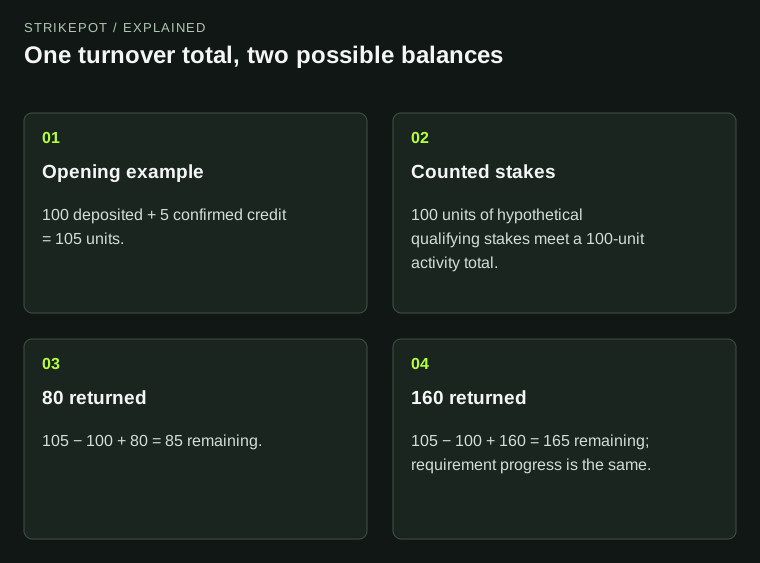
Arbitrary accounting examples show why outcome-independent progress cannot promise the amount remaining. No activity strategy or measured result is represented.
Keep three numbers in three columns
The official play-requirement article states that the total deposited amount must be played once and that winning or losing does not change whether activity counts. That describes turnover: the sum of qualifying amounts staked. It does not describe the sum returned from results or the balance remaining afterwards.
For a documentary review, keep deposit base, cumulative qualifying activity and current balance separate. If an account shows promotional credit, preserve that as another entry. A display that combines these concepts into a single prominent number does not make their accounting functions identical.
| Quantity | What it describes |
|---|---|
| Deposit base | The amount against which the documented requirement is calculated. |
| Qualifying activity | Progress from counted stakes. |
| Resulting balance | Funds or units remaining after debits, returns and other entries. |
| Bonus credit | A separate addition, if the actual offer qualifies. |
The same unit can appear in every column, which makes the difference harder to see. Each column still answers a different question. Equal units do not make turnover spendable balance any more than a shopping receipt’s total spending equals the money left in a wallet.
A hypothetical ledger can finish below its starting value
Consider an invented accounting example with a 100-unit deposit and five units of already-confirmed promotional credit. Its opening balance is 105. Three illustrative records contain stakes of 30, 40 and 30 units, and returns of zero, 20 and 60 respectively. These are arbitrary numbers for explaining a ledger, not a suggested sequence of activity.
The total stakes are 100. Total returns are 80. Starting from 105, subtracting 100 and adding 80 leaves 85. If all the activity qualified under the applicable rule, its counted turnover could reach 100 while its balance fell by 20. Requirement progress and the amount left have moved in different directions.
There is no paradox in this result. The requirement counts actions by their qualifying stake; the balance records their financial effect. Completing a meter cannot reverse a negative result or restore the starting amount. The example supplies no probability of this path and no method of ensuring a withdrawal.
The same progress can accompany a higher balance
Now keep the total hypothetical stakes at 100 and change the total returns to 160. Starting from the same 105, the remaining balance would be 165. The activity progress is unchanged, but the outcomes are different. Neither balance proves more or less requirement completion than the other.
This is why a screenshot showing a large win cannot establish that all conditions are finished. Equally, a declining balance does not prove that the qualifying activity failed to count. To answer the progress question, use the requirement record. To answer the balance question, use the debits and returns.
The requirement calculator can reproduce a known multiplier and base. It cannot infer either of those ledgers from the other, and it cannot predict what a random sequence will return.
The referral bonus does not replace the deposit base
CSGOGem’s referral article describes a 5% deposit bonus with a stated cap and cycle. It also says a deposit without an applied code receives no referral bonus. The separate any-deposit wording is therefore significant: no bonus and no play requirement are not interchangeable statements.
For the hypothetical 100-unit deposit above, five units of credit are five percent of the deposit. Calling those five units the requirement base would confuse the amount added with the amount the rule identifies. A percentage added to one column does not silently rewrite another column.
Additional deposits, an account’s previous activity or a different current offer could complicate an individual progress display. This review did not access such a display. Use its actual calculation rather than assuming that one public single-deposit example reconstructs every open requirement in an account.
Completion is one condition in a longer record
The public help links an unfinished requirement to withdrawal restrictions. It does not establish that finishing it bypasses every other account or delivery condition. A completed requirement, an approved withdrawal request and a received item are separate events.
If an existing request is blocked, preserve the exact restriction instead of assuming the cause from the balance alone. The offer-terms guide explains how to retain the rule attached to a particular benefit. Here, the useful record also includes the deposit reference, stated base and counted progress.
Resolve a disagreement with the history already available
A focused question can identify a transaction whose qualifying stake appears absent from progress, or a balance debit whose return appears wrong. Those are different requests. Include the reference and expected arithmetic, and avoid sending unrelated new activity to reproduce the issue.
The support-ticket template helps preserve the sequence. A clear ledger can explain how one-time turnover was counted without claiming the requirement is harmless, profitable or certain to finish. The number describes an obligation; the outcomes determine what remains.