
CSGOEmpire’s advertised 30% affiliate figure is a referrer commission rate applied to a post-bonus house-edge calculation. It is not a 30% addition to the referred player’s deposit. The recipient, the calculation base and the final account event are different.
That distinction also limits what an affiliate screenshot can reveal. Commission generated by referred activity is not the same thing as the players’ combined deposits or their realized losses. A percentage becomes meaningful only after its denominator is named.
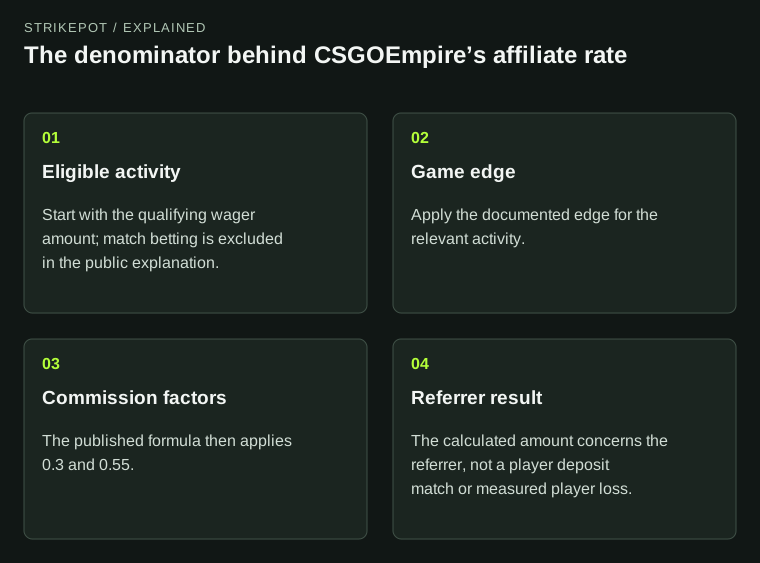
A conceptual reading of the published formula. It is not a forecast of earnings, losses or a specific account’s commission.
Start with who receives the benefit
The official referral-system explanation assigns the commission to the person whose referral code was used and excludes match betting from its stated scheme. The customer’s introductory case is a separate part of the explanation. It should not be merged with the referrer’s percentage.
The code-claim article describes the new-customer case and how it establishes referral attribution. It does not turn the case into a fixed percentage payment to the customer. A page can discuss both sides of a referral relationship without offering the same benefit to both people.
The referral explanation also requires the customer to be considered new for commission: it describes no bets in the 30 days before claiming the code. Eligibility is therefore an input to the formula, not a fact established merely by a referral address loading.
The code and referral guide explains that attribution distinction generally. This CSGOEmpire case adds a second layer: even the referrer’s 30% is not applied directly to the full amount of activity.
The published formula has several stages
CSGOEmpire’s help page gives the calculation as wager amount multiplied by the game’s house edge, then by 0.3, then by 0.55. The 30% describes one stage within that calculation. Treating it as 30% of the original stake discards the other stages.
A house edge in this formula is a rate used in the operator’s model. It is not a statement that a particular participant lost that percentage on an individual result. The amount staked can be known while the result varies. This is why model-based commission and an observed loss must be kept separate.
For a hypothetical 200 Empire Coins of eligible coinflip activity, using the documented 0.5% edge gives 200 × 0.005 × 0.3 × 0.55 = 0.165 coins of calculated commission. Using the documented 6.66% roulette edge with the same hypothetical activity amount gives 2.1978 coins. These are calculations from the public model, not observed earnings.
| Hypothetical eligible activity | Published edge used | Calculated commission |
|---|---|---|
| 200 coins, coinflip | 0.5% | 0.165 coins |
| 200 coins, roulette | 6.66% | 2.1978 coins |
The table is not a comparison of which activity someone should choose. It shows how the denominator and additional factors change the meaning of the same headline percentage. Actual account credit, eligibility and settlement would require their own records.
A commission rate is not a deposit match
A deposit-match percentage takes an eligible payment amount as its stated base and credits the qualifying customer under that offer’s terms. The commission calculation above starts with eligible activity and has a different recipient. Substituting deposit for activity changes the question before the arithmetic even begins.
For example, a hypothetical deposit of 200 coins does not establish 200 coins of eligible activity. Some balance might remain unused; activity might occur in an excluded category; other account conditions might apply. This article does not reconstruct those account facts from a payment amount.
Likewise, 200 coins of activity does not prove a 200-coin deposit. A balance can be reused across multiple recorded actions. Turnover is a flow across events, while a deposit is an incoming account entry. Confusing them can exaggerate both the benefit and the apparent amount of new money involved.
Why aggregate commission cannot identify individual losses
Suppose an entirely hypothetical affiliate report shows one coin of commission. Working backwards would require knowing which eligible activities contributed, their edges, the period and any applicable adjustments. A single total does not contain that breakdown.
Even with the activity mix known, the published formula does not include the individual player’s realized result as an input. Many different result histories could therefore be compatible with the same calculated commission. A participant might have a favorable or unfavorable short sequence; the model alone cannot identify which occurred.
This is a general limit of inference from an aggregate statistic. It is not evidence that any particular report is wrong. It means the report is measuring one quantity and cannot silently be relabelled as another. Avoid presenting an affiliate earnings screenshot as proof that a named player lost a corresponding amount.
A case picture does not fill the gap
The customer’s introductory case remains separate from all of this arithmetic. A result image, an available case and a completed case claim are different observations. Nothing about the referrer’s formula establishes the case’s actual outcome for an unobserved account.
For the same reason, a referral destination loading correctly does not confirm attribution or eligibility in that account. The referral-link guide helps establish the address being opened. It does not prove the later personalized result.
Use a complete sentence when repeating a percentage
A useful description names the recipient and the base: the published commission rate is for the referrer and is applied through the operator’s post-bonus house-edge formula. That sentence preserves the meaning without promising a player deposit credit, a cash return or a particular affiliate income.
When an offer is unclear, keep its actual wording and calculation together. The offer-terms guide explains how to identify a benefit’s conditions. For this case, the denominator does the essential work: once it is restored, a large-looking percentage stops being mistaken for money automatically added to the player’s deposit.