
A Rust vending offer is a small contract inside the current server world: give this quantity of one item and receive that quantity of another. Before considering whether the exchange is useful, make sure you have read its direction correctly. A machine's name or an attractive map marker is not the offer itself.
Remote delivery adds another layer. The desired stock, a reachable vending machine and an operating marketplace all have to line up. A player can have enough resources for a valid exchange while the delivery service is unavailable. That is a different problem from an incorrect offer or a missing Steam inventory item.
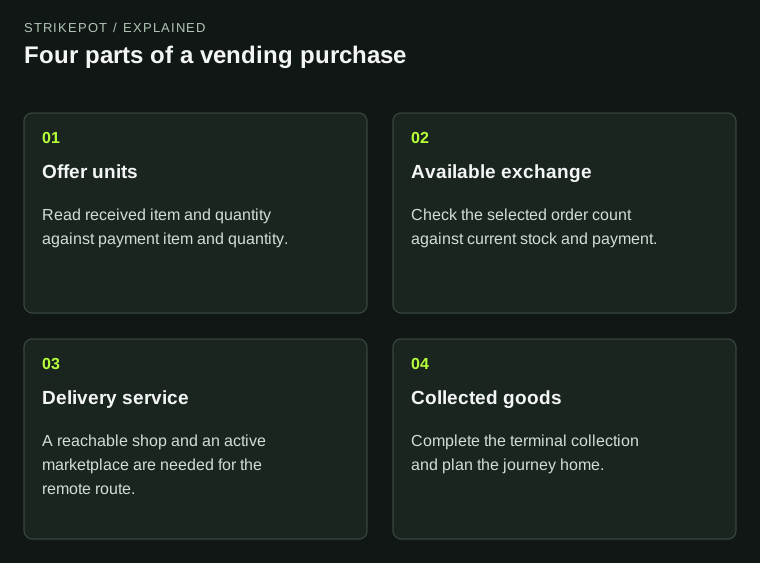
A valid offer and a working delivery route answer separate questions.
Read both sides with their quantities
The Facepunch-hosted item page describes buy and sell orders. Facepunch also documented the quantity shown per offer, a distinction that remains central to interpreting an exchange. Read the item you receive, its amount, the item you provide and its amount before choosing the number of orders.
For a deliberately fictional example, suppose one order gives 100 wood for 20 stone. Three orders mean receiving 300 wood and giving 60 stone. Reversing those two sides changes the meaning completely. This arithmetic illustrates offer units; it is not a claim about a fair exchange rate or a recommended current price.
Check the exact item as well as the icon. Similar-looking components, equipment and resources can serve different purposes. If the goal is a particular crafting recipe, decide which item the recipe requires before accepting a substitute. A cheap exchange is still unhelpful when it supplies something the next step cannot use.
Stock and purchase size are separate limits
There are several reasons a player might not complete the intended number of orders. The visible offer may be correct but insufficiently stocked. The buyer may have enough of the payment item for one order but not the selected quantity. Other buyers may also be using the same shop. Read the current interface again at the point of purchase.
A useful habit is to express the trip's goal as an output quantity. If a project needs 250 units and offers arrive in batches of 100, three orders supply 300. The extra 50 is part of the plan, not an unnoticed display error. Then calculate the required input from the order count rather than from a rough exchange ratio remembered from another shop.
This is in-world barter. It does not transfer the right to craft a Steam cosmetic or produce a cash payout. The Item Store and Community Market guide covers those separate ownership channels; the skin-selling checklist addresses a different kind of transaction altogether.
Remote delivery has a route and a service
When drone marketplaces launched, Facepunch explained that they bring purchases from reachable vending machines to a terminal. A machine enclosed away from drone access can be unsuitable for delivery. Read the current marketplace's availability, charges and delivery information rather than assuming every visible shop supports the same remote route.
Think of a remote order as several stages: selecting an exchange, paying the displayed total, waiting for transport and collecting the result. A screenshot of the first stage is not proof that the last stage has happened. Stay attentive to the terminal and its current collection rules until the items are actually in your inventory.
Delivery can reduce the need to visit a seller's base, but it does not remove the journey between your home and the marketplace. Decide how you will carry the payment there and the purchase home. A plan that ends at the terminal has left part of the transaction's practical cost unexamined.
The Power Plant can explain an unavailable marketplace
Since September 2026, drone marketplaces depend on the Power Plant system. Four or more active fuses build their battery charge. Purchases become available at 50 percent; at least one fuse prevents charge loss, and falling below the threshold deactivates the marketplace. Its map screen shows the current charge.
This shared dependency changes how to diagnose a failure. If the service is inactive, repeatedly selecting another shop does not address the condition. Check the marketplace display before assuming the vending-machine owner has configured the wrong offer or that your resources are being rejected.
It also gives a trade trip a timing question. Is the service operating now, and is waiting worthwhile for the task? The answer may differ for a small urgent purchase and a large planned restock. Treat alternative routes as decisions about the current world, rather than interpreting one unavailable delivery channel as a lost account item.
A seller has two audiences
For a seller, clear order quantities help customers while a sensible physical layout protects stock. The item documentation explicitly warns that access to the rear panel exposes the goods. A convenient customer-facing position therefore needs to be considered alongside the management side of the machine.
Before relying on a shop, inspect what a customer can read, how a legitimate purchase works and which areas the layout exposes. Remote reachability and protected rear access are different design questions. Making the machine visible does not establish either one by itself.
The most useful trade check is concrete: the correct item, the correct count, enough stock and payment, and a working collection route. That gives both buyer and seller a common way to describe a problem without confusing a world exchange, a transport interruption and cosmetic ownership.