
A skin-price report should decide how to summarize its observations before choosing the result it likes best. Mean, median, trimmed mean and winsorized mean can all be calculated correctly from the same records. They preserve different information and need different labels.
If you maintain a recurring comparison, write down the aggregation rule in advance and apply it consistently. Changing from one measure to another after seeing a surprising number makes the series harder to interpret, even when every individual calculation is correct.
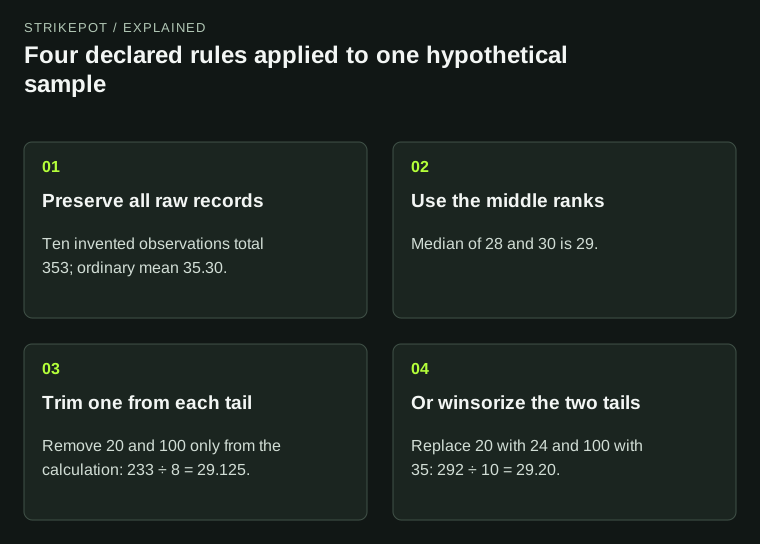
The rule is chosen in advance. Transformed amounts are analytical values, not altered transaction records.
Choose the question before the rule
The ordinary mean describes total recorded value divided by the relevant count. The median describes the middle of the ordered observations. A trimmed mean excludes a declared portion of each tail from its calculation. A winsorized mean retains the count but replaces tail values with specified boundary values.
NIST's measures-of-location discussion explains these alternatives. They are ways of describing a distribution, not competing guarantees of an item's true sale price. Reducing the influence of extreme observations can be useful, but it changes what the reported number represents.
The existing sales-statistics guide covers basic mean and median labels. The extra task here is a reproducible rule for an analysis you control. A provider's published measure should keep its own documented name; do not relabel it as your custom measure.
Declare an exact rule for a complete example
Use ten hypothetical compatible completed-sale prices in one currency: 20, 24, 25, 27, 28, 30, 31, 33, 35 and 100. They are invented observations, not measured prices. Each observation represents one copy, so no quantity weights are needed in this example.
For this exercise, declare a symmetric 10%-per-tail rule. Set the number handled at each end to the whole number below 10% of the observation count. With ten observations, that is one at each end. This is an explicit rank-based convention, not a claim that every software package uses the same percentile definition.
The rule applies because of position in the ordered sample, not because someone has proven the highest or lowest observation erroneous. It will handle the smallest value as well as the largest. Keep that symmetry in the description.
Calculate the four results separately
The full sample totals 353. Its ordinary mean is 35.30. The median is halfway between 28 and 30, giving 29. Neither figure requires changing or removing a recorded observation.
For the declared trimmed mean, exclude 20 and 100 from the calculation. The remaining eight values total 233, so the result is 29.125, displayed as 29.13 at two decimal places. The denominator is now eight.
For the declared winsorized mean, replace 20 with the next retained boundary value, 24, and replace 100 with 35. The transformed ten-value total is 292, giving 29.20. The denominator remains ten, but the transformed total no longer equals the actual recorded total.
| Measure | Rule in this example | Result |
|---|---|---|
| Mean | 353 divided by 10 | 35.30 |
| Median | Middle pair 28 and 30 | 29 |
| 10% trimmed at each end | 233 divided by 8 | 29.125 |
| 10% winsorized at each end | Transformed total 292 divided by 10 | 29.20 |
The proximity of three results does not certify them as the correct future price. It shows how the declared rules treat this particular distribution. The ordinary mean remains the appropriate arithmetic summary if your question is the actual total paid per recorded copy.
Keep transformed values away from transaction records
Winsorization creates analytical substitutes. It does not establish that a 100-unit transaction actually occurred at 35, or that the 20-unit transaction occurred at 24. Preserve the raw records and calculate the transformation in a separate analytical view.
Likewise, trimming does not erase the original sales. Report the original count, trimmed count and tail rule. If you later need currency turnover, return to the unmodified records; multiplying the winsorized mean by ten would produce 292 rather than the actual invented total of 353.
Skinport's history documentation provides aggregate measures. Those summaries alone do not give the complete ordered observations required for this custom calculation. Do not manufacture a trimmed or winsorized result from a published mean, median and count.
Small samples expose the rounding convention
Under this article's declared whole-number rule, nine observations produce a tail count of zero, because the whole number below 0.9 is zero. Ten observations produce a tail count of one. The method therefore changes discretely when the sample passes that boundary.
Other rules can use different ranks or interpolation. The important reporting requirement is to specify which one you used. A label such as “10% trimmed” without stating whether that means each tail, both tails together or a retained fraction can be ambiguous.
Do not increase the trimming percentage simply because a quiet item produces an inconvenient result. A recurring method can instead report that the sample is too limited for the chosen supplementary measure, while retaining the original observations and ordinary summaries.
A robust rule cannot repair an unsuitable sample
All four measures can summarize the wrong group. If ordinary and special variants were pooled despite a question about one exact copy, reducing tail influence does not establish comparability. Define identity, period, currency and inclusion rules first; the comparable-sales guide helps with that step.
A useful report names its main measure and any supplementary measures, states the rules and keeps the raw distribution accessible. It explains what changed if the methodology changes later. That consistency gives the reader something to evaluate beyond whichever summary happens to look most plausible today.