
A weaker Rainbet RakeBoost can spend some or all of its lifetime behind a stronger boost. Rainbet says boosts do not queue: time hidden by the stronger modifier is not automatically saved for later. The weaker boost’s own expiry remains the relevant boundary.
This explains why two visible timers need not produce two consecutive benefit periods. It also explains a subtler case: a weaker interval might have some time remaining after the stronger one ends, without receiving a new full duration. The difference is easiest to see by separating each interval’s start and expiry.
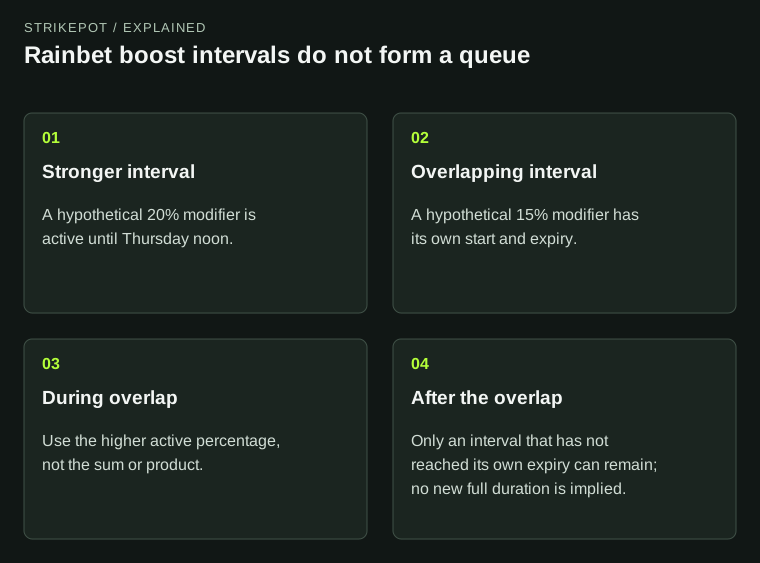
Conceptual timeline using hypothetical times. It separates modifier duration from reward calculation and claim deadlines.
The published rule has an arithmetic part and a time part
The official Rewards Overview lists several durations, including an affiliate-code 20% RakeBoost for 72 hours, a signup 15% boost for 24 hours and shorter reward-linked boosts. It says only the highest percentage applies at any time, and that boosts neither stack nor queue.
The highest-percentage rule resolves an overlap at a particular moment. The no-queue rule resolves what happens to time: another active interval is not a promise that a fresh duration begins after the current winner finishes. These are distinct parts of the same published rule.
The reward-boost comparison guide covers the percentage’s base. Here the additional question is temporal. Even before an amount can be calculated, a reader can distinguish an original interval from an imagined extension.
Case one: the weaker interval is completely covered
Use these invented timestamps to illustrate already-known intervals. A stronger modifier runs from Tuesday at 09:00 until Friday at 09:00. A weaker one runs from Thursday at 09:00 until Friday at 09:00. During the weaker interval’s entire day, the stronger modifier is also active.
At Friday 09:00, both intervals have reached their stated expiry. The weaker one does not then begin another day. That would store its covered time and replay it, exactly the queue that the published rule excludes.
This example does not assert that a signup benefit can be activated at any desired point. The timestamps are hypothetical interval records, not instructions for triggering an offer. An account’s actual start event must come from its own displayed conditions.
Case two: only the weaker interval’s last hours remain
Keep the stronger interval’s Friday 09:00 expiry. Now suppose the weaker interval instead runs from Thursday at 18:00 until Friday at 18:00. It overlaps the stronger boost first, but its last nine hours fall after the stronger one ends.
Those nine hours are a surviving part of the original interval. They are not a new 24-hour award starting Friday morning. The earlier 15 hours have already passed while the stronger modifier applied.
| Hypothetical weaker interval | Stronger expiry | Original time left afterward |
|---|---|---|
| Thursday 09:00 → Friday 09:00 | Friday 09:00 | None |
| Thursday 18:00 → Friday 18:00 | Friday 09:00 | Nine hours |
| Monday 09:00 → Tuesday 09:00 | Thursday 21:00 | None; its expiry occurred earlier. |
The rows interpret stated time boundaries. They do not establish that a particular reward allocation qualifies for a modifier or that an operator has credited any account. The underlying allocation rules remain separate evidence.
Activation order does not create a pause button
The third row becomes clearer with a stronger interval beginning Monday at 21:00 and ending Thursday at 21:00. The weaker interval was active for 12 hours before the stronger one began. Its remaining 12 hours overlap the stronger period and end Tuesday morning.
It would be a mistake to preserve those covered 12 hours and attach them to Thursday evening. That assumes a paused clock. No pausing or resumed duration follows from Rainbet’s no-queue wording.
Order therefore matters to the observed sequence without changing the expiry rule. A weaker modifier may be visible first, later be superseded, and then expire while superseded. A history showing that sequence does not establish that part of its duration is owed afterward.
A visible timer is not proof that its modifier won
A panel can describe an interval that exists while another interval supplies the highest active percentage. The presence of both records is insufficient to conclude that both percentages were used for the same period.
For an existing discrepancy, preserve each named interval rather than only the largest badge. A screenshot taken after the overlap can miss a stronger boost that was active at the time of the disputed allocation. Conversely, a later stronger boost should not be projected backward onto an earlier period without evidence.
This is why a dated timeline is more informative than a single final balance. It can locate the moment being questioned among intervals whose start and end times are known, while leaving unknown activation times explicitly unresolved.
Modifier time, allocation period and claim deadline differ
The public Rewards page separates reward categories. A modifier’s countdown should not be treated as the universal claim deadline for every allocation in those panels.
Keep three records where available: when the modifier was active, which period an allocation covers, and when the allocation can be claimed. An expired modifier alone does not establish that an existing allocation vanished. An unexpired modifier alone does not establish that an older unclaimed allocation remains available.
A changed underlying calculation can also change an allocation while the active modifier remains the same. The total by itself cannot identify which boost applied. Ask about the named allocation and period rather than deriving an overlap rule from one reward amount.
Ask which interval applied to the existing record
The transaction timeline tool can keep starts, expiries and allocation events in separate rows. Use consistent time zones and retain the exact panel wording. If a timer is unavailable, mark it unknown rather than inventing its start from the advertised maximum duration.
For support, the precise question is which modifier applied to the specified allocation during its relevant period, and whether any original interval still remained afterward. The support-record guide helps preserve those references. No new deposit or play is needed to make that historical question concrete. The result should account for the original clocks, without manufacturing a queue, pause or fresh duration.